Can Iran sink a US aircraft carrier? Khamenei’s warning for USS Gerald R Ford signals more
Amid heightened military tensions in the Gulf, Iran’s Supreme Leader Ayatollah Ali Khamenei issued a stark warning to the United States and President Donald Trump, declaring that even the “strongest military force in the world” could be struck so hard “that it cannot get up again,” and that a warship could be sent “to the bottom of the sea.”
The remarks come as Washington reinforces its naval presence in the region, including the deployment of the USS Gerald R. Ford, the most advanced aircraft carrier ever built by the US Navy. The statement raises a strategic question: could Iran actually sink a modern American supercarrier?
Why the USS Gerald R. Ford is so hard to sink
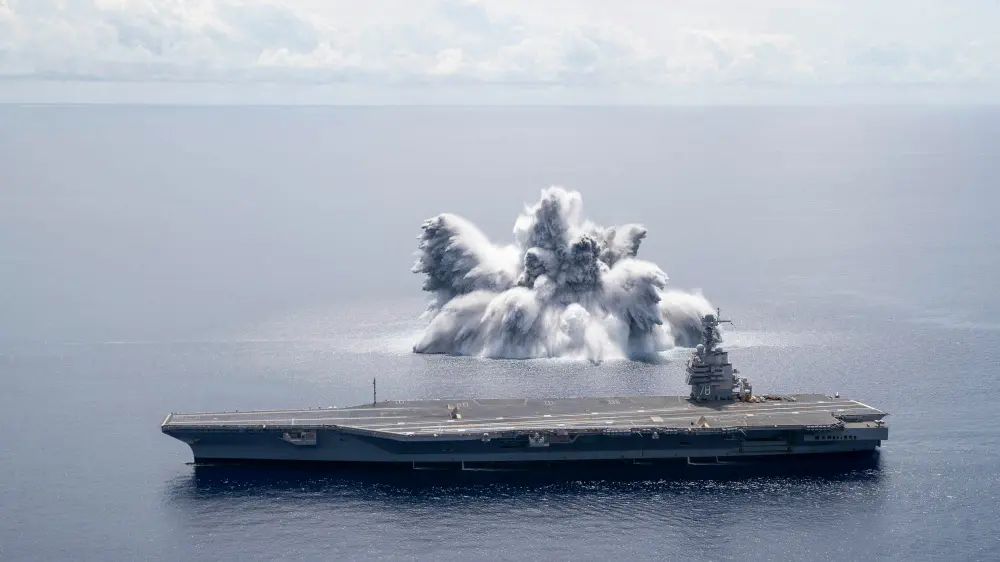
The USS Gerald R. Ford (CVN-78) is a 100,000-tonne nuclear-powered supercarrier designed with extensive survivability features. Its hull is divided into multiple watertight compartments, allowing flooding to be contained even if sections are breached. Critical systems — power, firefighting, aircraft launch and recovery — are built with redundancy so the ship can continue operating after sustaining damage.
Also read | US to discuss 99-year lease for Diego Garcia base in strategic Indian Ocean pivot
During shock trials, 40,000 pounds of explosives were detonated underwater near the hull to simulate combat conditions. The carrier remained structurally sound, with no catastrophic flooding or uncontrolled fires, a demonstration of its ability to withstand severe underwater blasts from mines or torpedoes.
Naval analysts widely argue that the idea of a single missile instantly sinking a supercarrier is more myth than reality. Modern carriers are engineered not just to float, but to fight through damage.
Why a single missile strike is unlikely to be fatal
A common perception is that a powerful anti-ship missile, particularly a hypersonic one, could punch through the deck and send a carrier to the seabed. In practice, the picture is far more complex.
The Ford-class displaces roughly 100,000 tonnes. Its size and buoyancy make it extremely difficult to sink quickly. A single hit could cause severe localised damage or halt flight operations, but would not necessarily compromise overall stability.
Also read | Iran temporarily shuts down Strait of Hormuz in the midst of nuclear talks with US
US Navy crews train intensively for fires, flooding and structural breaches. Carriers are equipped with layered firefighting systems, armoured magazines and protected fuel storage to prevent secondary explosions. Sinking the ship outright would almost certainly require multiple successful strikes on critical compartments that overwhelm onboard damage-control capacity.
Iran’s ‘carrier-killer’ strategy
Iran has invested heavily in asymmetric naval warfare focused on anti-access and area denial, particularly in confined waterways such as the Strait of Hormuz.
Tehran fields anti-ship cruise and ballistic missiles, armed drones, naval mines and fast-attack craft. Iranian rhetoric often references “carrier-killer” concepts, though actually hitting a moving carrier in the open ocean is one of the most difficult military tasks.
Also read | 3 US-sanctioned oil ships seized by India near Mumbai coast: Reports
A carrier strike group travels at high speed and changes course unpredictably. To hit it with a long-range missile, an adversary needs real-time intelligence, persistent surveillance via satellites, maritime patrol aircraft or drones, and secure data links to update targeting mid-flight. Without continuous tracking, even advanced missiles may arrive at empty ocean.
The more plausible danger lies in a coordinated saturation attack rather than a lone missile.
Hypersonic weapons, travelling faster than Mach 5, reduce reaction times and can manoeuvre unpredictably. Even without a large warhead, their kinetic energy could inflict significant damage. However, they still require precise targeting and must penetrate layered air and missile defences.
Also read | China’s growing nuclear network exposed in satellite images from Sichuan
A saturation strike would involve dozens of ballistic and cruise missiles, drone swarms and electronic warfare to jam radars and overwhelm interceptors. Multiple impacts on vital areas such as ammunition storage, aviation fuel reserves or key structural nodes would likely be needed to sink a carrier.
Iran claims to have operationalised hypersonic systems like the Fattah-2 and has adapted some ballistic missiles for anti-ship roles. The 2024 attacks by Houthi forces on shipping in the Gulf of Aden, using Iranian-supplied missiles and drones, demonstrated elements of this approach.
An actual strike on a US carrier would likely begin with large waves of Shahed-136 drones and lower-cost missiles to exhaust defences, followed by higher-value weapons in an attempt to achieve a breakthrough.
Iran’s recent live-fire drill and temporary closure of parts of the Strait of Hormuz, through which about 20% of the world’s oil passes, underline the broader strategic stakes. The waterway, about 33 km wide at its narrowest point, connects the Persian Gulf to global markets and has long been a flashpoint during regional crises.
The US military’s Central Command has warned that any “unsafe and unprofessional behaviour near U.S. forces, regional partners or commercial vessels increases risks of collision, escalation and destabilisation.”
The USS Abraham Lincoln has been operating in the Arabian Sea, and Washington has moved additional assets to the region as nuclear negotiations with Tehran continue.