History repeats? Midair collision at Reagan Airport draws parallels to 1982 Air Florida crash
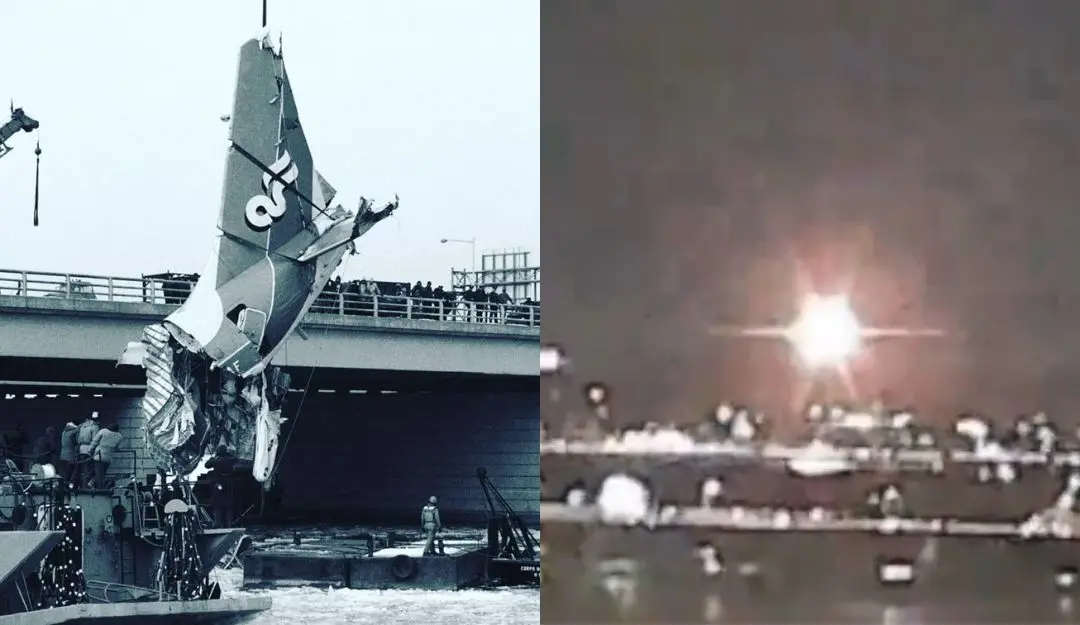
A catastrophic midair collision between a regional passenger jet and a military Blackhawk helicopter over the Potomac River has reignited memories of the tragic Air Florida Flight 90 crash more than four decades ago. The collision, which occurred near Ronald Reagan National Airport, prompted a massive search-and-rescue operation, halting all air traffic and sending emergency personnel scrambling to the icy waters.
Echoes of the 1982 Air Florida crash
On January 13, 1982, a Boeing 737-200 operated by Air Florida plunged into the icy Potomac River shortly after taking off from Washington National Airport. The aircraft, carrying 74 passengers and five crew members, struck the 14th Street Bridge before crashing into the river, killing 78 people, including four motorists on the bridge.
Investigators later determined that pilot error and failure to activate the aircraft’s de-icing systems led to the crash. Despite freezing conditions, the pilots did not switch on the engines’ internal ice protection systems, leading to false thrust readings that ultimately caused the aircraft to stall.
Captain Larry M. Wheaton, who commanded Flight 90, had over 8,300 flight hours but limited experience flying in snowy conditions. The National Transportation Safety Board (NTSB) found that the crew attempted to use jet exhaust from another plane to melt ice on their wings rather than following proper de-icing protocols.
Among the few survivors was flight attendant Kelly Duncan. Another passenger, Arland D. Williams Jr., sacrificed his own chance at rescue to help others before succumbing to the frigid waters. The heroic efforts of rescuers and civilians who pulled survivors from the river were later honored by President Ronald Reagan in his State of the Union address.
Latest tragedy at Reagan National Airport
The Federal Aviation Administration (FAA) confirmed that the crash took place around 9 pm EST when American Airlines Flight 5342, a Bombardier CRJ-701 carrying 60 passengers and four crew members, collided with the military helicopter while on its final approach. The aircraft, inbound from Wichita, Kansas, was just 2,400 feet short of the runway when its radio transponder stopped transmitting, signaling the moment of impact.
The collision happened in one of the most heavily monitored airspaces in the world, less than three miles from the White House. Shortly before the crash, air traffic controllers had cleared the regional jet to land on Runway 33. Moments before impact, they instructed the helicopter—identified as PAT 25—to pass behind the incoming flight. However, seconds later, disaster struck. Surveillance footage from the Kennedy Center captured a fireball in the night sky.
At least 18 bodies have been recovered so far. Rescue operations are underway.
Similarities between the two tragedies
While the exact cause of Wednesday’s midair collision remains under investigation, the circumstances surrounding the crash bear striking similarities to the 1982 disaster. Both incidents involved aircraft struggling over the Potomac River in treacherous conditions. The 1982 crash was caused by human error in dealing with adverse weather, while preliminary reports suggest the latest tragedy may have stemmed from miscommunication between air traffic control and the two aircraft.
In both cases, emergency response teams launched rescue efforts in the river under extreme conditions. Helicopters from law enforcement agencies, including the U.S. Park Police and D.C. Metropolitan Police Department, hovered over the scene while fireboats scoured the icy waters for survivors.
Ongoing investigation and response
Authorities have yet to confirm casualties from the latest crash, but air traffic at Reagan National remains suspended. Investigators are analyzing radar data, cockpit voice recordings, and air traffic control communications to determine what led to the collision.
The FAA and NTSB will focus on the sequence of radio transmissions leading up to the crash, particularly whether the air traffic controller’s directive for the helicopter to pass behind the CRJ-701 was properly executed. They will also examine whether the passenger jet’s sudden loss of altitude played a role in the disaster.
For now, the tragic events of January 2025 serve as a grim reminder of the deadly history that unfolded at the same airport 43 years ago.
(With input from agencies)