Markets stay positive amid ceasefire hopes and stable oil cues
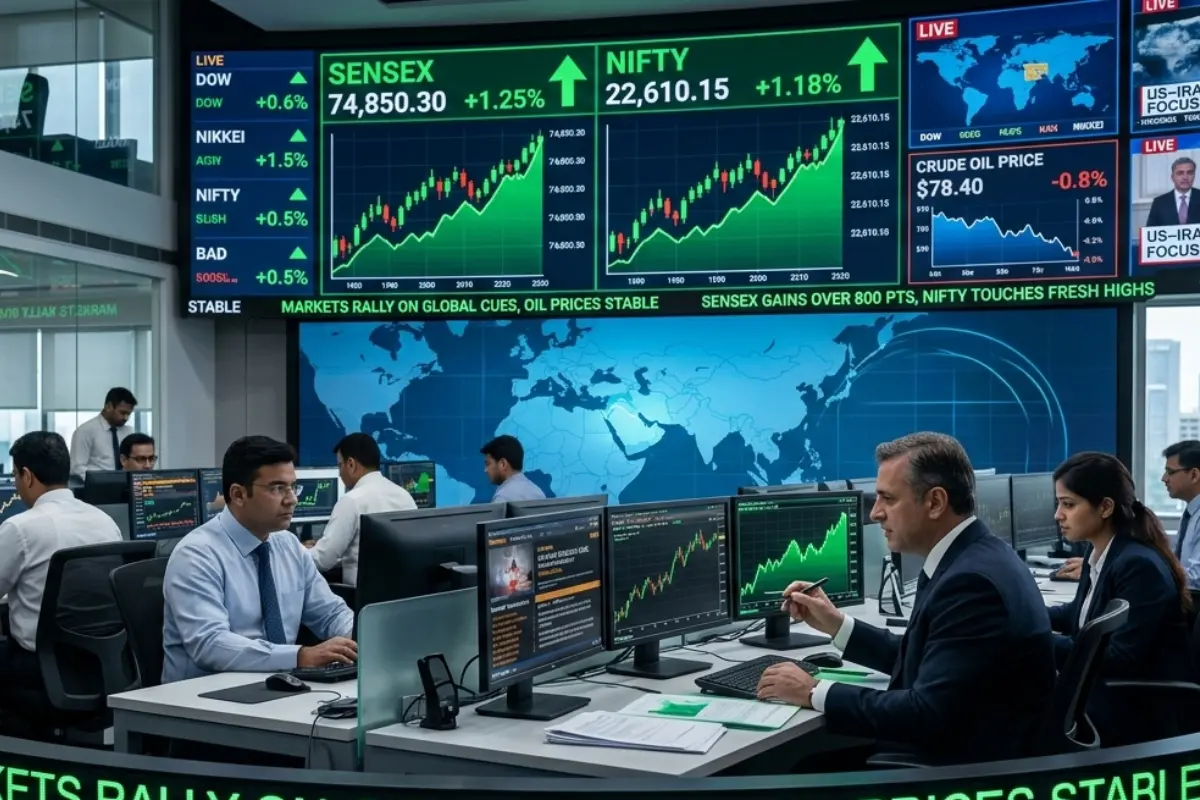
Benchmark indices extended their winning streak on Tuesday, with the Sensex and Nifty 50 closing at fresh highs amid strong global cues and sustained buying in banking, IT and capital goods stocks, even as traders turned cautious ahead of key central bank commentary later in the week.
The Sensex and Nifty added to Monday’s sharp gains, though the pace of the rally moderated as participants booked profits at higher levels. At 10:05 am, BSE Sensex was up 209 points over
These provisional closes come on the back of Monday’s strong session, when the Nifty had gained 231 points (0.98%) to end at 23,921.55, and the Sensex had rallied 736 points (0.97%) to settle at 76,537.20, briefly reclaiming the 24,000 mark on the Nifty intraday.
Market drivers
Sentiment remained broadly positive as investors continued to cheer the formal US–Iran ceasefire framework and the announced reopening of the Strait of Hormuz, developments that have eased fears of a prolonged spike in crude oil prices and supported risk assets globally.
Domestic traders also took comfort from the underlying technical structure of the market, with research houses pointing out that the Nifty’s trend remains upward despite intermittent profit-taking at higher levels.
According to analysts quoted by Goodreturns, the index continues to show a positive bias, even though Monday’s session had produced a near-term bearish candle on the daily chart.
Global markets were largely supportive, with Asian equities trading higher and US futures steady as investors awaited fresh signals on the interest rate trajectory from the US Federal Reserve.
Market participants expect the Fed’s guidance to play a key role in shaping foreign portfolio flows into emerging markets such as India.
ALSO READ | 'Iran agreed to never have a nuclear weapon!' Trump declares, dismisses $300 million payment reports
Sectoral and broader market performance
Provisional data from domestic exchanges and business portals showed that rate-sensitive and domestically oriented sectors outperformed, while a few export-linked pockets saw stock-specific profit-taking.
Indices such as Nifty IT, Nifty Auto and BSE Capital Goods were among the notable gainers, with Nifty IT up about 0.7–0.8%, and the BSE Capital Goods index advancing more than 0.6%.
Public sector enterprises, represented by the Nifty PSE index, also traded in the green, adding around 0.2%.
Broader markets once again showed healthy participation. Earlier in June, mid- and small-cap segments had outperformed even on days when the benchmarks were flat, and traders reported a similar pattern on Tuesday with steady buying interest in select mid-cap and small-cap names.
Technical view and near-term outlook
On the technical front, analysts noted that the Nifty’s close above 23,921.55 and the Sensex’s sustenance above 76,537.20 keep the short-term uptrend intact, though the indices are now in overbought territory after two strong sessions.
Immediate support for the Nifty is seen in the 23,600–23,650 zone, with resistance near the psychological 24,000 mark.
For the Sensex, support is pegged around 75,800–76,000, while resistance lies closer to 76,800–77,000 based on recent intraday highs.
Intraday data earlier on Monday had shown the Sensex testing levels above 76,537.20–76,580 and the Nifty trading close to 23,921.55, indicating that markets are attempting to build a base around these higher zones rather than treating them as one-off spikes.
Global cues to watch
Going ahead, traders will track three key sets of cues:
US Federal Reserve commentary: Any indication on the timing and pace of rate cuts will influence foreign institutional investor flows and the relative attractiveness of emerging market equities.
Geopolitical developments: The durability of the US–Iran framework and the smooth reopening of the Strait of Hormuz remain crucial for oil price stability.
Domestic macros and earnings: With the RBI already signalling policy stability earlier in June, focus will gradually shift to upcoming macro releases and the next leg of corporate earnings