Breaking barriers: Women from fishing community now operating cranes at Vizhinjam port
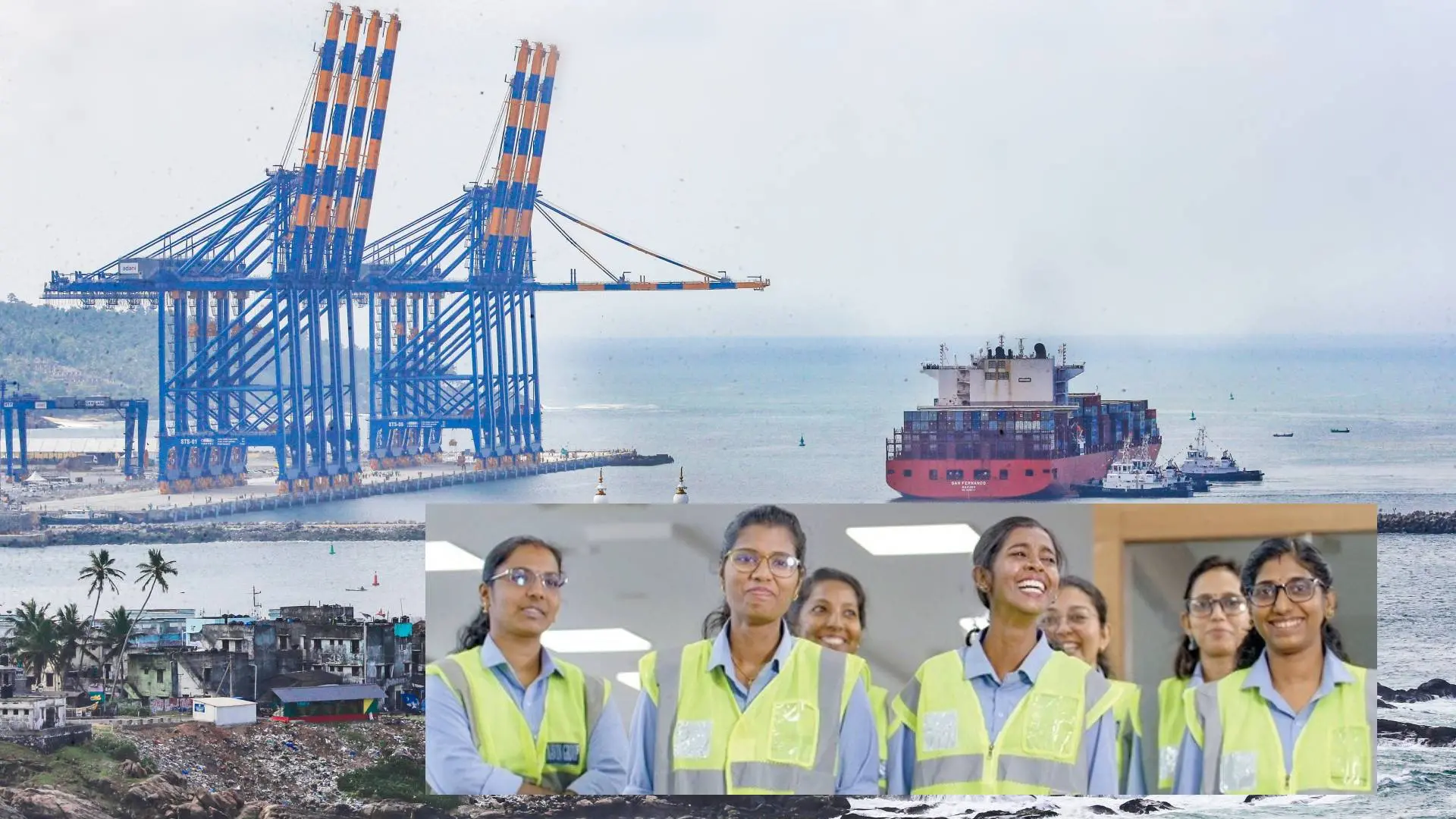
Thiruvananthapuram: The Vizhinjam deep-sea port in Kerala is not only India's premier transshipment terminal, but it is also setting new records by employing women, particularly from the local fishing community, to operate its massive automated CRMG (Cantilever Rail Mounted Gantry) cranes.
Nine women work alongside their male colleagues in what has traditionally been a male-dominated profession, making a significant breakthrough in an industry long considered a male bastion.
These women are the first in India to operate such machinery, which is exclusive to Vizhinjam. According to a port official, the fully automated CRMG cranes are not found at any other port in the country.
Of the nine women, seven are from the nearby fishing community, which had previously staged extensive protests against the port's construction in 2022. Despite the protests, the women have now become integral to the port’s operations, marking a major shift in the local community's involvement in the project.
All of them are BSc graduates, though for most, this is their first regular job.
Prinu, a 30-year-old BSc Chemistry graduate, was planning to pursue a career in teaching when she stumbled upon the opportunity to become a CRMG crane operator. Her father and husband are both fishermen, but their earnings from fishing were insufficient.
"I applied for the job when I learned it was available to locals, especially women. I was selected as a fresher and joined six months ago," Prinu told PTI. "I underwent a one-month training period, followed by a couple of months of supervised work. Now, I operate the crane independently."
Her job has provided a significant financial boost to her family.
Describing her work, Prinu explained that since the cranes are fully automated, operating them is not particularly challenging. "It becomes difficult when we have to manually pick up and load containers onto trucks. That part can be a bit challenging," she added.
On the earlier protests against the port, Prinu clarified, "The fishing community was not against the port. We protested only because some of our demands were not addressed. The people here wanted the port."
Prinu, who has grown fond of her job, expressed her intention to continue in this field, noting, "This is not as hectic as teaching."
The Vizhinjam port is equipped with 24 CRMG cranes, available in different sizes and capacities to handle varying container loads efficiently. These cranes ensure the swift and secure handling of containers. Currently, there are 20 operators, nine of whom are women.
L Karthika, a 27-year-old crane operator from Neyyattinkara, is one of the more experienced women on the team. Before joining the Vizhinjam port in 2023, she had worked for a year at a port in Kochi.
"I was sent to Gujarat for a month of training, and by the time I returned, the cranes had arrived," Karthika recalled. "I chose this job because it is closer to my husband's home in Neyyattinkara, and I preferred working with automated cranes."
Karthika has also been involved in training new recruits and has worked alongside Prinu and other women operators. "We mostly monitor the crane operations. However, if there is a malfunction, we intervene manually using joysticks at our desks," she explained.
The operators work in two 12-hour shifts: from 8 am to 8 pm and from 8 pm to 8 am, with appropriate rest periods during working hours. The company provides transportation for shift-based workers, including the female operators.
Karthika emphasized the positive impact the job has had on women recruits, many of whom were previously housewives. "This job has brought financial independence to many of us," she said.
Other women crane operators include S Anisha (29), L Sunitha Raj (35), D R Stefy Rebeira (30), R N Rajitha (36), P Asha Lakshmi (33), A V Sreedevi (37), and J D Nathana Mary.
The deep-water port, developed by Adani Ports and Special Economic Zone Ltd (APSEZ), India's largest port developer, under a public-private partnership model, is expected to become fully operational by 2028 upon completion of its second, third, and fourth phases. The port, which was completed at an estimated cost of Rs 8,867 crore, received its commercial commissioning certificate on December 4 last year following a successful trial run.
The state government has stated that the port will be officially inaugurated once Prime Minister Narendra Modi finalises a date.