MP Veerendra Kumar memorial speech: Revisiting Ramachandra Guha’s take on ‘Where is India heading?’
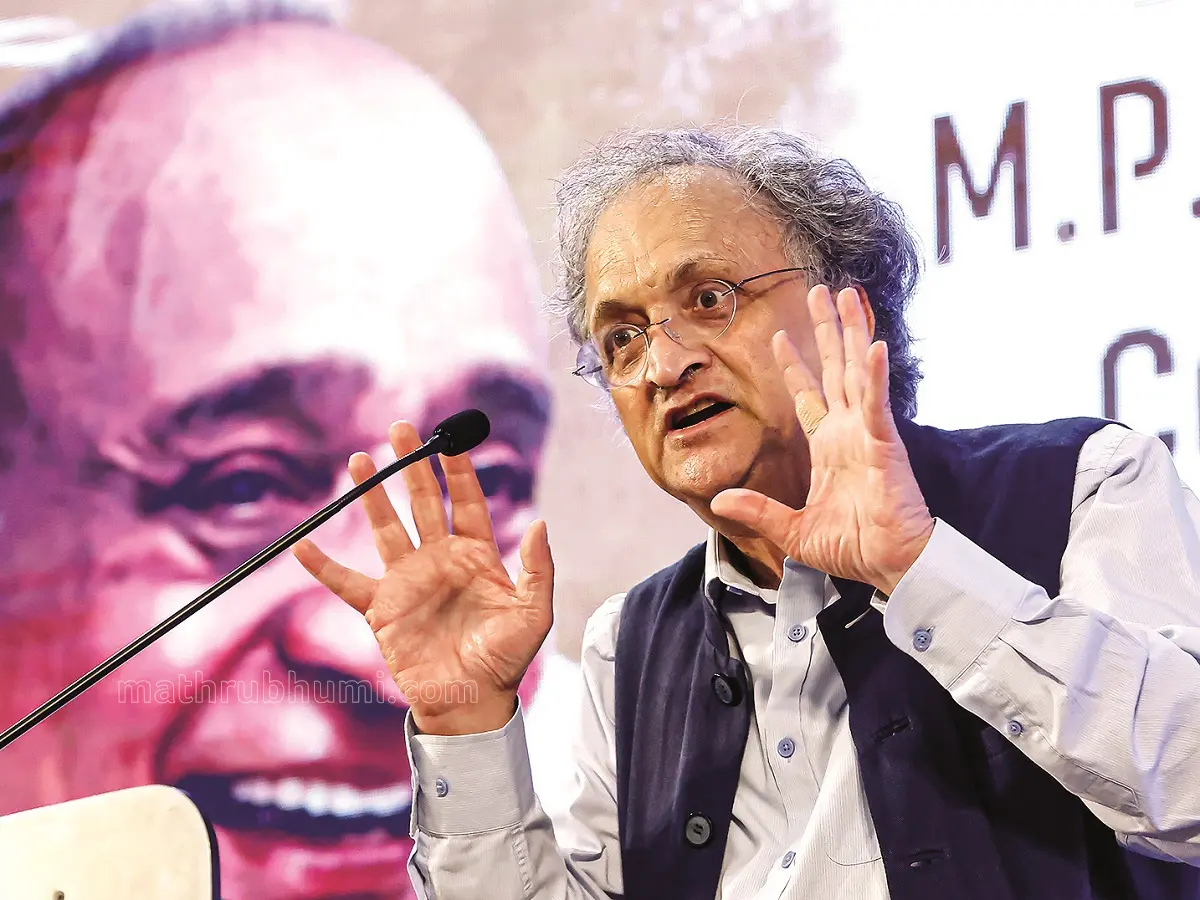
The fifth memorial speech in honour of the late MP Veerendra Kumar will be held at 11 AM on May 28, at the Muhammed Abdur Rahiman Sahib Memorial Jubilee Hall, Kandamkulam, Kozhikode. The annual event is organised by Mathrubhumi to commemorate the late MP’s enduring legacy in public life.
Veerendra Kumar, a leading socialist and environmentalist, left a lasting mark on this generation and beyond. Through his writings and speeches, he championed socialism and ecological awareness, serving as an ideal mentor with a strong ethical perspective on the role of media. Five years after his passing, his legacy remains deeply influential.
This year’s keynote address will be delivered by N Ram, one of India’s foremost journalists. With a longstanding association with The Hindu Group, Ram has remained an influential figure in Indian media for decades.
The highlight of the event will also include the presentation of the National Thought Leadership Award. It will be conferred upon Pandurang Hegde, veteran environmental and social activist and founder of the Appiko Movement. This grassroots initiative has played a pivotal role in ecological conservation. The award will be presented by Rajendra Singh, acclaimed across India for his work in reviving rivers and promoting sustainable water management.
In the fourth edition held in 2024, just ahead of the Lok Sabha elections, noted historian and environmentalist Ramachandra Guha delivered the memorial address. Guha, widely respected for his insights into Indian politics and history, spoke on the theme 'Where is India Heading?', offering timely reflections on the nation's democratic trajectory.
Excerpts from Guha’s speech:
A government without a single party enjoying a clear majority is better for preserving democracy, protecting federalism, and safeguarding minority rights. Ideally, no party should secure a majority when election results are announced. It would be better if no single party crosses 220–230 seats. I consider the coalition governments that prevailed from 1991 to 2014 as the best phase in India's democratic journey. It was not only a time of economic progress but also one when federalism functioned in its true spirit. States' rights were respected. Constitutional institutions functioned independently. Communal harmony prevailed. The judiciary functioned with greater confidence. When single-party governments with large majorities came to power, these benefits were missing.
Those who held India together
At the time of Independence, many global political observers believed India would not last long. It was a vast and diverse country. Poverty defined India’s identity. Following Gandhi’s assassination, there were fears that Indian democracy would collapse and authoritarianism would prevail. During the 1950s, ’60s and ’70s, intellectuals viewed us with sympathy. Some even believed the British might return. India faced multiple challenges—wars with China and Pakistan, monsoon failures, and food shortages. Yet we survived. Poverty declined. The country did not disintegrate, nor did it witness civil war.
There were clear reasons for this. First, the calibre of the early leaders. Contrary to what many now claim, Nehru and Patel worked together. Nehru succeeded in uniting people emotionally. He ensured equal rights for minorities like Muslims and Christians and advocated for gender equality. Patel, on the other hand, unified India geographically—his efforts led to the integration of over 500 princely states into the Indian Union. Without the Nehru–Patel partnership, today’s India would not exist. Another great leader was BR Ambedkar, the architect of the Indian Constitution. His insight made our Constitution extraordinary. One more often-overlooked name is Kamaladevi Chattopadhyay—the first woman to contest elections in India, a feminist who revived and popularised Indian handicraft industry globally.
Constitution and constitutional values
The second reason for India’s endurance is our Constitution. The fundamental rights granted to citizens are unique. The most remarkable feature is the multi-party democracy where everyone has the right to vote. In Europe and elsewhere, only the wealthy or educated initially had this right. Women got voting rights there much later.
Crucially, equality among religions was ensured. Discrimination on the basis of religion or language was avoided. Strong efforts were made to eliminate caste and gender-based discrimination. The federal structure gave states considerable autonomy, including the right to hold their own elections and govern independently.
In 2007, it was announced that India was on the path to becoming a global power. Growth of our IT sector captured global attention. The World Economic Forum described India as an emerging world power. Yet, despite these gains, India continues to face serious challenges.
Leadership cults and dynastic politics
The first challenge lies in the leadership cult and dynastic politics. Some proclaim Narendra Modi as godly. His supporters echo this. Modi has become the largest political brand globally. Your own chief minister could sometimes be seen in the same mould. Pinarayi Vijayan is sometimes considered the “Modi in mundu,” Mamata Banerjee the “sari-clad Modi,” Kejriwal the “Modi in a bush shirt,” and Naveen Patnaik the “Modi in a white dhoti.” Pinarayi Vijayan is the most autocratic communist chief minister in Indian history—this is said with full awareness of EMS Namboodiripad, Jyoti Basu, and Manik Sarkar.
Mamata Banerjee and Andhra’s Jagan Mohan Reddy also exhibit autocratic tendencies. We have plenty of mini-Modis. We have parties driven by charismatic leaders. Everything is decided by these “hero” leaders. All other leaders, including cabinet members, are reduced to pygmies.
Then there are parties run by families. Just as lawyers’ and doctors’ children often follow their parents’ professions, political leaders’ children now step into leadership. Priyanka Gandhi became a general secretary the moment she joined the Congress. With Priyanka, Rahul, and Sonia Gandhi as the key leaders, Mallikarjun Kharge’s stance is clear: “I’ll remain president; my son needs a ministry in Karnataka, and my son-in-law needs a Lok Sabha ticket.” This is what defines our democracy—parties led by hero figures and families.
Compare this with Britain. There, political dynasties are absent. Cults of personality do not exist. Their elections will be held in July. There are only two prominent leaders. If Rishi Sunak loses, someone else will replace him.
Undermining constitutional institutions
The second challenge is the overreach of constitutional institutions. This was evident even in preparing the Lok Sabha election schedule. Tamil Nadu, with 39 seats, votes in one phase; Maharashtra, with 48 seats, votes in five phases. The BJP has little chance in Tamil Nadu but prospects in Maharashtra. The Election Commission, civil services, and police are all compromised.
Another issue is the lack of sustainable development planning. Economic and gender inequalities are stark. Environmental concerns are growing. Our rivers are biologically dead. Delhi suffers massive air pollution. Environmental problems are now translating into unemployment. Climate change is set to create major socio-economic crises.
Policies that create inequality
The issues discussed so far date back to Congress rule. What follows are problems created in the last ten years under Modi’s leadership. One is Hindu majoritarianism. Those familiar with the ideologies of RSS and BJP will not be surprised by the statements of Narendra Modi and Amit Shah on Hindu–Muslim issues. Modi is a brilliant actor. His aim is to turn India into a Hindu Pakistan.
Another problem is policies that create regional inequality. The southern states that keep the BJP out of power embrace and accept all linguistic and cultural streams. The central government is creating difficulties in states ruled by opposition parties by using Governors.
When Lok Sabha constituencies are redrawn based on population, Uttar Pradesh’s 80 constituencies will increase to 100, while states including Kerala will lose seats. States that have made progress in population control and other areas will see reduced parliamentary representation, whereas states with poor performance will gain more representatives.
In summary, India faces six major challenges: political dominance, undermining constitutional institutions, the economy, environmental issues, Hindu majoritarianism, and regional inequality.
Whatever the outcome of this election, it is very important for the country. Governments without a single-party majority have driven economic growth and progress in India. When authoritarian rule prevails, the country will suffer.