‘Like Rajan, you could be next’: Kerala man recalls chilling death threat at Kakkayam camp during Emergency
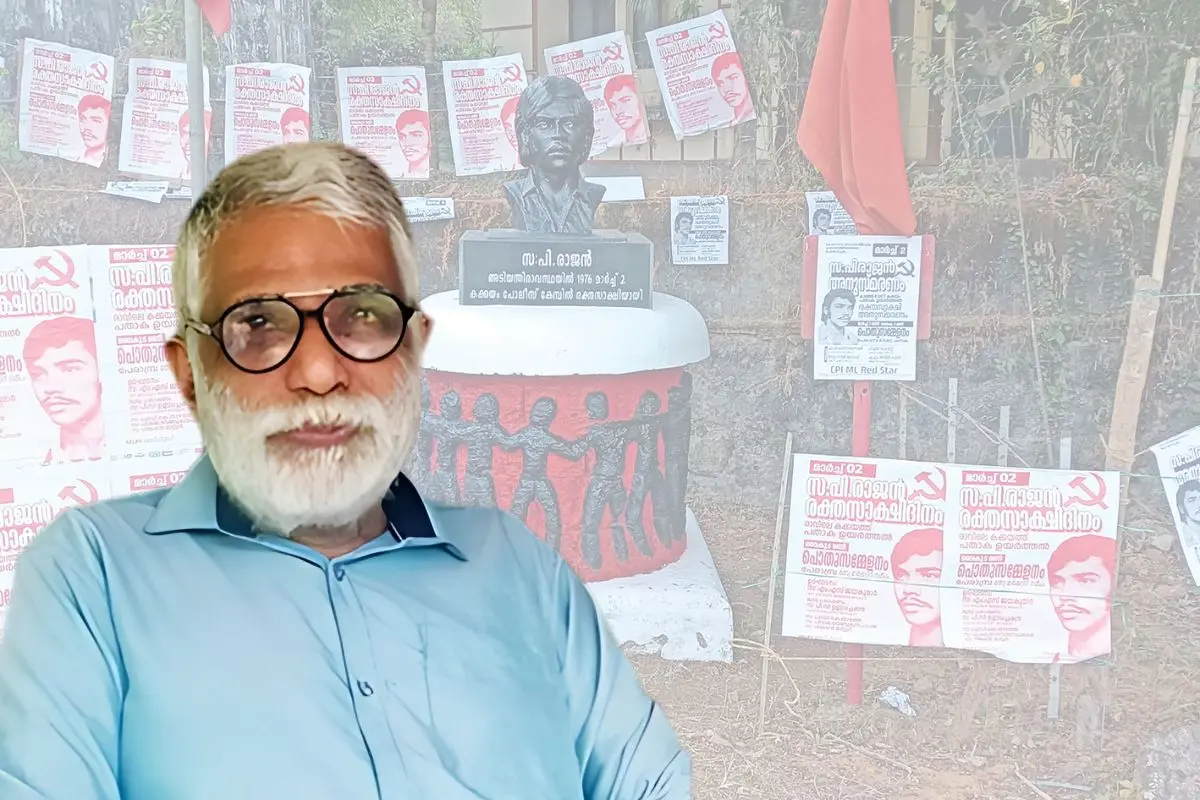
Vadakara, Kerala: MM Somashekharan, the first accused in the Kayanna police station attack case, vividly recalls the chilling words he heard upon being taken to the infamous Kakkayam police camp:
"We’ve already sent one that way… You could be sent next."
The veiled reference was to Rajan, the engineering student whose custodial murder remains one of the darkest chapters of the Emergency era.
Somashekharan remembers clearly that he was brought to the Kakkayam camp the day after Rajan was killed. At the time of the police raid at the Regional Engineering College (now NIT Calicut), Somashekharan and Vasu, also an accused in the Kayanna case, were present on the campus. Upon seeing the police vehicle, they fled but were caught soon after.
When the Emergency was declared, Somashekharan, a native of Onchiyam, was a final-year student at Madappally Government College. He and some others were then active organisers of the CPI(ML). With political activities banned under the Emergency, he and his comrades went underground. Madappally College had by then become a major centre of resistance against the Emergency.
“VK Prabhakaran, Valsarajan, and Vasu, who were accused in the Kayanna case, students PI Udayabhanu, Damodaran, and Murali were also charged under the MISA (Maintenance of Internal Security Act). Police questioned several students,” recalls Somashekharan. He remained underground until February 1976.
His arrest came shortly after the attack on the Kayanna police station on 28 February 1976. Following his arrest, he was taken to the Kakkayam camp, where he was subjected to brutal torture. The main method was ‘uruttal’ — where legs were crushed using an iron rod or wooden block. After a few days at Kakkayam, he was shifted to the Maloorkunnu camp. In total, he spent about a month between the two camps.
“Young men from different parts of the state were being brought to the Kakkayam camp. We never knew exactly how many were there. I could only recognise about five to seven. During torture, we could hear others crying in pain,” he recounts.
Somashekharan later spent two years in Kannur Central Jail. He was imprisoned in the CP cell, meant for high-risk detainees, along with Chootapurathu Achyuthan, Vasu, Prabhakaran, Ashokan, and others. Though the cell was meant for one person, they would cram in four to five inmates. Eventually, the court acquitted all accused in the case.
“By then, the Emergency period had ended. All the witnesses turned against the police, and the trial essentially became one against the police itself,” Somashekharan explains.
After his release, Somashekharan continued as an active organiser for the CPI(ML). Eventually, he was even raised to the party’s central committee. He led numerous struggles across Kerala.
“That was the most meaningful phase of my life,” he says.
He withdrew from active politics after 2005.
“My involvement in politics was driven by a desire to bring about social change. But I realised it was no longer an effective tool to achieve that. Still, that doesn’t mean we don’t need change anymore,” he added.