Disaster Management should be strengthened, warning systems need improvement: Kerala ADGP
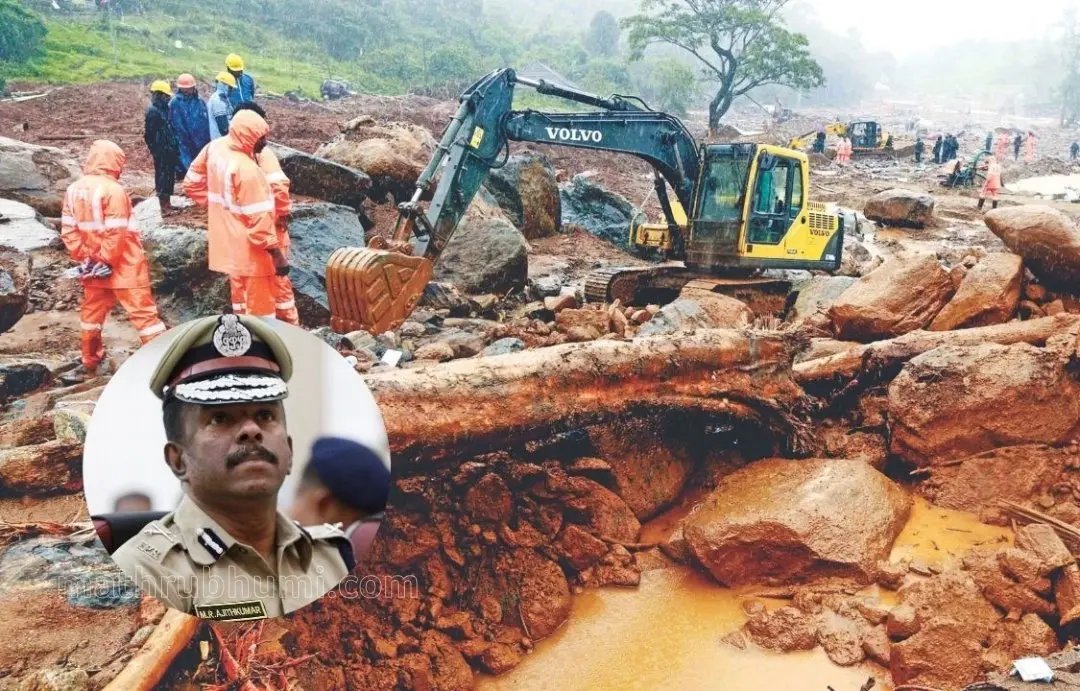
Wayanad: From day one, ADGP MR Ajith Kumar has been at the forefront of rescue and relief activities in the landslide-hit Wayanad. In an interview given to Mathrubhumi reporter Neenu Mohan at Wayanad, Ajith Kumar, who is also a geologist, speaks about the background of the disaster and the police interventions in the disaster-torn land. He emphasizes the need to strengthen the disaster management force and speaks about the improvements to be made regarding scientific preparations and warning systems. “A lot of improvements should take place in this area,” he says.
Q: The police have acted more as a rescue unit than a force to keep law and order in Wayanad. How handy was the knowledge of the force about the geography of the region in the disaster-hit land?
A: Here, the police acted as a basket or an umbrella. All other units active here were under the cover provided by us. We were there in every area, from involving in rescue missions to providing protection in hospitals and relief camps. Remember, the force was exceptionally effective in whatever they had done here. The knowledge about the local terrain has definitely proved handy. The police personnel were quite familiar with each and every nook and corner of the region as they used to travel extensively in the region in connection with the activities of Janamaithri Police. This was a collective effort. As they were up against an unprecedented disaster, they worked hard unmindful of their families and health.
Q: Each experience would be a lesson for the police. What would be the lesson learned by the police from this disaster?
A: Due to the climate changes taking place across the globe, Kerala has become more prone to natural disasters. If a disaster hits the state, the impact would be more as the density of the people here is a bit high. Kerala police already have a disaster management group called the Rapid Response Force (RRF). Work has been done for the last six months to turn this department into a separate group dealing with disasters. But things have not begun fetching the desired results. Our next goal is to strengthen the RRF by redesigning this unit and bringing in enough equipment to deal with disasters. We have been planning to introduce a Disaster Awareness and Response Mechanism under the district special branch. It is of utmost importance to make the force more powerful and vigilant. It would be a physically, mentally, and emotionally demanding task. RRF would be transformed into a unit strong enough to tackle these challenges. The reason behind the growing cases of suicides among police personnel is not the overburden of work. Those who join the police come through PSC tests. Not many have the mental strength to outlive the tensions from the job.
Q: How could the police play their role in the rehabilitation of disaster-hit people of Wayanad?
A: The police have been documenting the disaster in a comprehensive manner. A report would be submitted to the government based on the documentation. Many police personnel too have suffered losses in the disaster. Many had lost their houses. The Kerala Police Officers Association would give them land to build new houses.
Q: You were part of a team that traveled with Prime Minister Narendra Modi when he visited landslide-hit places. How was the experience?
A: The visit of the Prime Minister was an act of great support to the state government. He came and visited the landslide-hit areas. We understand that the disaster had shaken up the Prime Minister considerably. We could feel his pain during his interactions with the officials. Only those who could reach the disaster-hit land would be able to understand the gravity of the tragedy. The Prime Minister was so shattered.
Q: Before joining the police force, you were a geologist. How do you see the disaster?
A: Being a geologist, I was eager to visit the disaster-hit places. I went to the place from where the landslide had originated. When I reached the place first, I could go up to Mundakkai church only. It was a local resident who told me to go by the river if I had the courage. It was with the help of this man, named Alavi, that I reached Punchirimattam through the river. After that, I traveled through the forest with a team of forest officials. From my visit to the place, what I understood is the real reason behind the landslide was the continuous heavy rains in the region. Incessant rains had made the soil wet and muddy. Remember, a cloudburst of a less serious nature also occurred in the region. We could only put up some partial resistance to such natural calamities.
It would be quite inhuman to ask those who set up houses and farms through sheer hard work over decades to move out of the region. The most important thing is to make people aware of the nature of impending disasters. Warning systems should become more effective. A scientific evacuation should also take place in the region by setting up secure and safe places.
The Odisha disaster management wing, which functions under the Odisha government, is an effective and scientific unit. Japan, which is a potential earthquake country, is well-equipped to deal with such a disaster. Do we display the exit routes when a fire breaks out in big malls and buildings? Such systems should be introduced focusing on little children. Malayalis have a common belief that nothing tragic would happen to them. This should be changed to understanding what to do when something bad happens.