Decades-old Guruvayur temple gold mystery reignites political debates amid Sabarimala row
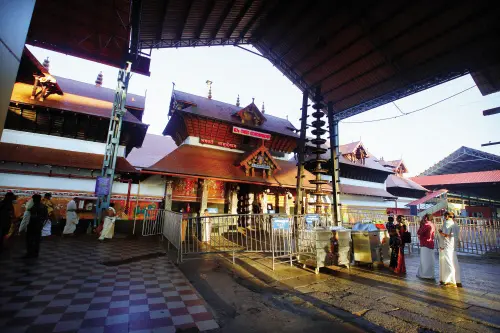
Thrissur: The decades-old controversy surrounding the missing Thiruvabharanam (sacred ornaments) of Lord Guruvayoorappan has returned to the political spotlight, nearly 40 years after the disappearance first came to light.
The mystery traces back to March 31, 1985, when the newly appointed Melshanthi (chief priest) discovered that three sacred necklaces were unaccounted for in the Guruvayur Devaswom records. Only a few temple insiders were aware of the happenings until 'Mathrubhumi newspaper' broke the story on April 8, 1985, prompting immediate government attention and escalating the issue to then Chief Minister K Karunakaran.
The controversy has resurfaced amid the Sabarimala gold smuggling row, after CPM state secretary MV Govindan recently revived allegations of massive financial loss relating to the 1985 Thiruvabharanam disappearance. Quoting the Justice Krishnanunni Commission report, Govindan accused the Congress-led administration of the time of failing to recover the ornaments and allowing the loss to remain unresolved.
However, Opposition Leader VD Satheesan dismissed the allegation, calling it an attempt by the CPM to deflect attention from the latest Sabarimala gold controversy. Satheesan said the CPM narrative was “completely false”, stressing that the main Guruvayur necklace was later recovered, and the discovery took place during the term of a Congress-appointed Devaswom chairman.
How the Thiruvabharanam disappearance unfolded
When Thiyannoor Krishnan Namboothiri succeeded Kakkad Damodaran Namboothiri as Melshanthi, a review of the records showed three necklaces missing. Following Mathrubhumi’s 1985 expose, the Devaswom Police registered a case against Damodaran Namboothiri and his son Devadasan. Though Rs 50,000 was collected as compensation from Damodaran, the crime could not be proven. Damodaran died while proceedings were ongoing, and in 1993, Devadasan was acquitted due to lack of evidence.
Despite the missing ornaments becoming a major political issue in the 1987 Kerala Assembly elections, Karunakaran and Devaswom chairman PT Mohanakrishnan secured victories in their constituencies.
The anonymous calls and the stunning discovery
A turning point came on July 19, 1994, when an anonymous caller informed Mathrubhumi that the missing Thiruvabharanam had been deliberately thrown into the Manikkinar (sacred well) to frame the Melshanthi. A week later, an envelope arrived with a note claiming the necklaces were indeed there, along with ₹200, requesting that it be made public.
The well was drained twice without success, first in 1994 and again in March 2013. On April 25, 2014, a renewed draining effort involving 14 workers finally yielded results. After sacred Salagrams were recovered, careful sifting through the mud revealed:
- Nagapadathali necklace weighing 60 grams
- 29 precious sapphires and a large-stone locket
- 15 fragments from another Palakka-stone necklace
The Thantri and Devaswom authorities verified the ornaments, and they were secured in a protected locker.
Although the main necklace was recovered, the search for the remaining ornaments and the probe into who threw them into the well saw little progress afterwards. K Karunakaran, who bore the political criticism for decades, died before the necklace resurfaced.
Satheesan slams CPM allegations
Responding to Govindan’s renewed accusations, VD Satheesan said, “The CPM is misleading the public to divert attention from the Sabarimala gold scam. 'Mathrubhumi' led the investigation into the Guruvayur issue. My response is based on examining Mathrubhumi news reports from the time. The Thiruvabharanam was recovered by draining the Manikkinar when Congress leader TV Chandramohan was Devaswom chairman. It is evident that someone cheated the Melshanthi; this has nothing to do with Congress rule.”