Fact check: Is Aphelion behind the sudden chill and rise in illnesses? Experts say no
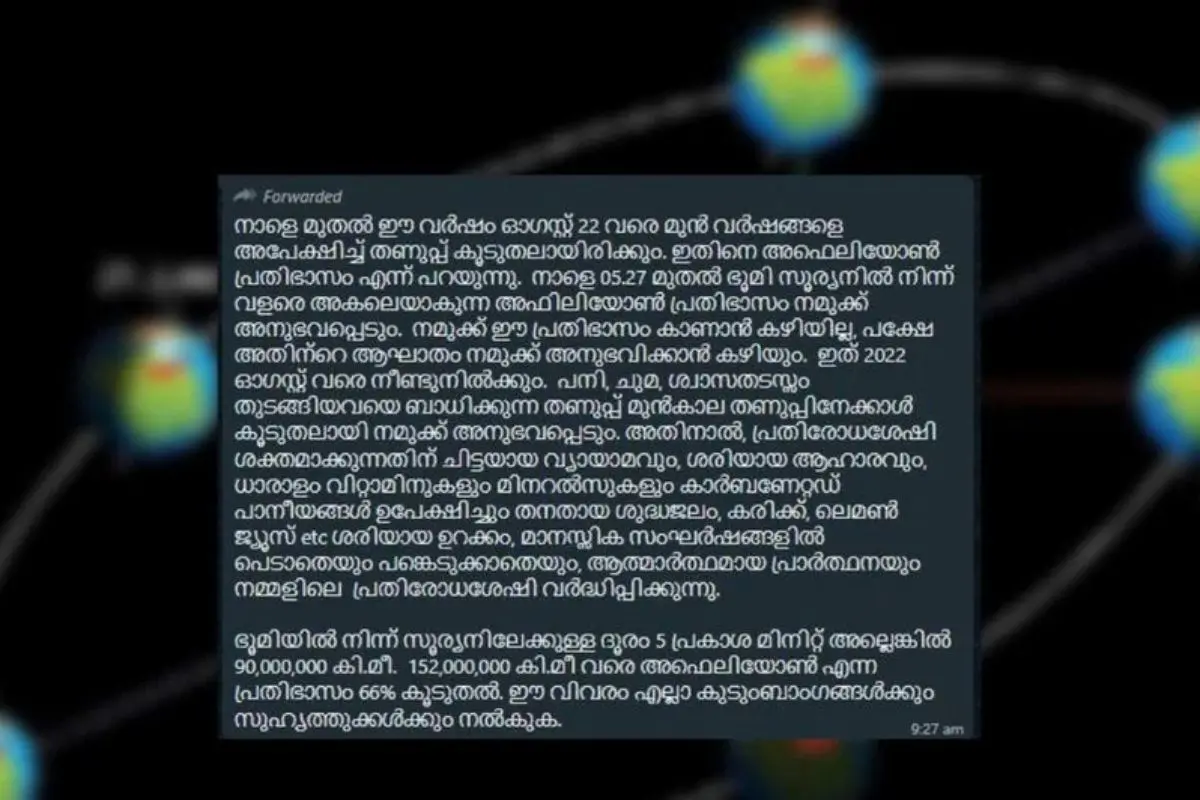
A message doing the rounds on WhatsApp has sparked concern, claiming that the Earth is currently at its farthest point from the Sun—a phenomenon known as aphelion—and that this is causing unusually cold weather between July and August 22. The message goes on to suggest that this temperature drop could lead to an increase in illnesses such as coughs and fevers.
The viral message claims that Earth’s distance from the Sun during aphelion is 152 million kilometres, compared to a usual 90 million kilometres (or 5 light minutes), alleging a 66% increase. It warns people to be cautious during this supposedly dangerous "cold period."
However, a deeper look into both the science and numbers reveals this claim to be entirely false.
What Is Aphelion, Really?
Many of us might recall the term aphelion from our school geography lessons. It refers to the point in Earth’s orbit where it is farthest from the Sun—not a month-long period. In 2025, aphelion occurred on July 4. In Malayalam, this point is referred to as ‘apasauram’.
Rather than having any noticeable climatic impact, aphelion is a brief astronomical event with minimal influence on day-to-day weather.
The Real Numbers
Contrary to the viral message, Earth is never just 90 million km from the Sun. In fact:
- The average distance is approximately 149.6 million kilometres, or 8.3 light minutes.
- During aphelion, the distance increases slightly to 152.1 million km.
- During perihelion (when Earth is closest to the Sun, occurring in early January), the distance reduces to 147.1 million km.
The variation in distance between perihelion and aphelion is only about 3.3%, not 66% as falsely claimed in the message.
Does This Affect Weather or Health?
To verify whether aphelion can cause cooler weather or illness, we reached out to Prof. Anand Narayanan from the Indian Institute of Space Science and Technology (IIST), Thiruvananthapuram. He confirmed that the minor variation in Earth’s distance from the Sun has no significant impact on weather or temperature.
“The average distance and the aphelion distance differ by only about 1.03%. That’s far too little to influence climate or health,” he explained.
Instead, it is Earth’s axial tilt and local geographic factors that dictate seasonal weather patterns and temperature variations.
Interestingly, aphelion happens during summer in the Northern Hemisphere, while perihelion falls in January, the peak of winter in the same hemisphere. If distance from the Sun were a dominant factor in weather, this seasonal pattern would be reversed—which it clearly is not.
NASA and Other Sources Confirm the Same
Organisations such as NASA and the University of Southern Maine have also published articles debunking myths around aphelion, confirming that it has negligible effect on Earth’s weather or human health.
Go through these links:
Links to the articles NASA and University of Southern Maine
https://www.nasa.gov/learning-resources/for-kids-and-students/what-is-an-orbit-grades-5-8/
Other links:
https://www.space.com/17081-how-far-is-earth-from-the-sun.html
https://www.space.com/aphelion-july-2022
Verdict: Misleading and Unscientific
The viral claim that aphelion causes a noticeable drop in temperature or triggers illness during July and August is entirely false. While Earth is indeed farthest from the Sun during aphelion, the increase in distance is minimal and not enough to alter weather patterns or cause health issues.
So, there’s no need to panic—your sniffles or summer chills are not being caused by a distant Sun.