Why hundreds of thousands of Indian trees become ‘brothers’ in a unique Raksha Bandhan tradition
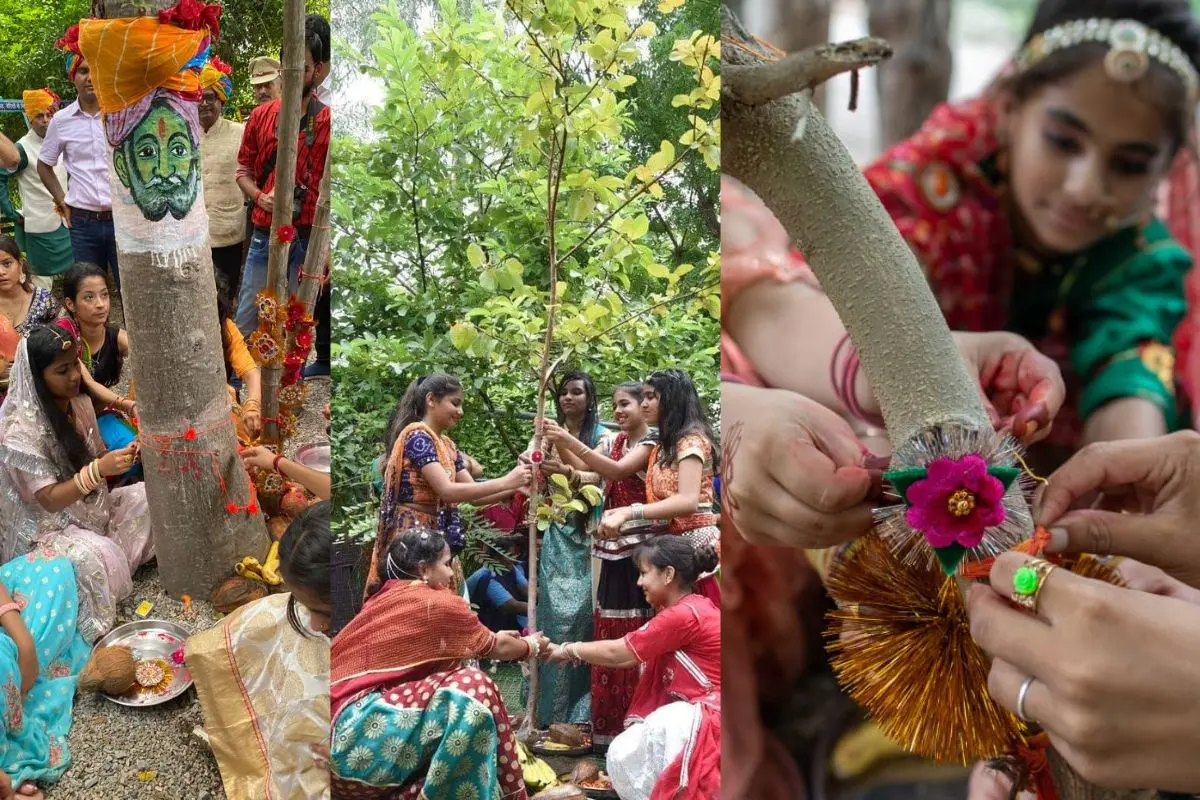
Raksha Bandhan is traditionally celebrated as a festival honouring the bond between brothers and sisters. On the occasion, sisters tie a Rakhi around their brothers’ wrists, while brothers give gifts as a gesture of love and care.
But in parts of India, the festival’s message of protection extends beyond family. In Jharkhand, villagers are using the occasion to pledge to protect trees and forests that support their livelihoods.
On Friday, thousands of villagers across Jharkhand are preparing to tie sacred threads to nearly one lakh trees as part of a large-scale forest protection campaign.
The initiative will begin in Gumla district and is scheduled to expand across all 24 districts of the state. Over the next month, the campaign aims to cover around three lakh trees.
Under the initiative, residents pledge to protect trees that they depend on for their daily needs. By linking the traditional Raksha Bandhan ritual with conservation, the state forest department is seeking to strengthen the emotional connection between rural communities and their natural surroundings.
Raksha Bandhan, which falls on August 28 this year, is deeply rooted in Indian culture and has been observed for centuries. The Rakhi traditionally symbolises protection, with brothers promising to safeguard their sisters from harm.
Jharkhand’s tree-protection campaign dates back to 2004. Forest officer Sanjiv Kumar first conceived the initiative in Lukaiya, a village that had previously been affected by Maoist activities.
Over the past two decades, the idea has spread to more than 12,000 villages across the state.
In Lukaiya itself, the campaign helped save more than 20,000 Mahua trees. The trees have since continued to support local families by providing livelihoods and minor forest produce.
The initiative has therefore moved beyond the symbolic act of tying a thread. For communities dependent on forests, protecting trees is closely connected with protecting their sources of income and everyday needs.
Official data cited in the initiative shows that Jharkhand’s forest cover increased from 22,637 square kilometres in 2001 to 23,765.78 square kilometres in 2023.
Forests now account for nearly 30 per cent of the state’s total geographical area, according to the data.
The state is also placing greater emphasis on protecting existing plantations. The focus is shifting from simply planting saplings to ensuring that they are nurtured, fertilised and protected over the long term.
Raksha Bandhan becomes a green tradition
Jharkhand is not the only part of India where Raksha Bandhan has been linked to environmental protection.
Neighbouring Bihar has officially observed Raksha Bandhan as a tree protection day since 2012. State leaders have also participated in ceremonies involving the tying of rakhis to trees to promote awareness about conservation.
In Visakhapatnam in coastal Andhra Pradesh, a civic group has adopted a similar practice to protect some of the city’s oldest trees.
The group had earlier mobilised local residents to prevent a century-old banyan tree from being cut down.
In Rajasthan, the village of Piplantri has developed another tradition that connects tree planting with the birth of girls.
Whenever a girl is born in the village, residents plant 111 trees. The local daughters then tie rakhis to the trees every year as a symbolic pledge of protection.
Across these initiatives, the traditional idea behind Raksha Bandhan is being given a wider meaning. What begins as a thread tied to a brother’s wrist becomes, in these communities, a pledge to protect trees and the environment that sustains them.