West Bengal polls 2026: Mamata Banerjee rides on ‘star power and political novices’
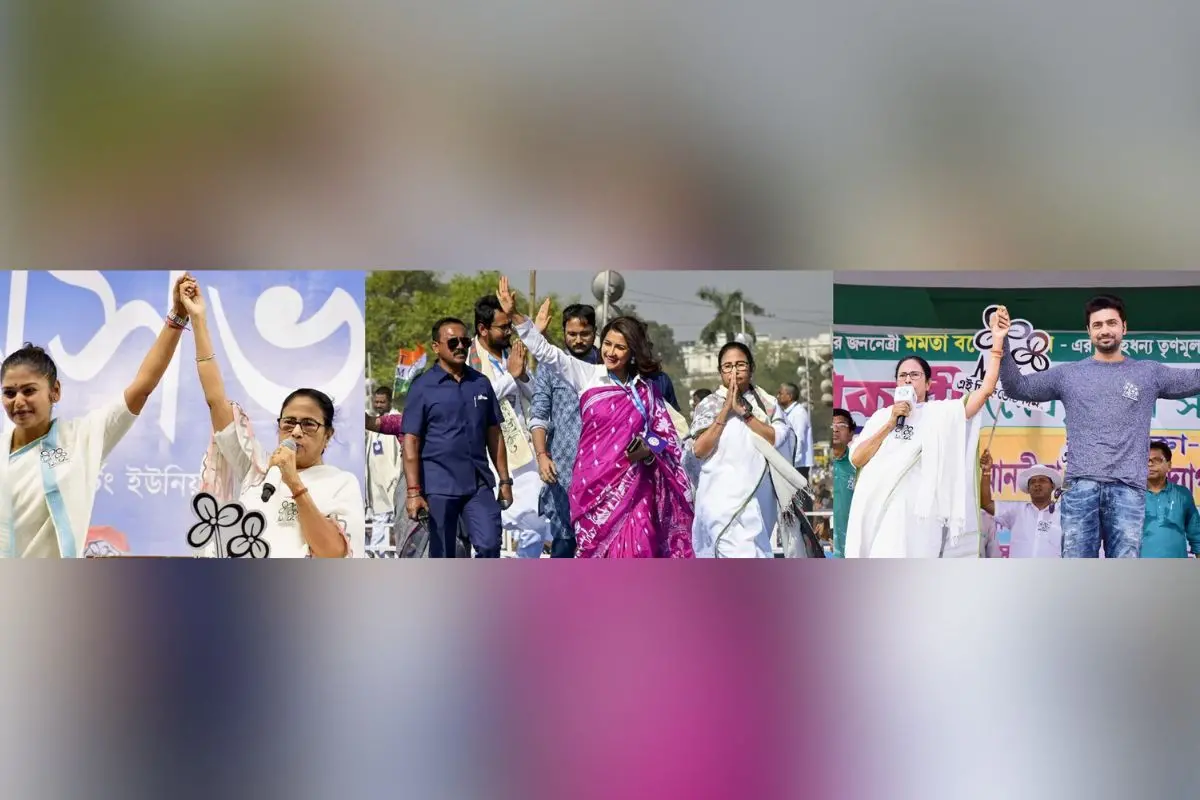
Kolkata: As West Bengal heads into the 2026 Assembly elections, one pattern in the Trinamool Congress (TMC) playbook remains unmistakably intact: Mamata Banerjee’s enduring reliance on celebrity candidates.
From film stars to cricketers and media personalities, the party has once again leaned heavily on recognisable faces.
The question, however, is not just who is being fielded, but why this strategy persists election after election. Is this a calculated mass-connect formula, or does it hint at a deeper political vacuum?
Over the years, Banerjee has consistently turned to celebrity appeal as a force multiplier. The logic is straightforward: stars bring instant recall, media traction, and a ready-made emotional connection with voters.Check out the complete list of 294 candidates as released by TMC on March 17.
However, critics argue that this approach often comes at the cost of political depth and administrative experience. Names like Mimi Chakraborty, Nusrat Jahan, Sayani Ghosh, Dev, Satabdi Roy, and June Maliah have been central to TMC’s celebrity experiment in recent years.
While their popularity is undeniable, questions around their legislative effectiveness and political articulation have frequently surfaced in public discourse.
Similarly, figures like Raj Chakraborty and Rachana Banerjee represent the party’s continued preference for cultural capital over grassroots political grooming.
Even individuals like Indrani Sen, known more for her cultural contributions, have drawn criticism for overt political loyalty rather than an independent political voice. In the following video, one can see the splurge of Bengali film stars in the CM’s rally.
The trend is not limited to cinema. The inclusion of sportspersons further underscores the strategy. Former Indian cricketers like Manoj Tiwari and Yusuf Pathan have been fielded in high-stakes contests, decisions that raised eyebrows within political circles.
Pathan’s candidature against Congress heavyweight Adhir Chowdhury in a Lok Sabha election was seen by many as a gamble driven more by visibility than electoral arithmetic.
At the state level, too, names like former cricketer SS Paul and media figures such as Devadeep Purohit, as cited in political discussions, add to the growing list of non-traditional entrants. Even actors like Soham Chakraborty have often been viewed as symbolic picks rather than politically seasoned leaders.
A one-person high command?
The underlying criticism is sharper and more political. Opponents and even some observers believe that this recurring dependence on celebrities stems from the highly centralised nature of TMC’s leadership.
Banerjee remains the undisputed nucleus of the party, often overshadowing second-rung leadership.
This was particularly evident during controversies like the Narada sting case, when Banerjee led the campaign almost single-handedly, appealing directly to voters in her name.
The message was clear: the party’s biggest and perhaps only pan-Bengal face is Banerjee herself. In such a structure, celebrities serve a dual purpose.
They amplify the party’s reach while rarely challenging the leadership. Unlike seasoned politicians, they are less likely to “cross swords” with the high command, ensuring organisational cohesion, at least on the surface.
Strategy or structural weakness?
This approach, however, raises a critical concern: Does TMC face a shortage of strong grassroots leaders?
Senior party members who have spent years building the organisation often find themselves sidelined or “immersed in oblivion,” as critics put it. Ticket distribution increasingly favours visibility over experience, leading to murmurs of dissatisfaction within party ranks.
Moreover, electoral success is not always guaranteed by popularity alone. Governance, constituency management, and policy articulation require a different skill set, one that cannot be substituted by fame.
Will it work in 2026?
The West Bengal CM’s celebrity-driven strategy is not new, but its effectiveness may now face a tougher test.
With anti-incumbency, a resurgent opposition, and rising political awareness among voters, the reliance on “star power and political novices” could either pay off spectacularly or backfire.
For now, the TMC supremo appears unwavering in her belief that her own mass appeal, combined with familiar faces, can carry the party through yet another electoral battle.
However, in a state as politically aware as West Bengal, the final verdict will depend on whether voters choose charisma or credibility.