US Army grounds Apache flights after fatal Texas crash; India watches closely
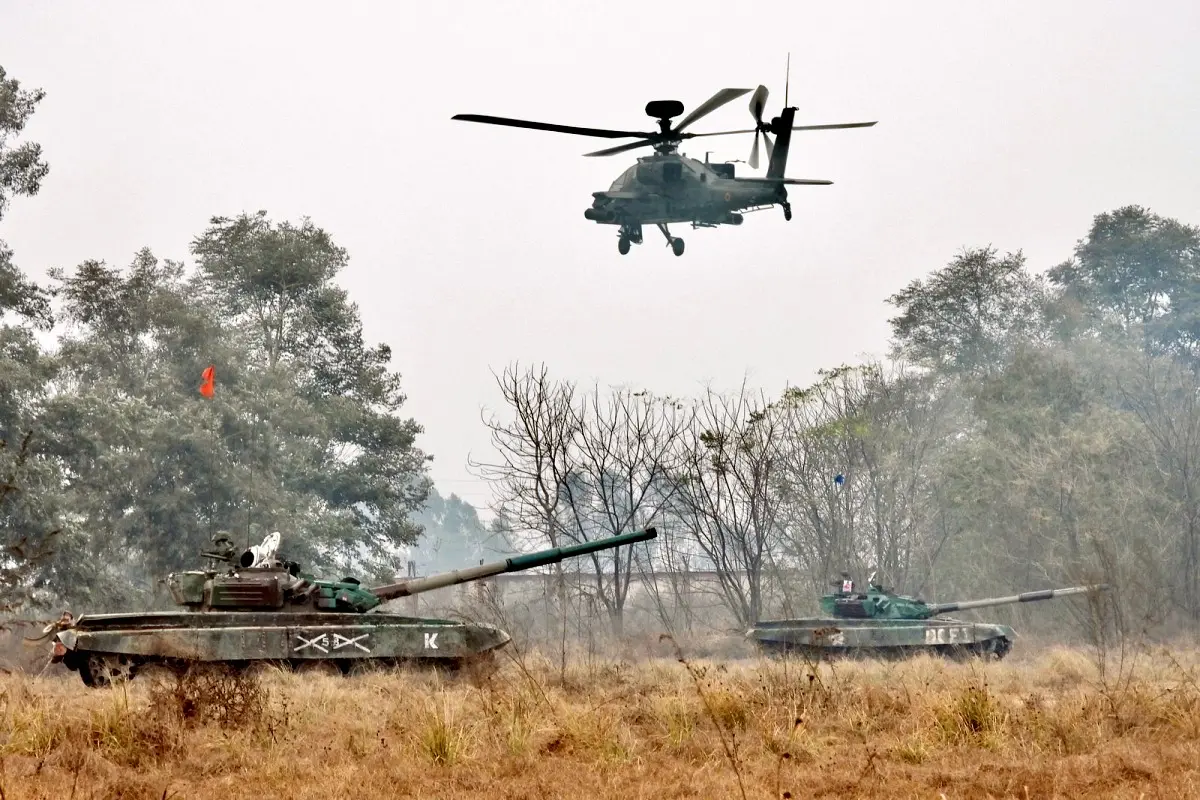
The United States Army's decision to temporarily ground all AH-64 Apache training flights following a fatal crash in Texas has put the spotlight back on the safety record of the world's most widely used attack helicopter - and drawn close attention in India, where the Indian Air Force (IAF) operates the same AH-64E Apache Guardian variant.
While the American grounding is currently limited to training missions and does not affect combat deployments, the incident has triggered fresh questions about maintenance protocols, rotor-system integrity and operational stress on a platform that forms the backbone of attack helicopter fleets from the US to India, Israel, South Korea and several Middle Eastern countries.
The US Army announced on August 14 that it was ordering a temporary stand-down of all AH-64 Apache training flight operations after a two-seater Apache crashed in a grassy field near Fort Hood, Texas, on Wednesday, August 12, killing both crew members.
The dead were identified as Chief Warrant Officer 2 Deontre T Huey, 34, and Warrant Officer Seth L Olmstead, 25 -- both assigned to Bravo Company, 1st Battalion, 227th Aviation Regiment, 1st Air Cavalry Brigade, 1st Cavalry Division. The helicopter was on a maintenance test flight when it went down, sparking a grass fire in Bell County, about 48 km from the base.
In a statement, the Army said: "Army leaders directed a temporary stand-down of AH-64 Apache training flight operations. The stand-down will remain in effect until we have a better understanding of the root cause of the accident." A safety investigation team from the US Army Combat Readiness Center at Fort Rucker, Alabama, has been deployed to lead the probe.
The Army has not disclosed a definitive cause, but early reports and social media posts citing preliminary investigation inputs suggest that during the impact sequence, a main rotor blade may have contacted the tail rotor drive shaft, causing an engine surge and an uncontrollable yaw that led to the crash.
Officials stress that these are initial observations and that the formal investigation is still in its early stages.
Training flights paused, combat missions continue
Crucially, the US Army has clarified that the grounding applies only to training flights. Operational and combat missions involving Apaches, including those deployed in the Middle East around the Strait of Hormuz, are continuing as normal.
This distinction matters for India because the IAF’s Apaches are primarily configured for high-intensity operational roles -- strike, close air support, anti-armour missions and border patrol -- rather than the kind of repetitive training-sortie profile that dominates the US Army’s fleet usage. Still, any hint of a systemic technical issue in the AH-64E platform is bound to be scrutinised closely by Indian planners.
India operated 15 AH-64E Guardians
India operates 15 AH-64E Apache Guardian attack helicopters, all in the latest E-model configuration, making its fleet technically more advanced than many older AH-64A/D variants still in service with other operators. The IAF inducted its first batch of Apaches in 2019, with subsequent deliveries completed over the next few years, and has since deployed them along the western and northern borders, including in Punjab, Rajasthan and Ladakh.
The Indian fleet is operated by No 125 Helicopter Unit (“Gladiators”) and possibly a second squadron that has been raising progressively as more airframes and spares become available.
The Apaches are armed with AGM-114 Hellfire missiles, Hydra 70 rockets and a 30 mm M230 chain gun, and are integrated with the Longbow fire-control radar and advanced electro-optical sensors, giving the IAF a potent day-and-night, all-weather strike capability.
Given the high operational tempo along the Line of Control and the Line of Actual Control, the IAF’s Apaches are among its most heavily tasked rotary-wing assets, often flying border patrols, quick-reaction alert duties and live-fire exercises in demanding terrain and weather conditions.
Past Apache incidents in India add to sensitivity
The safety of the Apache fleet is not an abstract concern for India. The IAF has already experienced at least two notable incidents involving its Apaches, though both were described as non-fatal and contained.
One incident reportedly took place in Indora, Punjab, where an Apache is said to have suffered a technical malfunction during a training or operational sortie, forcing an emergency landing or precautionary touchdown. Another incident was reported near North Pullu in the Leh sector, where an Apache allegedly encountered a systems anomaly in high-altitude conditions, again without loss of life.
Details of these events have not been fully disclosed, but defence sources have indicated that they triggered internal reviews of maintenance schedules, pilot procedures and vendor support from Boeing and US agencies.
The fact that the IAF’s Apaches operate in extreme environments -- from the desert heat of Rajasthan to the high-altitude cold of Ladakh -- adds another layer of complexity to their upkeep and safety management.
What the US crash means for India
Defence analysts caution against reading too much into a single crash, noting that the Apache has one of the most extensive combat and operational histories of any attack helicopter, with hundreds of thousands of flight hours logged across multiple wars and conflicts.
They also point out that recent data show Apaches have a higher number of mishaps per 100,000 flight hours compared to some other Army helicopters, but that this is partly a function of their complex mission profile, which includes low-level flight, nap-of-the-earth manoeuvres, high-G turns and frequent weapons employment.
For India, the immediate implication is likely to be heightened scrutiny rather than any drastic policy shift. The IAF is expected to review recent maintenance logs of its AH-64E fleet, with particular attention to main rotor assemblies, tail rotor drive systems and transmission components.
The IAF is also expected to seek clarifications from Boeing and US Army aviation safety agencies on the preliminary findings of the Fort Hood investigation, especially if any component-level defect is identified.
Further, it may reassess training protocols for Apache pilots and maintenance crews, particularly for high-stress manoeuvres, emergency procedures and post-maintenance test flights.
There is, however, no indication that the IAF is considering any grounding or operational pause for its Apaches at this stage. The helicopters continue to fly regular operational sorties along the borders, and senior officers have described the platform as “critical to our strike capability” and “performing well within expected parameters.”
Boeing, obsolescence fixes and a new US order
The timing of the crash also coincides with a fresh US Army decision to sole-source a contract to Boeing for up to 12 new AH-64E Apaches, folded into an existing 53-month remanufacture and obsolescence-management programme.
Boeing remains the only viable supplier because it holds all the proprietary design and manufacturing data for the aircraft, and the new contract includes work to address aging electronic components and other obsolescence issues in the fleet.
For India, which depends on Boeing and US government channels for spares, upgrades and technical support, any long-term finding that points to systemic design or manufacturing flaws could complicate future procurement plans, including potential additional Apache orders or mid-life upgrades.
At present, however, the US Army’s language suggests a precautionary pause pending investigation, not a fundamental indictment of the airframe.