Why did Shashi Tharoor call Rahul Gandhi a ‘nepo kid’? Here’s how Congress and BJP reacted
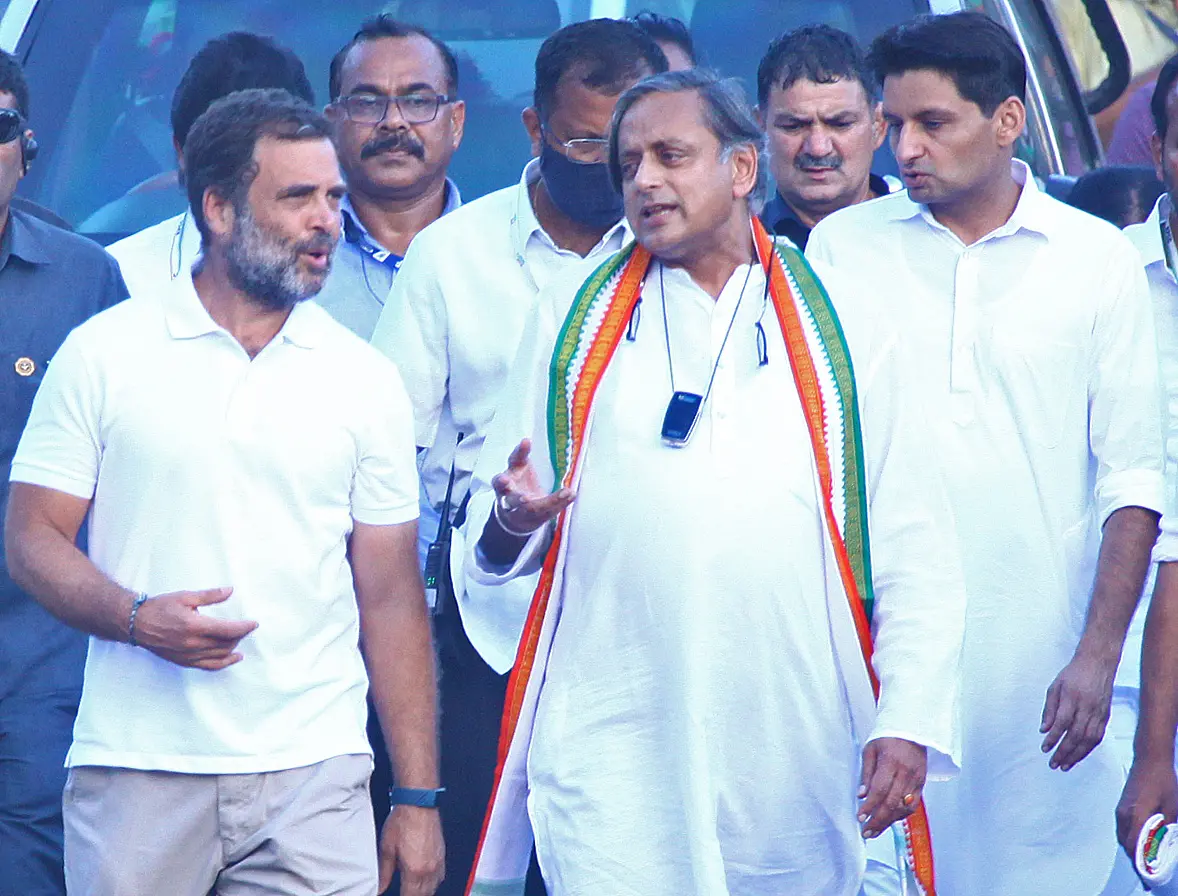
New Delhi: Congress MP Shashi Tharoor’s recent critique of dynastic politics — interpreted by the BJP as a swipe at Rahul Gandhi — has stirred fresh debate inside the party, with senior leaders stepping in to defend the Gandhis and clarify their stance.
Tharoor’s opinion piece sparks political storm
The controversy stems from Shashi Tharoor’s opinion article, published on 31 October 2025 by Project Syndicate. In the piece, Tharoor argued that lineage-based politics undermines governance and entrenches inequality within India’s democratic system.
Tharoor wrote that the Nehru-Gandhi dynasty’s historic role in India’s independence movement also reinforced the perception that “political leadership can be a birthright.” He added, “When political power is determined by lineage, rather than ability, commitment, or grassroots engagement, the quality of governance suffers… it is especially problematic when candidates’ main qualification is their surname.”
The remarks, while general in tone, were immediately seized upon by the BJP, which claimed that Tharoor had “attacked” Congress leader Rahul Gandhi — branding him a “nepo kid” — and Tejashwi Yadav as a “chhota nepo kid.”
BJP capitalises on Tharoor’s comments
The BJP’s media wing quickly amplified Tharoor’s essay, calling it an “admission of truth” from within the Congress about its dynastic core. Party spokespersons said the Congress MP had “exposed” his own party’s leadership model and questioned the meritocratic basis of Rahul Gandhi’s role in national politics.
The BJP’s campaign targeted both the Gandhis and regional leaders seen as inheritors of political legacies, tying the issue to what it calls India’s “culture of entitlement.”
Congress leaders defend Gandhis and downplay controversy
As the BJP intensified its attack, several Congress leaders responded, defending the Gandhis’ contributions and challenging the notion that political legacy equates to privilege.
Congress leader Udit Raj told ANI that dynastic continuities exist in every field — from medicine to business — and politics is no exception. “A doctor’s son becomes a doctor, a businessman’s child continues in business, and politics is no exception. If a politician’s child enters politics, it reflects society. Election tickets are often given based on caste and family lines,” he said.
He also cited examples across political parties, mentioning figures like Mamata Banerjee, Amit Shah’s son Jay Shah, Sharad Pawar, and M.K. Stalin, arguing that dynastic influence is widespread and not exclusive to Congress.
Congress MP Pramod Tiwari mounted a strong defence of the Nehru-Gandhi family, asserting that its leadership is rooted in sacrifice and service. “Pandit Jawaharlal Nehru was India’s most capable Prime Minister. Indira Gandhi sacrificed her life for the nation. Rajiv Gandhi also gave his life for India. If people call this a dynasty, which other family in India has shown such dedication?” he asked.
Senior leader Rashid Alvi echoed similar views, noting that democracy allows anyone to contest elections regardless of background. “The public decides in a democracy. You cannot stop someone from entering politics because their father was an MP. This happens in every field,” Alvi told ANI.
Internal friction resurfaces within Congress
Tharoor’s piece also rekindled old tensions between him and the party’s high command. His selection by the government to lead Operation Sindoor, a diplomatic humanitarian mission, without Congress’s formal recommendation, had earlier stirred unease within the party.
Congress MP Udit Raj later referred to Tharoor as the BJP’s “super spokesperson” after the Thiruvananthapuram MP praised the 2015 Uri strike during his visit to Panama — a statement that drew criticism from within his own ranks.
These developments have once again highlighted Tharoor’s delicate position within the Congress — respected for his intellect and global stature, yet often viewed as too independent for the party’s central leadership.
Tharoor’s essay reignites debate on merit vs dynasty
While Congress leaders have sought to contain the fallout, Tharoor’s observations have revived a broader national debate on the role of family legacy in Indian politics.
In his essay, Tharoor wrote that nepotism “trumps meritocracy” and weakens governance by favouring lineage over capability. His comments mirror concerns voiced by reform advocates that dynastic politics across all parties limits opportunities for new talent and entrenches inequality.
Political analysts note that this controversy comes at a sensitive time for the Congress, as it prepares for state elections in 2026 and continues to project Rahul Gandhi as the face of its leadership.
Tharoor’s remarks — though nuanced — have been weaponised by opponents and complicated by internal party sensitivities. While his article calls for a merit-driven political culture, the backlash within and outside the Congress underscores how deeply India’s democracy remains entangled with questions of legacy, privilege, and political inheritance.