‘Virtually strong, literally weak’: ₹500-crore Rewa Airport wall collapses in rain — again
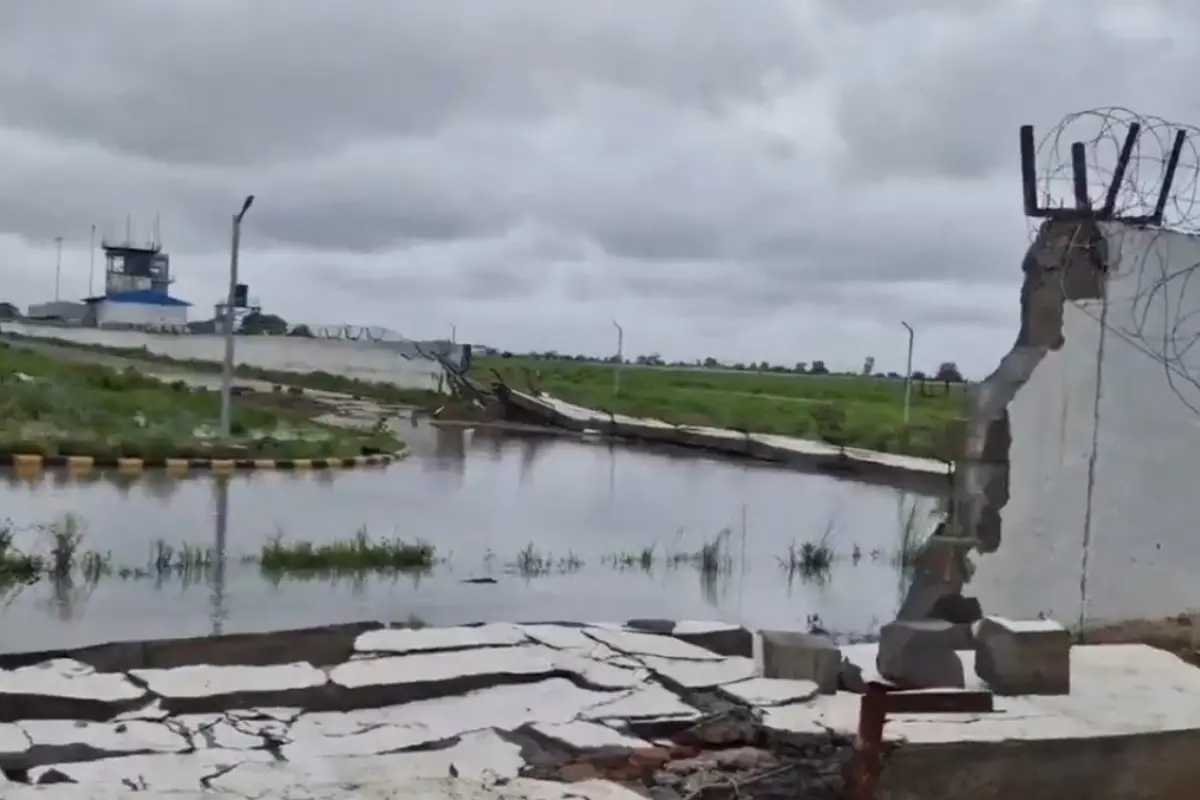
Madhya Pradesh: On Saturday a portion of the boundary wall of Rewa Airport in Madhya Pradesh collapsed following continuous rainfall in the area.
Visuals of the damaged wall quickly went viral online, with many users criticising the airport’s structural integrity and the speed at which the Rs 500-crore project was completed.
This marks the second such collapse in two years—a similar incident occurred during the 2024 monsoon season, which had already prompted a series of inquiries into construction standards.
Although official reasons for the collapse have not been confirmed, local accounts suggest that the ground beneath the structure gave way due to heavy rain, leading to the failure of the wall. Netizens were quick to point fingers at the construction quality, especially given the airport’s high-profile status and cost.
Social media reactions included sarcasm and memes, with users remarking that the wall couldn’t withstand even the first major rain after its inauguration.
Rewa Airport was built at a cost of Rs 500 crore and spread across 323 acres, with completion claimed in just 18 months. Inaugurated virtually by Prime Minister Narendra Modi from Varanasi, the project was hailed as a game changer for the Vindhya region, aimed at improving regional connectivity.
Currently, the airport handles 19-seater flights to Bhopal, with plans to accommodate larger 72-seater aircraft soon.
Rewa Airport is functional and licensed by the Directorate General of Civil Aviation (DGCA). The airport was designed for 50 years of service, and authorities have indicated that more flights are expected to be added in the near future.
Despite these promises, incidents like the boundary wall collapse raise doubts about the long-term durability and quality of the infrastructure.
Social media users, especially on X (formerly Twitter), reacted sharply to the incident. One user wrote, “Virtually inaugurated by PM Modi last year, shockingly, the airport wall couldn’t withstand the first rain.”
Another post mocked the speed of construction, questioning whether “record time” came at the cost of structural stability.
Repeated infrastructure failures at a newly constructed, high-budget public facility not only raise questions about oversight and quality control, but also diminish public confidence in rapid development projects. For a region like Vindhya, which has historically seen slower infrastructure growth, such incidents are especially troubling.
Authorities are expected to issue a detailed report and initiate corrective action in light of this second collapse in two years.