No relief for Umar Khalid, Sharjeel Imam as court rejects fresh bail pleas in Delhi riots case
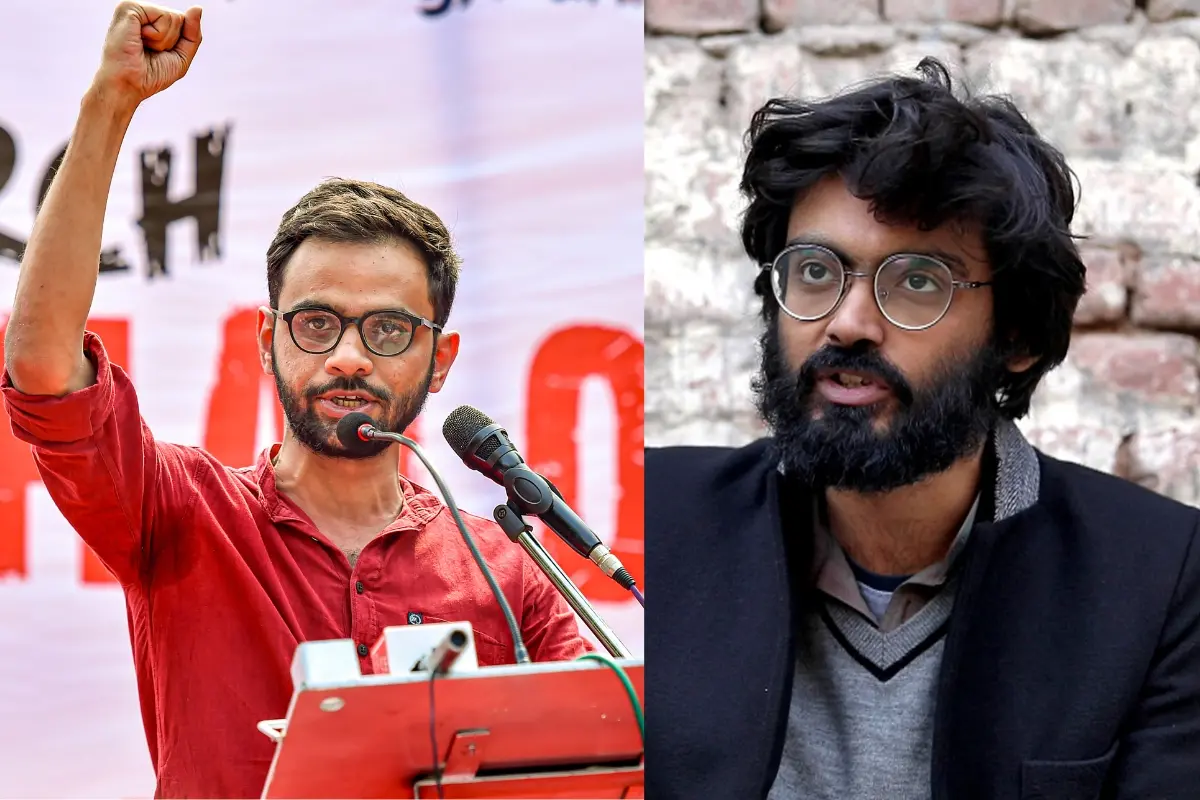
New Delhi: A city court on Saturday rejected the bail applications of activists Umar Khalid and Sharjeel Imam in connection with the "larger conspiracy" case linked to the February 2020 northeast Delhi communal violence.
Additional Sessions Judge Sameer Bajpai denied relief to the dual accused after concluding the arguments presented by both the defence and the prosecution.
In their respective applications, Khalid and Imam contended that their ongoing imprisonment without the start of a trial directly infringed upon their fundamental right to personal liberty.
Khalid's legal counsel argued that although his previous bail plea had been turned down by the Supreme Court, subsequent legal rulings represented a definitive "change in circumstances”. The defense pointed to judicial observations made in May regarding a different matter, emphasising that the principle of "bail is the rule" holds true even under the stringent Unlawful Activities (Prevention) Act (UAPA).
These fresh petitions were moved after the top court had previously denied them bail in the UAPA-registered case on January 5.
Imam, in his petition, highlighted that there had been no "significant development" in the legal proceedings even six months after the Supreme Court's refusal, adding that he has been in detention for nearly six years. The application stressed that charges have not yet been framed in the matter despite the lengthy confinement of the accused.
Echoing similar concerns, Khalid’s plea drew attention to the extended period of incarceration and trial delays, pointing out that he too has spent close to six years behind bars without charges being formally framed.
The defense highlighted the Supreme Court's May 18 ruling in a separate terror case. In that instance, a two-judge bench granted bail while critiquing a January 5 verdict, reaffirming that anti-terror legislations must not be transformed into mechanisms for indefinite imprisonment. Khalid's petition claimed these subsequent judicial observations constituted a "change in circumstances”, validating the maintainability of his fresh bail plea despite the apex court's prior rejection.
Furthermore, the application cited multiple Supreme Court precedents regarding prolonged detention—including Union of India Vs K A Najeeb and Vernon Gonsalves Vs State of Maharashtra—to assert that statutory UAPA bail restrictions cannot eclipse constitutional safeguards when a trial is unlikely to finish within a realistic timeframe.
On January 5, the Supreme Court had denied bail to Khalid and Imam in the conspiracy case, while simultaneously granting relief to co-accused persons, including Gulfisha Fatima, Meeran Haider, Shifa Ur Rehman, Mohammad Saleem Khan and Shadab Ahmad.
A bench, comprising Justices Aravind Kumar and N V Anjaria, had observed at the time that a prima facie case existed against Khalid and Imam under the UAPA, ruling that the accused could not be treated uniformly due to a clear "hierarchy of participation”.
Khalid, Imam, and several others face charges under the anti-terror law UAPA along with various sections of the Indian Penal Code (IPC) for their suspected roles in orchestrating the deep-rooted conspiracy behind the February 2020 riots in northeast Delhi. The communal clashes, which broke out during demonstrations against the Citizenship (Amendment) Act (CAA) and the proposed National Register of Citizens (NRC), resulted in 53 fatalities and left over 700 people injured.
PTI