How are motorists escaping toll payments? NHAI seeks police help over hidden number plates
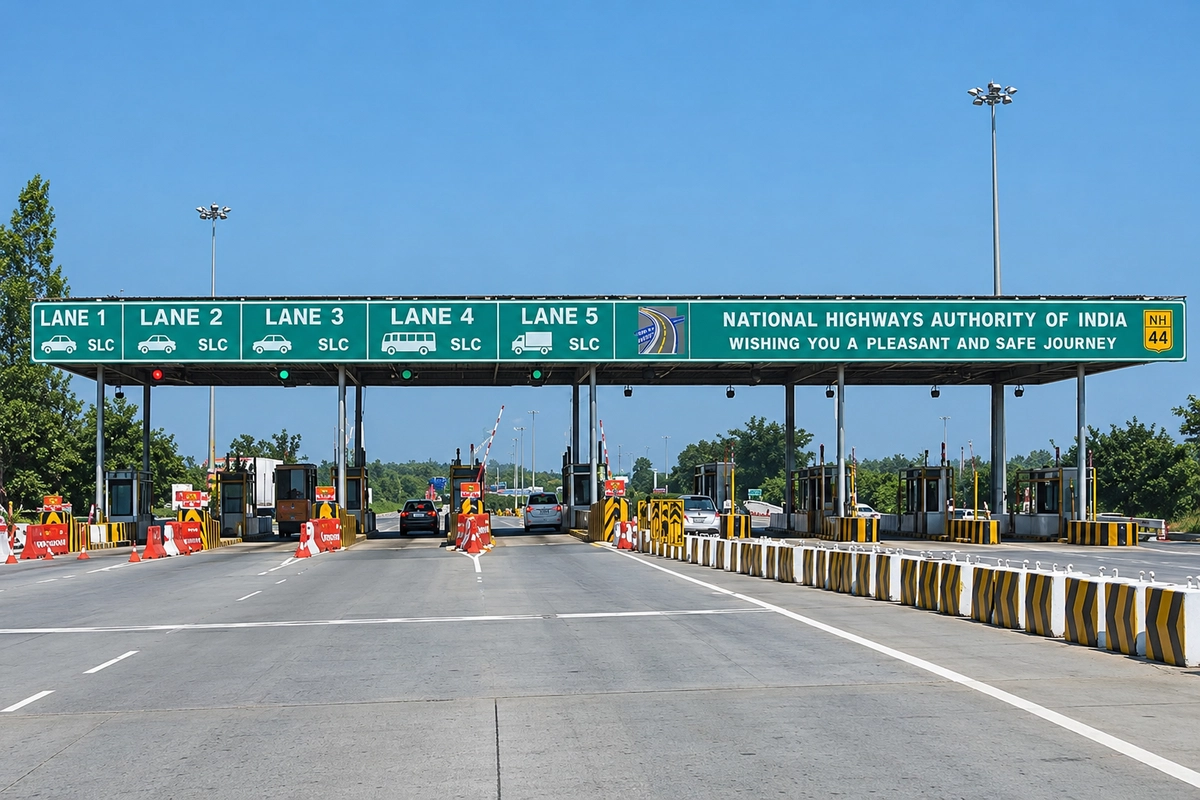
The National Highways Authority of India (NHAI) has sought the deployment of police personnel and transport officials at barrier-less toll plazas to curb toll evasion by vehicles operating with hidden, covered or tampered registration plates.
The authority has asked the district magistrate, superintendent of police and district transport officer in Jaipur to initiate an immediate enforcement drive near the Manoharpura Fee Plaza on National Highway 48.
The move follows concerns over a growing number of vehicles crossing Multi-Lane Free Flow (MLFF) toll plazas without paying the applicable user fee. According to NHAI, more than 99,500 vehicles were recorded as unidentified out of 31.74 lakh crossings up to October 21, 2026.
The issue was previously highlighted in a report by The Indian Express on November 10, which found that thousands of vehicles were passing through barrier-less toll plazas without paying toll charges.
What are unidentified vehicles at barrier-less toll plazas?
NHAI uses the term 'unidentified vehicles' for vehicles whose registration details cannot be established when they pass through a toll plaza.
This can happen when motorists conceal or cover their number plates, tamper with registration details, use fake or cloned number plates, or ensure that their FASTag and vehicle registration number cannot be matched.
Under the MLFF system, toll charges are deducted electronically when the vehicle's registration number and FASTag details match.
Unlike conventional toll plazas, barrier-less systems do not use physical boom barriers to stop vehicles. This allows traffic to move without stopping, but also creates opportunities for motorists to evade payment by interfering with vehicle identification.
NHAI seeks enforcement drive at Manoharpura toll plaza
In its communication to Jaipur district authorities, NHAI requested an immediate enforcement operation near the Manoharpura Fee Plaza on NH-48.
The authority has asked officials to place temporary barricades near the toll gate and intercept vehicles with concealed, covered or tampered number plates.
Manoharpura is one of three MLFF toll plazas on the Gurgaon-Jaipur section of NH-48. The other two are Shahjahanpur and Daulatpur.
NHAI data indicates that Shahjahanpur has recorded the highest number of unidentified vehicles, with at least one in every 10 vehicles crossing the plaza reportedly going unidentified.
Officials said enforcement at Manoharpura would also help address the problem across the other two plazas because all three are part of the same barrier-less highway corridor.
How much revenue is NHAI losing?
According to the authority, more than 99,500 unidentified vehicles were recorded among 31.74 lakh crossings up to October 21, 2026.
NHAI has warned that the problem is causing recurring revenue losses for the government. It has also raised concerns about incorrect FASTag deductions and electronic notices being issued to innocent vehicle owners when registration details are not properly matched.
The authority said the issue could also create law-and-order and security concerns on national highways.
Vehicles using concealed or fake registration plates could potentially be involved in activities such as smuggling, illegal sand mining and other criminal operations. NHAI has also flagged the possibility of tax evasion, including evasion of the Goods and Services Tax (GST), as the e-way bill system is linked to FASTag.
What happens when a vehicle fails to pay toll?
Under the MLFF system, toll charges are deducted when the FASTag and the vehicle's registration number are successfully matched.
If a FASTag has insufficient balance, an electronic notice is issued to the vehicle owner, giving them 72 hours to pay the outstanding toll.
However, recovery becomes difficult when a vehicle cannot be identified because its registration plate is hidden, fake or tampered with.
A senior NHAI official said motorists caught during police enforcement could face two separate consequences: a police challan for the violation and an NHAI electronic notice for the unpaid toll.
The official added that once the vehicle's details are captured in the database with police assistance, the system could use its image to identify it if the same vehicle attempts to evade toll payment again by changing or concealing its number plate.
Police action at other barrier-less toll plazas
Rajasthan is not the only state taking action against unidentified vehicles. Police have also established a check post near the Gharaunda toll plaza on NH-44 in Haryana to intercept vehicles suspected of avoiding toll payments.
The enforcement measures are intended to address a challenge arising from the transition to barrier-less toll collection, which relies on electronic identification rather than physical barriers.
NHAI plans wider rollout of MLFF toll system
NHAI aims to implement the Multi-Lane Free Flow system across all four-lane and wider national highways and expressways by March 2029.
The authority has already awarded contracts for 10 additional fee plazas and invited bids for another 104.
The expansion is expected to reduce congestion at toll points and allow vehicles to travel without stopping for manual toll collection. However, the latest enforcement concerns highlight the need for reliable vehicle identification, accurate FASTag matching and stronger action against deliberate toll evasion.
Can enforcement address the challenges of barrier-less toll collection?
The MLFF system is designed to make highway travel faster by removing physical toll barriers and enabling electronic toll collection. Its effectiveness, however, depends on the ability to identify vehicles accurately and link them to their FASTag accounts.
The identification problem presents two challenges. First, unidentified vehicles can avoid toll payments, affecting revenue collection. Second, incorrect identification can result in legitimate vehicle owners receiving deductions or electronic notices for journeys they did not make.
Police enforcement can help identify offenders and discourage motorists from concealing or altering registration plates. Linking enforcement records with vehicle images could also help authorities recognise repeat offenders.
However, the wider rollout of MLFF will require more than temporary checkpoints. Reliable number-plate recognition, accurate FASTag databases, effective dispute-resolution mechanisms and coordination between highway authorities, police and transport departments will be important.
With NHAI planning to extend the system across national highways and expressways by March 2029, addressing these gaps will be essential to ensuring that faster toll collection does not come at the cost of revenue recovery, accountability and highway security.