Modi’s podcast diplomacy: strategic storytelling or historical revision?
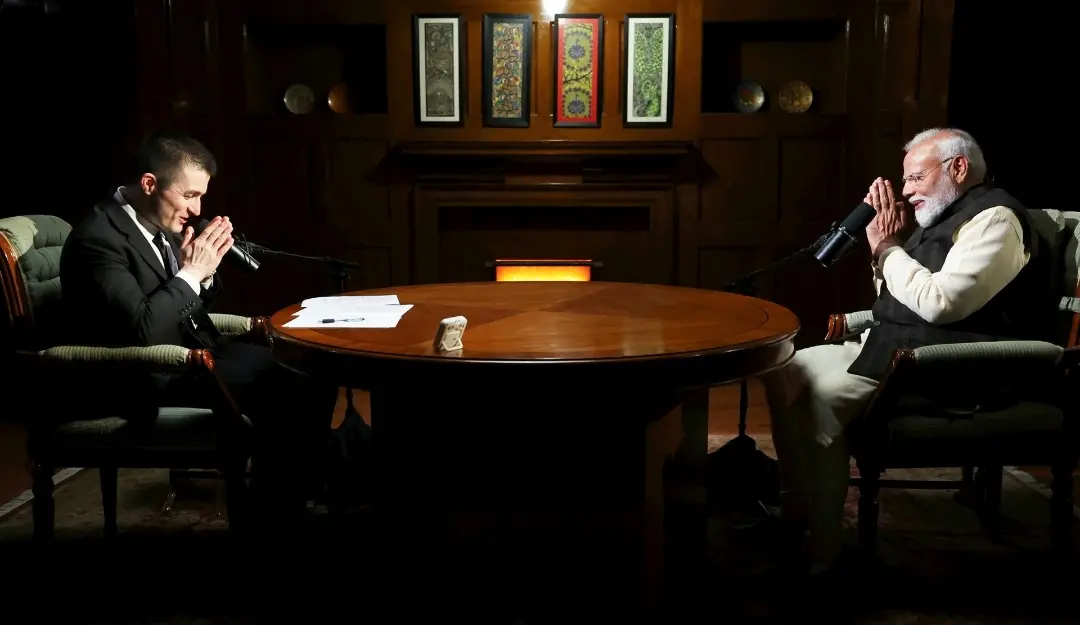
In his conversation with Lex Fridman, Narendra Modi carefully crafted a narrative that redefined history, repositioned India’s global role, and reinforced his image as a strong yet diplomatic leader. Through selective storytelling, he presented a version of India’s past and present that aligned with his political ideology, sidestepping contentious issues while amplifying cultural and civilisational themes.
Rewriting the RSS’s role: from ideology to service
One of the most notable aspects of Modi’s interview was his depiction of the Rashtriya Swayamsevak Sangh (RSS), the Hindu nationalist organisation with which he has long been associated. Instead of addressing the RSS’s controversial past, including its bans and allegations of religious extremism, he framed it as a service-driven organisation.
"Many initiatives are thriving. Like some volunteers established an organisation called Seva Bharati… To my knowledge, they run approximately 125,000 service projects without any government assistance, solely through community support," Modi said.
This portrayal completely omits the RSS’s well-documented history of stoking religious tensions, its ideological opposition to Mahatma Gandhi, and its influence on policies that critics argue marginalise India’s minorities. By linking the RSS to Swami Vivekananda and India’s Vedic traditions, Modi sought to mainstream the organisation’s image, detaching it from its political and ideological controversies.
Defining India as a cultural identity, not a nation-state
Modi also strategically shifted the idea of India from a modern political entity to an ancient civilisational force. While India’s political landscape has been shaped by its democratic institutions, diverse communities, and constitutional values, Modi placed its unity in cultural traditions rather than governance.
"India is a cultural identity. It is a civilization that dates back thousands of years… If you dig a little deeper, you will find a common thread," he said, citing religious customs and pilgrimage sites as unifying elements.
This framing aligns with the Hindutva narrative that prioritises India’s cultural and religious heritage over its pluralistic and secular foundations. It conveniently overlooks India’s deep-rooted social and political divisions, including regional disparities, caste dynamics, and religious tensions that continue to shape the nation.
Gandhi’s legacy, but on Modi’s terms
Despite his ideological roots in an organisation historically critical of Gandhi, Modi positioned himself as a follower of the Mahatma’s ideals. He praised Gandhi’s mass mobilisation tactics, presenting them as a model for his own governance.
"Mahatma Gandhi… told teachers their work was part of the freedom struggle… He made it happen," Modi said, drawing a parallel between Gandhi’s movement and his own initiatives.
However, Modi carefully avoided any mention of Nathuram Godse, Gandhi’s assassin, who was once affiliated with the RSS. This omission is significant given the growing attempts within sections of Modi’s support base to rehabilitate Godse’s image. By celebrating Gandhi’s ability to mobilise the masses while avoiding the ideological rift between Gandhi’s inclusive nationalism and the RSS’s Hindu nationalist agenda, Modi selectively reshaped history to suit his own narrative.
India and Pakistan: a one-sided story
Modi’s remarks on Pakistan reinforced a singular narrative of perpetual hostility, portraying India as the victim of Pakistani aggression without acknowledging any past diplomatic efforts.
"Wherever terror strikes in the world, the trail somehow leads to Pakistan... The world has recognized that terrorism and the terrorist mindset are deeply rooted in Pakistan," he asserted.
While terrorism remains a significant issue in India-Pakistan relations, this framing disregards past peace initiatives, including Vajpayee’s Lahore Declaration, the Agra Summit, and backchannel negotiations between the two countries. Modi’s refusal to acknowledge even the possibility of future reconciliation suggests a hardline stance that aligns with his domestic political base but limits the scope for meaningful diplomatic engagement.
A strong India, but at what cost?
Throughout the interview, Modi positioned himself as the architect of India’s rise on the global stage. He rejected the notion that India should be seen as subservient to any power, emphasising its new assertiveness in world affairs.
"India will neither allow itself to be looked down upon, nor will it ever look up to anyone. India will now see eye-to-eye with her counterparts," he stated, reinforcing his strongman image.
However, this narrative ignored India’s diplomatic setbacks, including strained relations with Canada, tensions with the European Union over democratic concerns, and questions about its balancing act between Russia and the West. By focusing only on India’s strengths while sidestepping its geopolitical challenges, Modi presented an incomplete picture of India’s global position.
Trump, Musk, and strategic friendships
The interview also provided Modi an opportunity to highlight his relationships with influential Western figures, particularly Donald Trump. He recalled an incident from their 2019 “Howdy Modi” event in Houston to emphasise Trump’s boldness and trust in him.
"His entire security detail was thrown off guard, but for me that moment was truly touching. It showed me that this man had courage… and trusted me," Modi recounted.
This anecdote served a dual purpose: reinforcing Modi’s ability to command respect from global leaders while subtly aligning himself with Trump’s brand of nationalist politics. Similarly, he spoke of his meetings with Elon Musk, JD Vance, and Vivek Ramaswamy, presenting them as strategic engagements rather than ideological alignments.
Modi as a peacemaker—without taking sides
One of the most revealing parts of the interview was Modi’s positioning of himself as a global mediator, particularly in the Ukraine-Russia war. He claimed a neutral stance, advocating for peace while maintaining close ties with both nations.
"I have a close relationship with Russia and Ukraine alike… The resolution will only come when both Ukraine and Russia come to the negotiating table," he said.
However, his remarks carefully avoided addressing India’s continued arms trade with Russia and its abstention from UN resolutions condemning Russian aggression. By portraying himself as a voice of reason while avoiding direct criticism of Russia, Modi navigated a diplomatic tightrope, ensuring India’s strategic interests remained intact.
A closing vision: India leading the world
Modi concluded the interview by reinforcing his vision of India as a guiding force for global unity and sustainability.
"We hosted the G20 Summit with the motto, One Earth, One Family, One Future. We have inherited this timeless wisdom, and it’s our duty to share it with the world," he stated.
This optimistic outlook left little room for acknowledging India’s internal divisions or foreign policy challenges. Instead, it reinforced a grand narrative in which India’s cultural and civilisational heritage positions it as a natural leader in world affairs.
The power of controlled storytelling
Narendra Modi’s interview with Lex Fridman was more than just a conversation—it was a carefully crafted exercise in narrative control. Through selective retelling of history, strategic omissions, and well-placed anecdotes, Modi reinforced his image as a leader who has redefined India’s place in the world. Ultimately, the interview showcased Modi’s mastery of political storytelling—rewriting the past, reframing the present, and reshaping the future, one conversation at a time.
- The RSS’s controversial past was replaced with a service-driven image.
- India’s unity was framed as cultural rather than political.
- Gandhi was celebrated, but his ideological conflict with the RSS was ignored.
- Pakistan was depicted solely as a terror state, with no mention of peace efforts.
- India’s global rise was highlighted, but diplomatic setbacks were omitted.
- Trump and Musk were mentioned as allies, without delving into their controversies.
- India was positioned as a peacemaker, without addressing its geopolitical balancing act.