Durga Puja 2026 in trouble? BJP’s Ganga soil crackdown leaves idol-makers worried
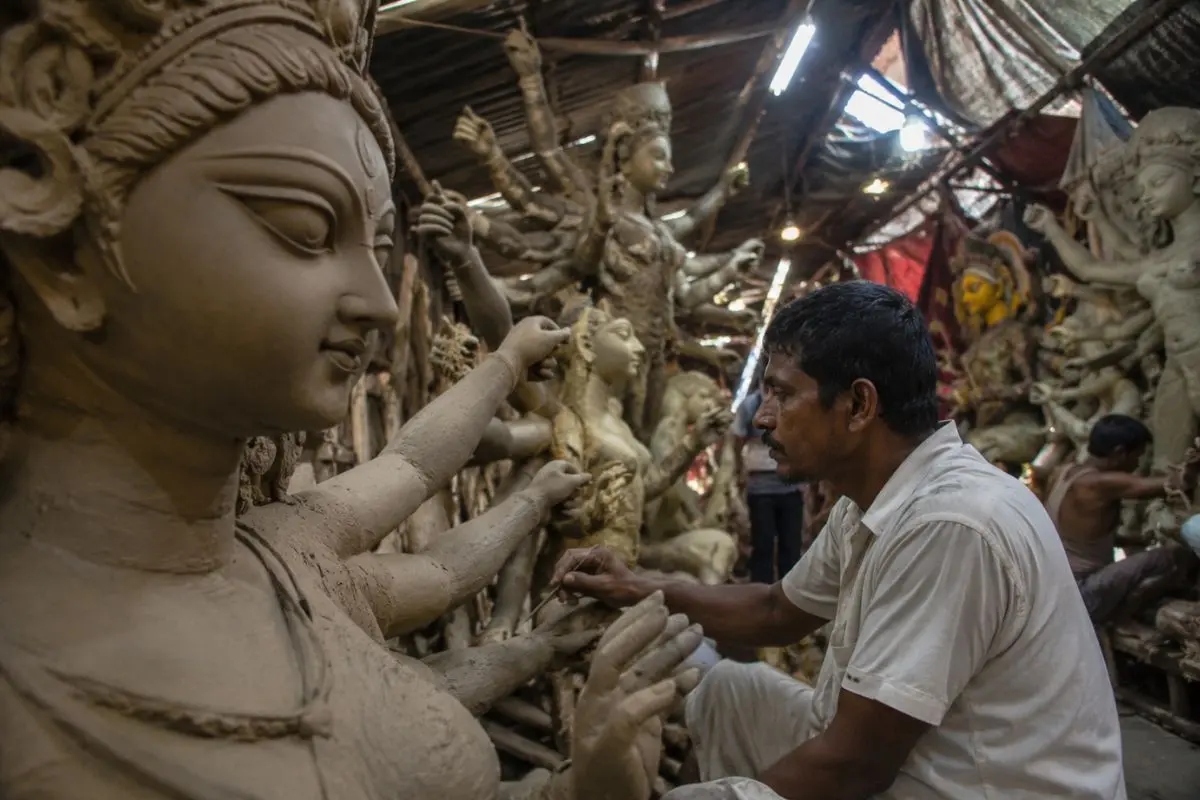
There are few sights in Bengal as reassuring as the first glimpse of a Durga idol taking shape in Kumartuli.
Every year, long before the sound of dhaaks fills the autumn air and before pandals begin to rise across cities and villages, the narrow lanes of Kolkata’s famed potters’ quarter come alive.
Bamboo frames are tied together, straw is layered carefully, and hands hardened by generations of craftsmanship mould clay into the familiar form of the goddess.
For Bengalis, Durga Puja is more than a festival. It is memory, identity and emotion rolled into one. It is the season of homecoming, when the goddess returns to her children and families reunite under the glow of festive lights.
However, this year, as preparations gather pace for Durga Puja 2026, a growing concern has cast a shadow over the celebrations.
The crisis is not about funding, weather or logistics. It is about something far more fundamental: Soil.
The clay that gives life to the goddess
Kumartuli, home to nearly 200 potter families operating from around 600 workshops, produces more than 4,000 idols every year.
Many of these idols travel far beyond Bengal, finding homes in puja celebrations across India and overseas.
Yet the artisans who create them say they are struggling to obtain a crucial ingredient: a special sticky black clay known as entel mati.
Traditionally sourced from the banks of the Ganga in areas such as Raichak, Jibantala and Diamond Harbour, this clay forms the foundation of Durga idol-making.
Revered by artisans as Ganga Mati, it is prized for its texture and binding quality, making it indispensable for crafting the intricate forms of the goddess and her family.
Idol-making typically begins soon after March. Artisans start with idols of Saraswati and Lakshmi before moving on to the elaborate Durga sets.
With barely four months left before the festival, many fear that continued disruption in the supply of clay could affect production schedules and increase costs.
A crackdown, a supply chain and growing concerns
The shortage has also acquired a political dimension. According to artisans and people associated with the trade, the problem stems from restrictions on digging soil from riverbanks.
The BJP government has enforced a ban on such extraction, arguing that illegal excavation and associated activities required stricter oversight.
Before coming to power, the BJP had frequently alleged that an illegal soil supply network operated under the protection of local Trinamool Congress-linked strongmen.
Since assuming office, the government has launched a broader crackdown on what it describes as unlawful activities, including unauthorised extraction from riverbanks.
While officials see the move as part of a larger effort to enforce regulations, artisans say the consequences are now being felt in Kumartuli.
Seeking intervention, a delegation led by Padma Shri awardee Sanatan Rudra Pal recently met BJP MLA Swapan Dasgupta.
After the meeting, Dasgupta appealed on social media for immediate government action and urged Chief Minister Suvendu Adhikari to address the issue.
‘The supply of the Ganga soil that is indispensable in the crafting of the Devi has abruptly stopped. Unless the supply is resumed immediately, the state will face a problem during the forthcoming Durga Puja,’ he wrote.
The Canal East Road Artisans Organisation has also submitted a letter to the chief minister, requesting a solution.
For now, the artisans of Kumartuli continue their work, shaping straw and clay with the same patience that has defined their craft for generations.
Yet beneath the rhythmic movement of their hands lies an uncertainty they rarely face.
After all, every Durga idol begins with a handful of earth. And when that earth becomes scarce, an entire tradition begins to worry.