Jammu and Kashmir elections: A vote for hope, identity and justice
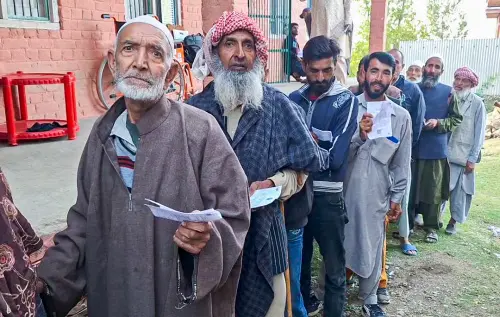
Jammu and Kashmir is often confined within the limits of defining external beauty with language that has lost its sheen due to overuse, and defining the public with descriptions of events. For decades, Kashmir’s history has been marked by either flowers or bullets. The burden of sharing borders with hostile neighbours, combined with the unhealed scars of the Partition era, weighs heavily on the people of Kashmir in ways that are unlike any other region.
Beyond that, the region is also defined by the history of oppression, alienation and rights violations. Elections have always been an experiment to determine whether they can become a democratic way for Kashmir to break out of these struggles and walk into the mainstream. Election results are a test of whether they can reflect the hopes and aspirations of a people. Assessing the impact of reforms introduced by governments as a solution to these issues also remains integral to these elections.
The just concluded Jammu and Kashmir elections are crucial not just because of usual political and non-political reasons, but also due to significant developments such as the first Legislative Assembly elections in ten years, the abrogation of Article 370, the potential restoration of state status, direct intervention by the Central Government through the Lieutenant Governor, the local desire for self-governance, the government's response to protests, and regional issues like unemployment. The themes of restoring peace, ensuring progress and development, and the slogan of "Naya Kashmir" (New Kashmir) have also shaped the electoral narrative.
The basis of the Jammu and Kashmir elections this time is thus defined by the quest to regain statehood and self-governance, along with the question of safeguarding identity and ensuring social justice.
The history and present of public mandate
The recently concluded election is notable as it was the first Legislative Assembly election to be held since the abrogation of Article 370, which provided special status to Jammu and Kashmir, and is also being held after a gap of ten years, with the last one in 2014. Since 2018, Jammu and Kashmir has been under Lieutenant Governor's rule. The Assembly election is happening in the backdrop of the political and governance measures taken by the central government since the abrogation of Article 370 on August 5, 2019. Evaluating these political and administrative decisions by putting them to the people's vote makes this election a vast lesson for national politics. The fact that the elections are taking place in a region with troubled relations with two countries with whom India shares borders is significant for international politics as well.
Chief Election Commissioner Rajiv Kumar characterised the election process as "the victory of the ballot over the bullet and the boycott”, recognising the peaceful conduct of elections, which is a departure from the history of violence, terrorism and boycott calls.
Although the Supreme Court has ordered the completion of Legislative Assembly elections by September 30, 2024, the main mission of this public mandate is to bring back democracy through an elected government. The last Assembly election in Jammu and Kashmir was held in December 2014. Since no party gained an outright majority, Governor's Rule was imposed on December 28. However, negotiations began to form a government between the People's Democratic Party (PDP) and the Bharatiya Janata Party (BJP), which continued for two months. Eventually, the two parties formed a coalition government based on a common minimum programme, and in March 2015, PDP leader Mufti Mohammad Sayeed was sworn in as Chief Minister.
After Mufti's death in January 2016, the PDP-BJP coalition that was ideologically divergent struggled to continue in power. Governor's Rule was again imposed, but a meeting between Mehbooba Mufti and Prime Minister Narendra Modi in Delhi led to a consensus on continuing the coalition. On April 4, Mehbooba became the first woman Chief Minister of Jammu, and the BJP took the position of Deputy Chief Minister.
However, the coalition and the governance were far from smooth. Regional political issues created grounds for conflict, and on June 19, 2018, the BJP decided to pull out of the coalition, leading to the collapse of the government. Governor's Rule was reinstated, and it continues to date.
In 2019, the Central Government revoked Article 370, which granted special status to Jammu and Kashmir. The state was restructured into two Union Territories, which led to opposition in the local political landscape. The BJP and regional parties remain divided over this decision. While the BJP claims that it was a move to enhance development and security, the Opposition accuses them of employing divisive politics. The upcoming Legislative Assembly election is expected to determine the direction of this ideological dispute.
On Article 370
It is natural that Article 370 has emerged as a topic of discussion in the Legislative Assembly election. The politics of both the revocation of the Article and the opposing of it have become prominent in campaign platforms. While the National Conference and its allies claim they will restore Article 370, the BJP and the Central Government insist that the Article is now a part of history. The primary criticism from Opposition leaders is that revoking Article 370 was unjust to Jammu and Kashmir, and that reducing its status from a state to Union Territories was degrading. While the BJP and the Central Government claim that controlling the protests after the Article's abrogation brought peace, they also argue that this move brought development to the region.
At the same time, there are two differing discussions in Kashmir’s academic community about whether the abrogation of the Article is still the main issue in the election. While protests against the abrogation have been subdued on the surface, one argument is that the sentiment still simmers within the Kashmiri society and that these emotions will translate into votes.
"People are watching everything in silence. In the current situation post-abrogation, people are being restrained in expressing their emotions. It is likely that they will come out in large numbers and cast their votes against these systems in silence," says senior Kashmiri journalist Jaleel Firdausi.
However, Professor Aslam, a retired academic from Kashmir University and political observer, has a different opinion: "I don't think Article 370 is the main issue now. The main thing is that elections are happening here after ten years. I don’t think any political party is considering the Article a primary election issue, especially since Parliament revoked it and the Supreme Court upheld the decision. Parties might be discussing it here and there, but the people are not discussing it."
Meanwhile, both sides agree on the importance of having a locally elected government in Jammu and Kashmir. "None of the current administrative officials since the abrogation are from Kashmir. They do not understand the needs or sentiments of the Kashmiri people. They were brought in from outside. People are disappointed with this. The large voter turnout is a silent vote against these systems," Jaleel Firdausi points out, suggesting this is the meaning of high polling.
Professor Aslam also points out that the real issue is the non-political administration in place. "That’s what has been happening since 2019. The people are eager to see if this administrative setup will change. They hope that their elected representatives will win and form a government," he said.
Nevertheless, many political observers are not ready to claim that separatist sentiments have been extinguished. The streets are now seeing large crowds for the first time since 2019. The slogans appear similar to those of separatists, with some words or expressions altered. However, the mood remains the same, they observe. They also point out that militant forms of protest, such as stone-pelting, have decreased.
“In addition to the strong intervention by the administration, changes in the attitudes of parents and the general public have also contributed to this. People stopped stone-pelting and protest marches. Article 370 has helped in this regard, but more importantly, people themselves realised that nothing could be achieved through stone-pelting. This change in mindset reached parents and society, leading to peace,” Professor Aslam concludes.
Is the wind favouring NC?
Jammu and Kashmir is contesting for 90 seats in the Assembly elections, increased from the previous 87 seats as per the delimitation exercise conducted in 2022. There are 47 seats in the Kashmir valley and 43 in Jammu. Historically, Jammu and Kashmir has seen different political leanings based on political history and religious composition. The BJP has had an upper hand in Jammu, while the National Conference (NC) and the PDP have dominated Kashmir.
The evaluation that the abrogation of Article 370 and the actions taken to control protests served as an impetus for silent votes is seen as favourable for the Indian National Developmental Inclusive Alliance (INDIA), led by the NC in Kashmir. The INDIA bloc comprises NC, Congress, CPM and the Panthers Party. Among these, only the NC has organisational strength and cadre power in Kashmir. The NC has entered the election arena, having prepared its organisational setup for elections after a gap of ten years. However, there is concern about possible cracks within the alliance in some places. From the beginning, the NC has been leading the campaign in Kashmir.
The PDP, which is contesting outside the INDIA bloc, is making significant efforts to regain its secular image, which suffered due to the alliance it formed with the BJP in 2014. However, these efforts have not been very successful, and people remain suspicious that the PDP may switch sides depending on the election results. Nevertheless, the PDP is expected to use this election as an opportunity to regain its secular credentials. PDP leadership has felt that the alliance with the BJP politically exhausted them. However, the history of the BJP alliance is a liability for the NC also.
The BJP, on the other hand, is calculating to make gains again in Jammu, where Hindu vote banks are deeply rooted. In 2014, the BJP won 25 seats from Jammu. The party has made several maneuvers based on caste dynamics in Jammu with such gains in mind. The Central Government's move to announce a 10 per cent job reservation for Pahari groups, as well as the Gaddi, Brahmin, Koli and Paddari communities, is part of this strategy.
The BJP hopes to gain power by increasing the number of seats in Jammu and securing the support of independents from the Kashmir Valley. However, the party also faces challenges, such as group rivalries, dissenters and internal issues, which could prove exhausting in Jammu.
Small parties and Independents to play crucial role
With the PDP keeping its position uncertain, the unexpected emergence of hundreds of Independent candidates has complicated the electoral landscape in Kashmir. Out of a total of 873 candidates, 365 are independents. This is the second time in Jammu and Kashmir's election history that so many independents have emerged.
In 2008, there were 408 Independent candidates, prompted by protests related to the Amarnath land dispute. This time, the high number of Independents comes after controversies surrounding Article 370. Among the candidates are individuals with regional influence, some who were formerly linked to separatism and even those currently in jail.
The Opposition accuses the BJP of deploying these Independent candidates to split the INDIA bloc’s votes. The BJP, which contests all the seats in Jammu where it has deep influence, is only contesting 19 seats in Kashmir, where it lacks influence. In the remaining seats, the party has decided to support Independent candidates. The NC accuses the BJP of secretly backing these Independents to execute this strategy. The temporary bail of Awami Ittehad Party leader and Lok Sabha member Engineer Rashid has also raised suspicions and sparked discussions.
Engineer Rashid, Sarjan Barkati, Sajjad Lone and other former separatist leaders are actively contesting in the elections. Many of them are candidates.
Former chief minister Omar Abdullah has accused the BJP of targeting the NC through these moves. However, the BJP denies any connection with such parties or leaders. Regardless, these Independents are likely to play a crucial role in determining the political direction of Kashmir this time.
In any case, the real drama in Jammu and Kashmir is likely to unfold after the results are announced, rather than before or during the elections. The complexities of the inner and outer winds of the Valley are also a pointer towards the future of Jammu and Kashmir.