From microgravity research to space tourism: ISRO unveils Bharatiya Antariksh Station Model
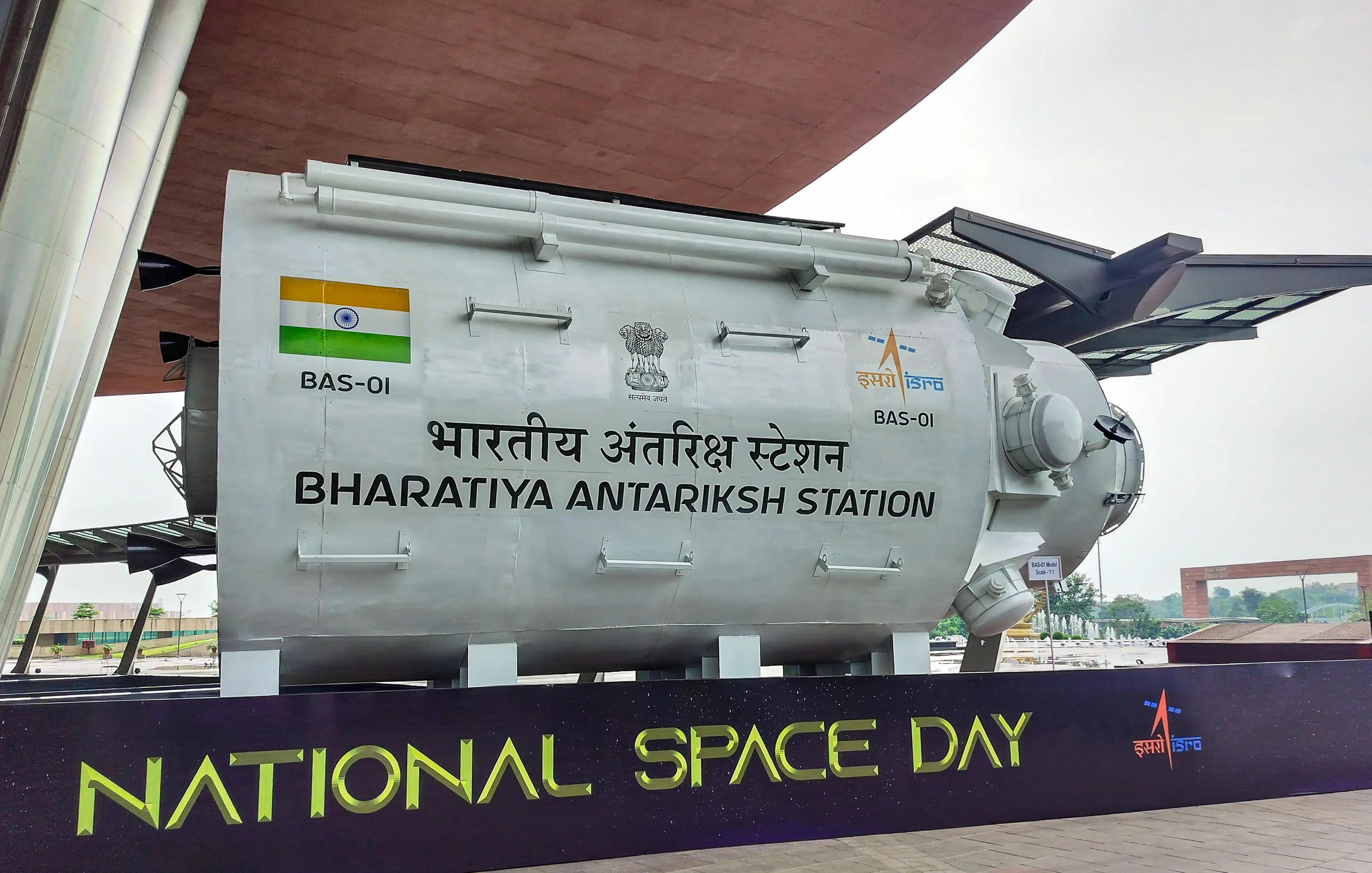
New Delhi: Taking a major step towards building its own orbital laboratory, the Indian Space Research Organisation (ISRO) on Friday unveiled a model of the Bharatiya Antariksh Station (BAS) at the National Space Day celebrations in Bharat Mandapam, New Delhi.
The reveal marks the beginning of India’s ambitious plan to join the exclusive club of nations with operational space stations.
What is the Bharatiya Antariksh Station?
The BAS is India’s upcoming space station, expected to house five modules by 2035. The first module, BAS-01, is slated for launch in 2028, weighing around 10 tonnes and orbiting at 450 km above Earth.
Currently, only two orbital laboratories exist: the International Space Station (ISS) and China’s Tiangong station. With BAS, India aims to become the third nation with an independent orbital lab.
What will BAS feature?
The BAS comes packed with indigenous systems and futuristic design:
- Environmental Control and Life Support System (ECLSS)
- Bharat Docking System & Bharat Berthing Mechanism
- Automated hatch system
- Platforms for microgravity research & technology demonstrations
- Viewports for scientific imaging and even crew recreation
- Airlocks and space suits for spacewalks
- Protection against radiation, thermal stress, and orbital debris (MMOD)
- Provision for propulsion refills and ECLSS fluids
The orbital lab will act as a platform for:
- Studying the impact of microgravity on human health
- Advancing life sciences, medicine, and interplanetary exploration
- Testing technologies for long-term human presence in space
It will also serve as a hub for global collaborations, hosting international research and experiments.
Will BAS support Space Tourism?
Yes. ISRO envisions space tourism as part of BAS operations. By commercialising access to the orbital lab, India plans to open doors to private enterprises and international partnerships, boosting the space economy.
Beyond science and commerce, the BAS project carries symbolic weight, showcasing India’s rise as a space power.