Supreme Court hints at easing Diwali celebration restrictions in Delhi-NCR: Why focus is on green crackers
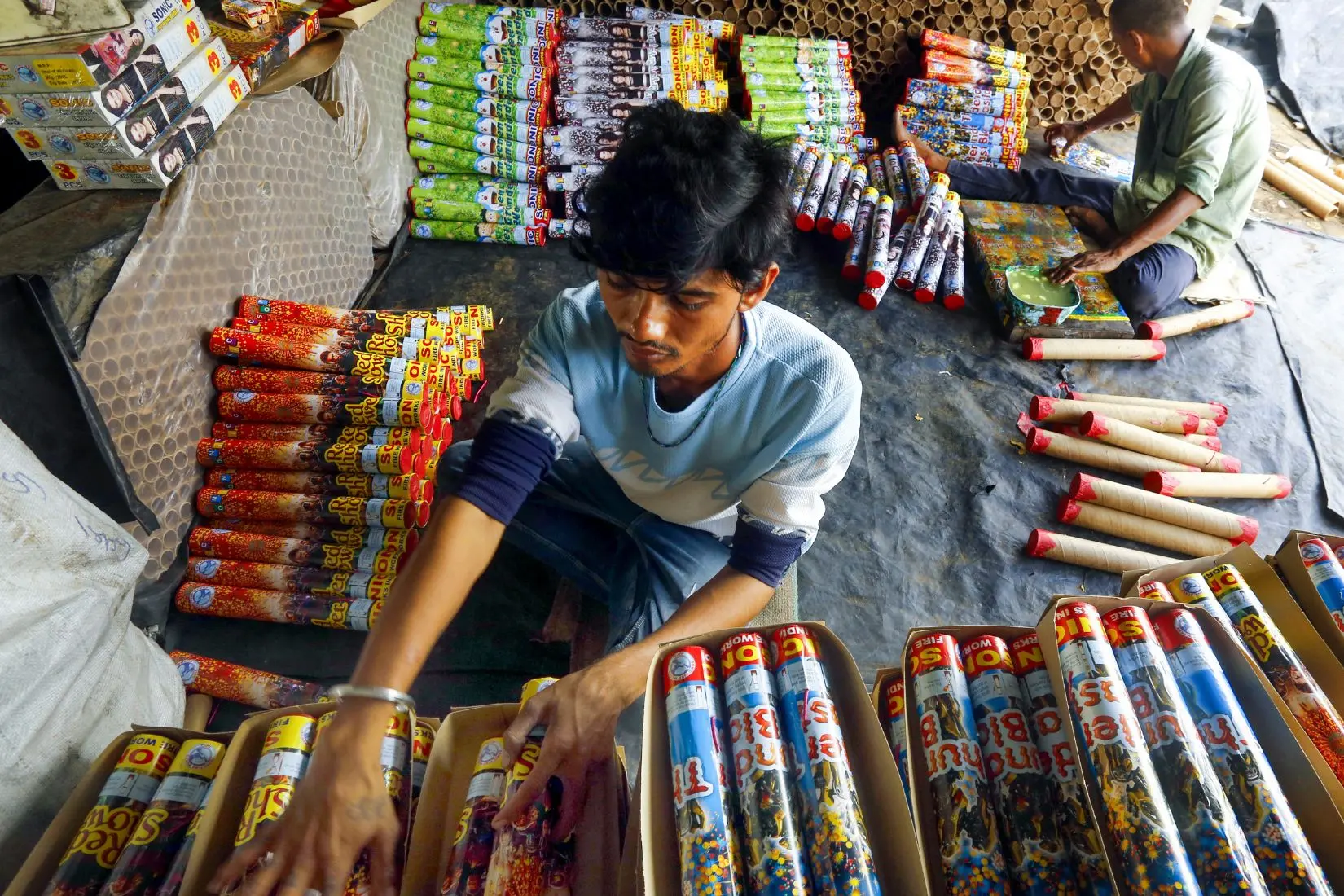
Just days before Diwali, the Supreme Court hinted that a complete ban on firecrackers in Delhi-NCR might be reconsidered. The bench, headed by Chief Justice B R Gavai and Justice K Vinod Chandran, remarked that a total ban was neither practical nor ideal, given that such restrictions were often violated in the past.
The court’s observation came while hearing petitions seeking permission to manufacture and sell eco-friendly “green” firecrackers in the capital region. These remarks, viewed as favourable towards relaxing the ban, have stirred both relief and concern across Delhi.
What did the Centre argue?
Solicitor General Tushar Mehta, representing the Centre and NCR states, strongly pushed for easing restrictions, saying citizens — especially children — should be allowed to celebrate festivals like Diwali, Gurpurab and Christmas without strict time limits. He said that despite years of prohibition, data from the Commission for Air Quality Management (CAQM) showed pollution levels remained largely unchanged since 2018, except during the COVID-19 lockdown when all activities had stopped.
The Centre urged the court to strike a balance between the right to livelihood and the right to celebrate festivals. It proposed that only certified “green crackers,” approved by the National Environmental Engineering Research Institute (NEERI) and the Petroleum and Explosives Safety Organisation (PESO), be manufactured and sold under strict monitoring.
How will green crackers be regulated?
Under the Centre’s proposal, the sale of firecrackers would be limited to licensed vendors. Online sales would be prohibited, and only those products carrying NEERI and PESO certification would be allowed. Officials from both organisations would carry out periodic inspections to ensure compliance, and any manufacturer found violating norms would face immediate action, including closure of their units.
The green crackers, developed by the Council of Scientific and Industrial Research (CSIR) and NEERI, are designed to emit fewer pollutants by reducing the size of the shell, cutting down raw material use, and adding dust suppressants. They can be identified through the CSIR-NEERI green logo and encrypted QR code on each packet.
What are the court’s main concerns?
The Chief Justice questioned whether the long-standing ban had actually improved Delhi’s air quality. He also asked why the restrictions applied only to parts of Haryana and certain NCR districts rather than to the entire state. The bench observed that despite the ban, firecrackers continued to be used widely, suggesting that extreme restrictions often led to non-compliance.
While reserving its order, the court made it clear that it sought a balanced approach — one that safeguarded both environmental interests and livelihoods dependent on the firecracker industry.
Why are environmentalists and residents worried?
Hindustan Times reported that experts and citizens across Delhi have expressed concern over the development. They argue easing the ban could worsen the city’s already toxic air. Environmentalists say that the term “green” does not mean “pollution-free.” Scientists have pointed out that these crackers still emit fine particles and gases, only in slightly reduced quantities.
The report quoted Chetan Sharma, a residents’ welfare association leader from Greater Kailash. He said that allowing even green crackers just before winter, when Delhi’s air quality plummets, could be reckless. He urged strict action to prevent fake or duplicate crackers being sold as certified ones, warning that many unlicensed sellers have already begun using cloned QR codes.
Activist Bhavreen Kandhari highlighted that while NEERI’s data shows a 30 per cent reduction in emissions, pollution during Diwali rises by as much as 800 to 1500 per cent above World Health Organisation limits. She noted that such reductions make little difference when the city’s air quality is already at crisis levels.
What lies ahead for Delhi?
The Supreme Court had earlier, on September 26, permitted certified manufacturers to produce green crackers under certain conditions. Now, with the bench signalling that it might lift the absolute ban “for the time being,” Delhi could witness legal fireworks this Diwali for the first time in years.
However, experts caution that the infrastructure to test or verify whether firecrackers sold in Delhi are genuinely eco-friendly is not yet in place. Without proper inspection and certification systems, enforcement could remain weak, allowing non-compliant products to flood the market.
For many Delhiites, the court’s favourable stand has created mixed emotions — optimism for those awaiting festive celebrations and deep concern among those fearing a repeat of the choking post-Diwali smog that blankets the capital each winter.