India’s AMCA: Soaring toward stealth supremacy in a high-stakes race
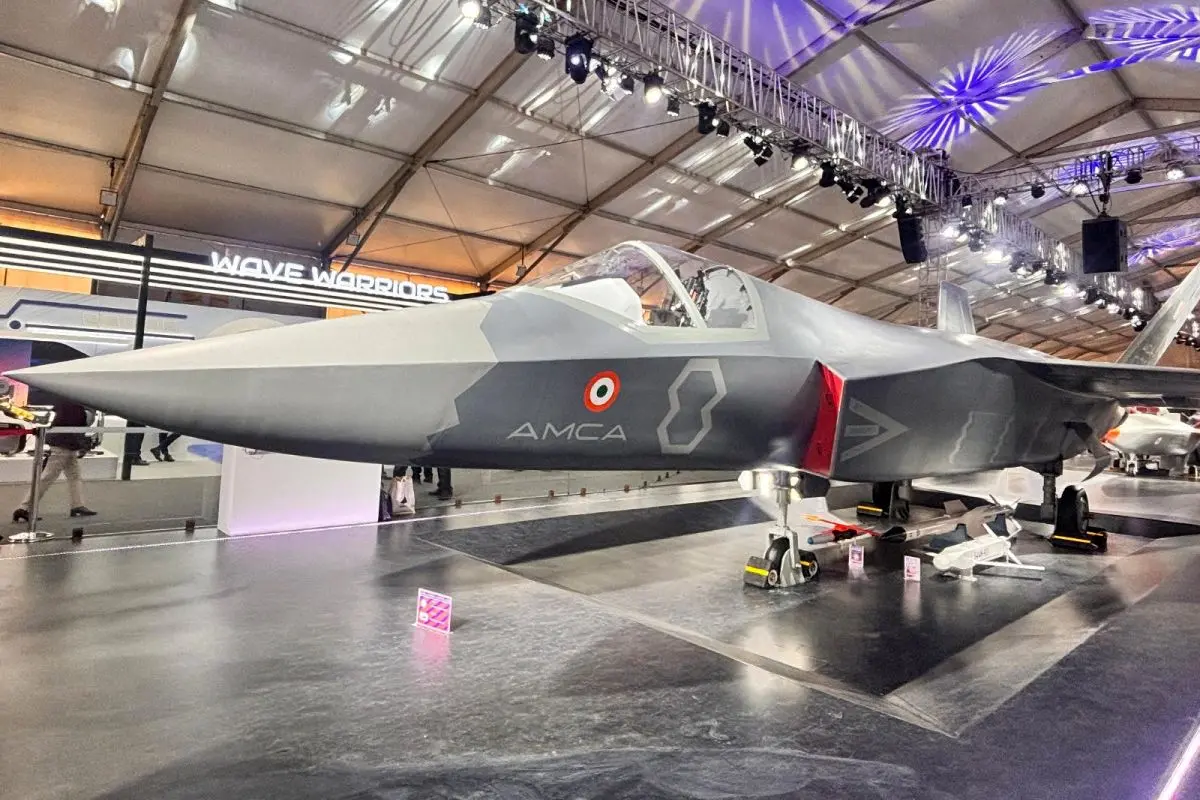
On March 7, 2024, India’s Cabinet Committee on Security approved the country’s plan to develop its first fifth-generation stealth fighter jet, called the Advanced Medium Combat Aircraft (AMCA). Later, on May 27, 2025, Defence Minister Rajnath Singh approved how the project would be carried out, allowing full development to begin. During the Aero India 2025 air show held in Bengaluru, India displayed a full-size model of the AMCA for the first time. This model showed off its sleek design and stealth features. This event shows how serious India is about becoming one of the few countries that can build very advanced fighter jets.
The AMCA is being developed by the Defence Research and Development Organisation (DRDO) and the Aeronautical Development Agency (ADA). The full project will cost about ₹15,000 crore. This jet, built in India, will be used for deep attacks, high-level air battles, and flying in all weather conditions. It will be an important part of the Indian Air Force’s (IAF) future strength.
Joining the elite club
If India completes the AMCA successfully, it will become the fourth country in the world to use fifth-generation stealth fighter jets—after the United States (F-22 and F-35), China (J-20), and Russia (Su-57). This would be a big step forward for India’s defence strength and prove that it is among the top nations in building modern fighter aircraft.
AMCA’s capabilities and design
The AMCA will be a single-seat jet with two engines. It will be medium-sized and will be able to take off with a total weight of about 25 to 27 tonnes. It can fly at heights up to 55,000 feet and carry 6,500 kg of fuel, which will help it fly long distances. Some of its special features include:
- Stealth from all directions: It can avoid being seen by enemy radar because of its shape and design, like S-shaped air intakes and a body that reflects very little radar.
- Internal weapons storage: It can carry 1,500 kg of weapons inside its body. This includes Indian missiles like Astra and precision bombs, which help keep it hidden from radar.
- Extra external weapons: It can also carry another 5,500 kg of weapons on the outside when stealth is not needed.
- Supercruise: It can fly faster than the speed of sound without using extra fuel boosters, which saves fuel and helps remain stealthy.
- Modern sensors and data systems: It can collect and show real-time data from the battlefield to give the pilot better awareness.
- Artificial Intelligence (AI): It will have smart systems that help make decisions quickly, like an “electronic co-pilot.” It can also work smoothly with unmanned drones.
- AESA radar: This radar can track and target enemies from far away.
- Integrated Vehicle Health Management (IVHM): This system helps predict problems early so the aircraft can be repaired in time and stay ready for action.
The first version (Mk-1) will use General Electric’s F414 engines. These engines will be built in India through a partnership with Hindustan Aeronautics Limited (HAL). The next version (Mk-2) will have a stronger Indian-made engine, which could be built by foreign companies like Safran (France) or Rolls-Royce (UK). Both companies are willing to share all the design rights. As of October 2024, Safran is leading the talks.
Production strategy and private sector push
To speed up work and avoid delays like in the Tejas jet program, the Defence Ministry is using a public-private partnership (PPP) model. HAL will lead production but will work alongside private companies in a Special Purpose Vehicle (SPV). On June 18, 2025, ADA invited Indian companies to show interest in building, testing, and approving the prototypes. So far, 24 companies are being considered. This method is new and is meant to encourage faster work and better quality, moving away from HAL doing everything alone.
The AMCA project will have two production lines—one by the government and one by a private company. This will help build jets faster and on time. Each of the five prototypes will cost ₹1,000 crore and will be tested thoroughly before starting large-scale production.
Deployment timeline
As explained by Krishna Rajendra Neeli, the Project Director at ADA, the AMCA program will follow a 10-year plan:
- Prototype Rollout: Late 2026 to early 2027
- First Flight: 2028
- Final Testing and Certification: 2032
- Official Induction into the IAF: 2034
- Start of Full Production: 2035
At first, the IAF will bring in two squadrons (around 40 aircraft), but the long-term plan is to add more than 200 AMCA jets. There is also a plan for a naval version to be used on aircraft carriers. The Indian Navy wants to buy about 45 such jets to replace its old MiG-29K fighters.
Why the AMCA is urgently needed
India needs the AMCA quickly because of rising security threats, especially from China. China already uses the J-20 stealth jet and, as of May 2024, had deployed six J-20s just 150 km from India’s border in Sikkim. There are also fears that China might give Pakistan 40 J-35 stealth jets. These J-35 jets are being made for aircraft carriers and are hard to detect on radar. If Pakistan gets them, its air force will become much stronger.
This is not the first time China has shown off its stealth power near India. In August 2020, two J-20 jets were seen at the Hotan airbase in Xinjiang, which is just 320 km from Aksai Chin—the nearest Chinese base to this disputed area. China already has over 1,300 fourth-generation fighter jets and more than 200 J-20s as of late 2023. A recent report to the US Congress also mentioned this as a big concern.
The AMCA’s stealth, fast flying without boosters, and AI systems are meant to face such threats and keep India’s airspace safe. It will also be able to work with drones and use future weapons like laser beams, making it ready for tomorrow’s battles.
Latest developments
During the Aero India 2025 show in February 2025, the AMCA program gained more speed. The full-size display showed its inside weapons storage and Indian-made weapons like the Astra missile, TARA 250 glide bomb, and Smart Anti-Airfield Weapon. The design part of the project, including an important review, was completed by December 2023. A key part, the diverterless supersonic intake, was also tested and passed.
India’s international partnerships have also moved forward. In September 2024, the US allowed GE Aerospace and HAL to make F414 engines in India. These engines will be used for the AMCA Mk-1 and the Tejas Mk-2. At the same time, talks are ongoing with Safran and Rolls-Royce for building the Mk-2 engine, with Safran currently in the lead. These partnerships aim to make India more self-reliant and less dependent on foreign defence supplies.
A top-level team led by Defence Secretary Rajesh Kumar Singh is working on a plan to make the AMCA’s development and production smoother. The team includes IAF Vice-Chief Air Marshal S. P. Dharkar and other senior officers. They are expected to submit their final plan by August 2025. The focus is to speed things up and solve engine-related delays so that the project stays on track.
Conclusion: India’s stealth push takes off
The AMCA is a major step for India to become stronger in modern air combat. It is not just about building a jet—it is about building a future-ready air force. With rising threats from China and the need to reduce foreign dependence, AMCA is India’s big move towards becoming a top power in the skies. By 2035, when the AMCA is flying, it will increase India’s air strength and prove that India is among the world’s best in making advanced fighter jets.
(Girish Linganna is an award-winning science communicator and a Defence, Aerospace & Geopolitical Analyst. He is the Managing Director of ADD Engineering Components India Pvt. Ltd., a subsidiary of ADD Engineering GmbH, Germany. Contact: girishlinganna@gmail.com )