India to soon unveil Sustainable Aviation Fuel policy: Civil Aviation Minister
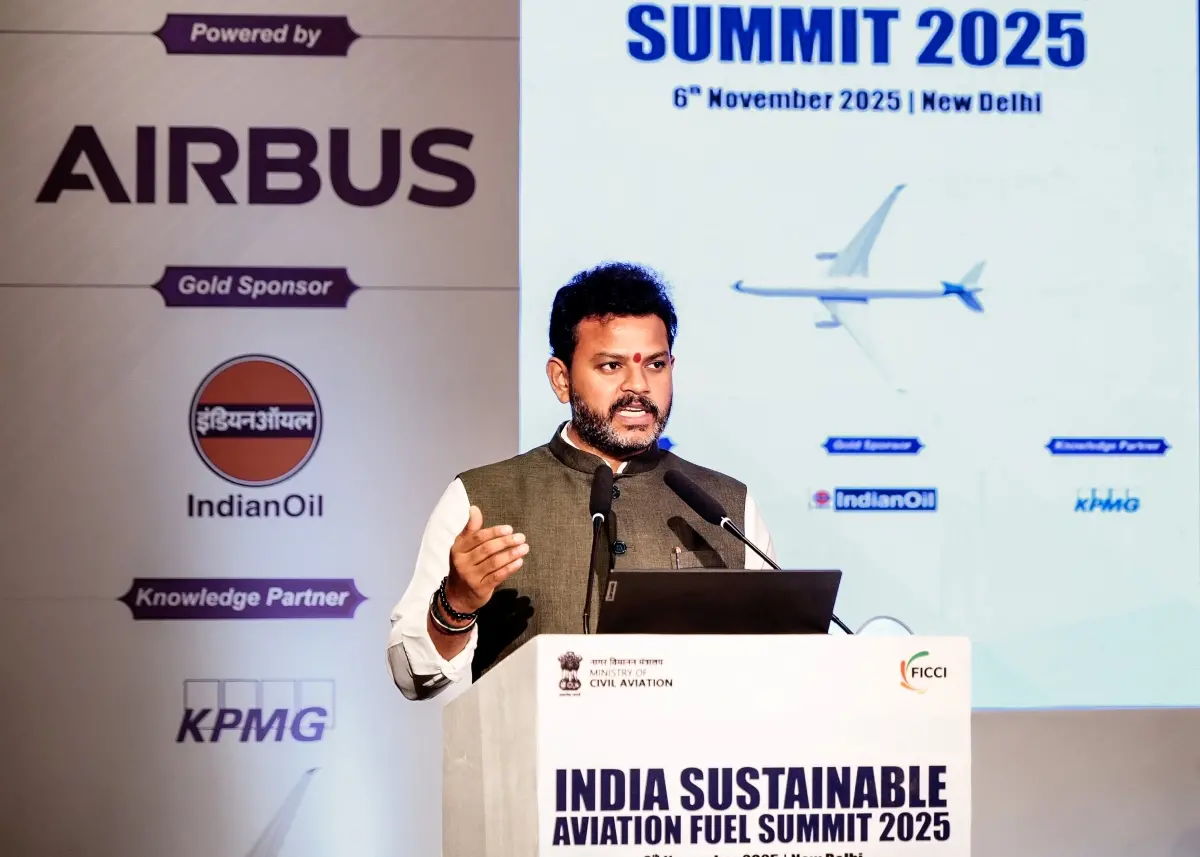
India will soon introduce a Sustainable Aviation Fuel (SAF) Policy to promote cleaner air travel and reduce the aviation sector’s carbon footprint, Civil Aviation Minister Ram Mohan Naidu Kinjarapu announced on Thursday.
Speaking at the India Sustainable Aviation Fuel Summit, organised by FICCI in collaboration with the Ministry of Civil Aviation, the minister said the government is in the final stages of drafting the policy, which will outline clear guidelines for the use and production of SAF in India.
“The Ministry is drafting the SAF Policy and will release it soon. As an agricultural powerhouse with over 750 million tonnes of biomass, India has the potential to become a global leader in SAF production,” Kinjarapu said. He added that widespread adoption of SAF could help India reduce crude oil imports by USD 5–7 billion annually and create up to one million green jobs.
Highlighting the environmental benefits, he noted that sustainable aviation fuel can reduce carbon dioxide emissions by up to 80 percent compared to conventional jet fuels. “The aviation industry stands at a crossroads between rapid growth and climate concerns. The solution lies in sustainable aviation fuel,” the minister said.
Kinjarapu pointed out that India’s aviation turbine fuel (ATF) consumption is projected to reach 15–16 million tonnes by 2030 and 30–31 million tonnes by 2040, calling for urgent action to make flying greener.
India’s aviation sector, one of the fastest-growing in the world, continues to expand at an annual rate of 6.7 per cent, driven by strong passenger demand. The minister noted that nearly 10 million passenger trips are expected in 2025, underlining the need for sustainable growth.
Over the past nine years, India has added 90 new airports and 400 aircraft, with plans to add 50 more airports in the next five years and 200 over the next two decades. Passenger numbers are projected to reach 500 million annually within the next decade, Kinjarapu said, adding that the government’s focus remains on balancing growth with sustainability.
Director General of Civil Aviation (DGCA), Faiz Ahmed Kidwai, also addressed the summit, saying India aims to achieve a 5% SAF blending target by 2030. “This is not just a target but a declaration of intent to lead by example,” he said.
Jurgen Westermeier, Chairman of the FICCI Civil Aviation Committee and President & MD of Airbus India & South Asia, called SAF a “transformative opportunity” for India that can enhance both energy security and fuel sovereignty.
Ashish Saraf, Co-Chairman of the FICCI Civil Aviation Committee and Vice President & Country Head (India), Pratt & Whitney, described SAF as the “cornerstone of India’s Net Zero aviation story”, capable of cutting emissions by up to two-thirds and helping India become a global export hub for green fuels.
During the summit, FICCI and KPMG also released a Thought Leadership Report on Sustainable Aviation, highlighting pathways for policy, production, and partnership to accelerate SAF adoption in India.