'Pakistan's terrorism will have consequences': India responds to PM Sharif's UN speech
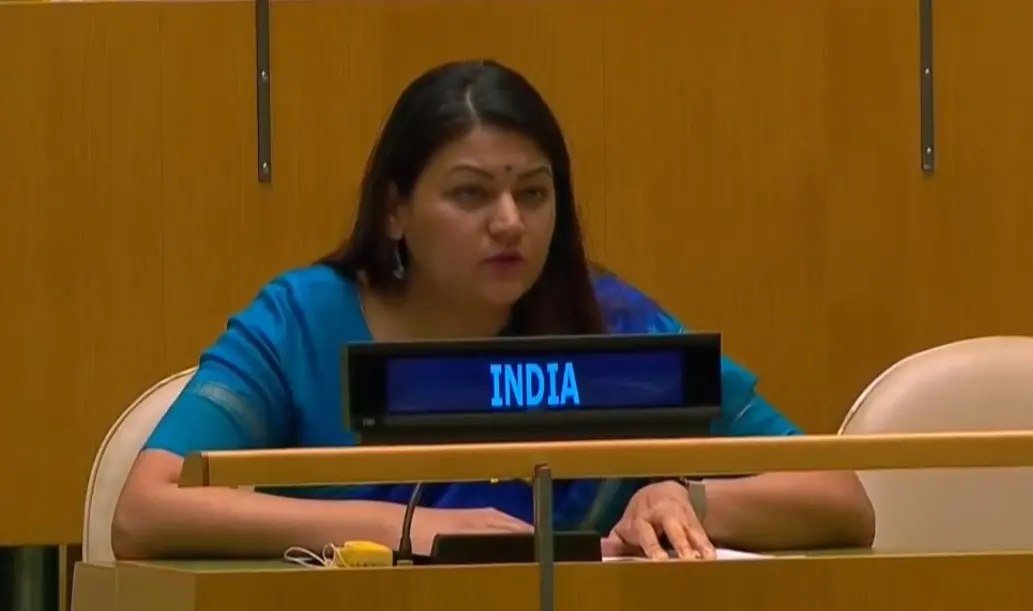
New York: India has strongly criticised Pakistan over its references to terrorism, Kashmir and the Indus Waters Treaty at the United Nations General Assembly, with Indian diplomat Petal Gahlot asserting that Islamabad's support for cross-border terrorism would have consequences.
Responding to Pakistan Prime Minister Shehbaz Sharif's remarks at the UN General Assembly, First Secretary in India's Permanent Mission to the UN Petal Gahlot said Islamabad's repeated allegations against New Delhi would not change the facts.
"We heard some hypocritical homilies about democratic rights and human values from a regime whose capital at this very moment is being fortified against its own people. And that…is happening because this is a regime of the army, by the army, and for the army. Their puppets may come and go, but let us have no illusion who calls the shots. The reality of Pakistan is expressed in its 27th Amendment and the lifelong immunity granted to its real ruler," Gahlot said.
She was referring to the 27th Constitutional Amendment passed in November last year by the Shehbaz Sharif government, which grants Pakistan's Chief of Defence Forces and Chief of the Army Staff Field Marshal Asim Munir, lifelong immunity from any legal prosecution.
"We are confident that this Assembly will recognise Pakistan and its policies for what they really are; not what its representative mendaciously projects it to be. Reiterating falsehoods year after year does not make them true. Pakistan's terrorism, deceit and duplicity will neither benefit it nor the world," she said.
In his address, Sharif had thanked Trump for his "resolute and visionary leadership", saying that the American leader's "timely intervention" saved hundreds of millions of lives in South Asia.
In his about 23-minute address, Sharif also raised the issue of Kashmir, saying that to ensure South Asia never reaches that precipice of the conflict of 2025 again, a just and fair solution to the Kashmir issue is required.
India reminded the UN General Assembly that Sharif's "bizarre remarks" came just a fortnight after New York City and the world marked the 25th anniversary of the horrendous 9/11 terrorist attack.
"This context…is important to keep in mind because its mastermind, Osama Bin Laden, was living right on the doorstep of the Pakistani Army's premier academy," Gahlot said.
Slamming Sharif for raising the Kashmir issue in his address, Gahlot said the Indian Union Territory of Jammu and Kashmir is an integral and inalienable part of the country.
"And will always remain so. But if we must talk about Kashmir, let us turn our attention to the Pakistan-occupied Jammu and Kashmir. Ask the people of Rawalakot about the wanton killings, the brutal violence and the denial of basic rights that they have long experienced," she added.
Her remarks came after Sharif addressed the UN General Assembly, speaking about the May 2025 India-Pakistan conflict, the Indus Waters Treaty and the Kashmir issue.
Sharif credits Trump for preventing escalation
Sharif described Pakistan's response during the May 2025 conflict as a success and credited US President Donald Trump with helping prevent further escalation between the two nuclear-armed neighbours.
"His timely intervention came at a decisive juncture when two nuclear-armed neighbours stood at the brink of an all-out war. And, who knows, Mr President, the extent of devastation that could have taken place had President Trump not stepped in at this critical moment with clarity of thought and action," Sharif said.
He added, "Mr President, we must therefore ensure that South Asia never reaches that precipice ever again."
During Sharif's address, Indian diplomat R Srinivas was seen laughing when the Pakistan Prime Minister referred to Islamabad's claimed "victory" in the conflict.
India launched Operation Sindoor on May 7, 2025, targeting terror infrastructure in Pakistan and Pakistan-occupied Kashmir following the April 22 Pahalgam terror attack that killed 26 civilians.
India has maintained that the operation was aimed at dismantling terrorist infrastructure and that its response was guided by strategic restraint.
Trump has repeatedly claimed that he played a role in stopping the India-Pakistan conflict, including during his address to the UN General Assembly this week.
New Delhi, however, has consistently maintained that the ceasefire was reached through direct communication between the two countries and that no third-party intervention was involved.
Sharif challenges India's decision on Indus Waters Treaty
Sharif also criticised India's decision to place the Indus Waters Treaty in abeyance, arguing that the move had no legal basis and warning against any disruption to Pakistan's share of the river waters.
"The shared waters of the Indus River system are the lifeblood not only for the people of Pakistan, but for the entire region. India's unilateral decision to hold the existing treaty in abeyance has no legal basis whatsoever," Sharif said.
He further said, "Water must never be weaponised. Rivers should nourish nations, not divide them. Therefore, any attempt to stop, impede or divert Pakistan's share of the waters will be treated as an act of war. India must make no mistake about it."
The Indus Waters Treaty, signed by India and Pakistan in 1960, governs the sharing of the waters of the Indus river system between the two countries.
India placed the treaty in abeyance following the Pahalgam terror attack, stating that the decision would remain in effect until Pakistan takes credible and irreversible action against cross-border terrorism.
Pakistan raises Kashmir issue at UN
Sharif also called for an international resolution of the Kashmir issue, referring to the United Nations' role and alleged human rights violations in the region.
"But this requires a just and fair solution to the Kashmir dispute. For eight decades, the Kashmiri people have waited for the United Nations to fulfill its solemn commitment to a free and impartial plebiscite under its auspices. Generations have endured illegal occupation, arbitrary detention, extrajudicial killings, enforced disappearance, sexual violence, and collective punishment," he claimed.
India has repeatedly rejected Pakistan's references to Jammu and Kashmir at the UN General Assembly and other United Nations platforms, maintaining that the Union Territory of Jammu and Kashmir has been, is, and will always remain an integral and inalienable part of the country.
Sharif's address came amid domestic political and economic challenges in Pakistan, including protests over the continued detention of former Prime Minister Imran Khan and economic difficulties.