India-Japan summit: First defence co-development pact tops as Modi calls Takaichi 'younger sister’
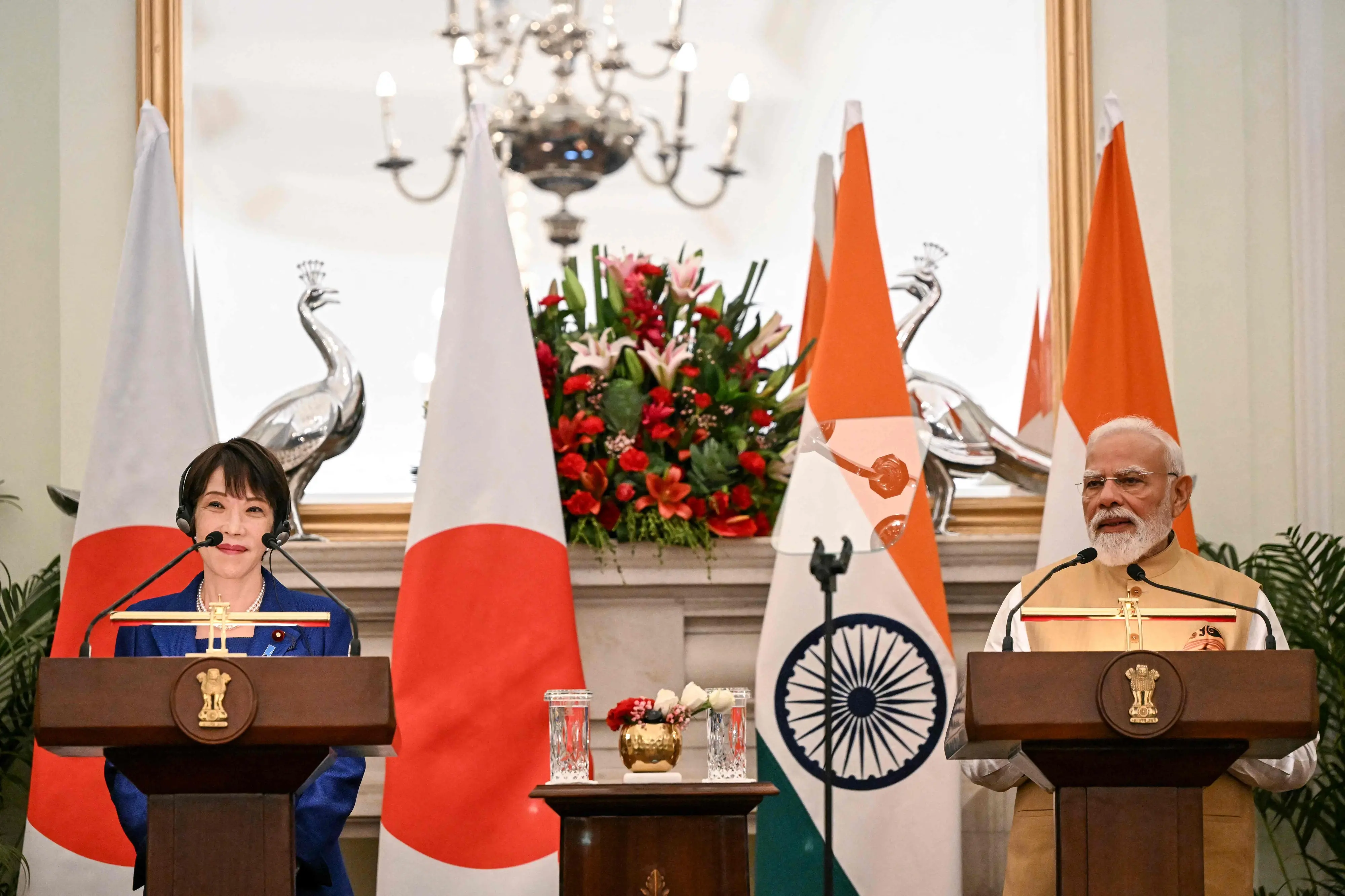
New Delhi: Prime Minister Narendra Modi on Thursday described his Japanese counterpart, Sanae Takaichi, as his ‘younger sister’ as the two leaders announced a major expansion of the India-Japan Special Strategic and Global Partnership following the 16th Annual Summit in New Delhi.
#WATCH | Delhi: During press statement with Prime Minister Narendra Modi, Japanese PM Sanae Takaichi says, "You called me a beautiful younger sister, Prime Minister Modi but at, the small meeting before the big meeting, we we confirmed that we are on the same page and develop… pic.twitter.com/VsIG9QeGil
— ANI (@ANI) July 2, 2026
Addressing a joint press conference after bilateral talks, Modi said Takaichi's maiden visit to India as Prime Minister was ‘writing a new chapter’ in ties between the two countries.
Calling her a ‘Japan First Prime Minister’ and a ‘visionary leader’, Modi said India and Japan shared a common vision for a free, open and rules-based Indo-Pacific.
Sharing my remarks during the joint press meet with PM Sanae Takaichi of Japan. @takaichi_sanae
https://t.co/vIcOdb1d8j— Narendra Modi (@narendramodi) July 2, 2026
The two countries signed a series of Memorandums of Understanding to strengthen cooperation in energy, trade, investment, defence technology and other strategic sectors.
Modi said India and Japan would work together to develop defence technologies that contribute to regional peace, maritime security and a rules-based international order.
Referring to the growing economic partnership, PM Modi said India and Japan had signed 120 new business agreements over the past year, accompanied by fresh Japanese investments worth USD 10 billion in India. He said economic engagement between the two countries continued to expand across manufacturing, infrastructure, technology and innovation.
Earlier in the day, Takaichi received a ceremonial welcome at Rashtrapati Bhavan before holding delegation-level and bilateral talks with Modi at Hyderabad House.
The annual summit remains the flagship platform steering the strategic agenda of the India-Japan partnership, with the bilateral framework now comprising more than 70 institutional dialogue mechanisms spanning defence, security, trade, technology, infrastructure, education and cultural exchanges.
Takaichi, Japan's first woman Prime Minister, arrived in New Delhi on Wednesday for a three-day visit, her first to India since assuming office.
Soon after landing, she shared photographs of her arrival on X, describing the visit as her first official trip to India as Prime Minister and her first personal visit to the country.
Prime Minister Modi welcomed her on the social media platform, writing, 'A very warm welcome to India, Prime Minister Sanae Takaichi. We are delighted to host you on your first visit to India, and I look forward to our wide-ranging discussions that will further deepen the India-Japan Special Strategic and Global Partnership.'
He added that both nations would continue working together to promote peace, stability and prosperity across the Indo-Pacific and beyond.
Ahead of the summit, Takaichi said her discussions with Modi would focus on pressing issues including economic security, energy security and expanding strategic cooperation amid an evolving global geopolitical landscape.
She said the visit would help deepen the India-Japan Special Strategic and Global Partnership through mutually beneficial cooperation.
The Ministry of External Affairs also underlined the significance of the visit. MEA spokesperson Randhir Jaiswal said the summit marked an ‘important step’ in advancing bilateral ties.
The ministry said the meeting would provide an opportunity for both leaders to review the full spectrum of cooperation while exchanging views on regional and global developments of mutual interest.
Takaichi's visit comes less than a year after Modi travelled to Tokyo for the 15th India-Japan Annual Summit in August last year, where Japan committed to doubling its investment in India over the next decade.
Bilateral trade between the two countries reached USD 27.5 billion in FY2025-26, with both governments also exploring a framework to enable trade settlements directly in the Indian rupee and Japanese yen, reducing dependence on the US dollar and further strengthening economic ties.