Buy your first bullet train ticket on Independence Day 2027, says Ashwini Vaishnaw | VIDEO
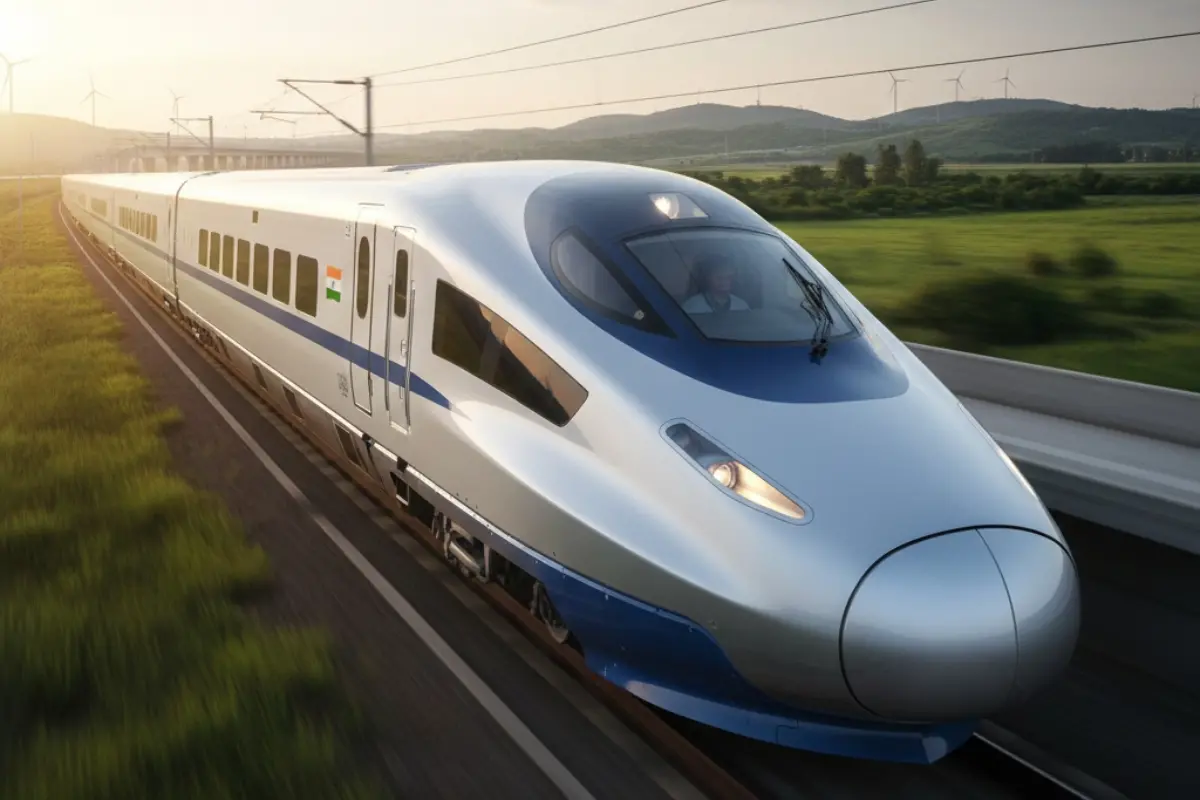
New Delhi: Union Railway Minister Ashwini Vaishnaw on Thursday officially slated the debut of India’s inaugural high-speed rail service for Aug. 15, 2027. The announcement marks a definitive timeline for the Mumbai–Ahmedabad High-Speed Rail (MAHSR) corridor, a flagship infrastructure project being developed in collaboration with Japan.
The project, which leverages advanced Shinkansen technology, is designed to be rolled out through a multi-stage operational strategy rather than a single launch. According to the minister, the service will expand in the following sequence:
- Initial Launch: Surat to Bilimora
- Secondary Phase: Vapi to Surat
- Third Phase: Vapi to Ahmedabad
- Fourth Phase: Thane to Ahmedabad
- Final Completion: Full connectivity between Mumbai and Ahmedabad
Engineering and Technical Specifications
The 508-kilometre corridor spans a diverse geographical layout, requiring a mix of elevated and underground structures.
- Geographic Distribution: The route includes 352 kilometres within Gujarat and the Union Territory of Dadra and Nagar Haveli, with the remaining 156 kilometres situated in Maharashtra.
- Speed and Efficiency: Trains are engineered for a design speed of 320 km/h. Once the full corridor is operational, the travel time between the two major financial centres is expected to drop from seven hours to approximately two hours.
- Urban Integration: The network will serve 12 stations, including key transit hubs in Ahmedabad, Vadodara, Bharuch, Surat, Vapi, Thane, and Mumbai.
- Funding Model: The estimated cost of ₹1.08 lakh crore is largely supported by the Japan International Cooperation Agency (JICA), which provided an 81% loan at a 0.1% interest rate.
Construction Status and Milestones
As of early 2026, the National High Speed Rail Corporation Limited (NHSRCL) has reached several critical infrastructure benchmarks. More than 330 kilometres of viaducts and 408 kilometers of supporting piers have been erected, while 17 of the planned 25 river bridges are now complete.
Current focus has shifted toward the project's most challenging section: a 21-kilometre tunnel connecting the Bandra-Kurla Complex (BKC) in Mumbai to Shilphata, which includes a portion travelling beneath the sea. While superstructure work for stations in Gujarat is in its final stages, foundation work for Mumbai’s specialised underground terminal is actively progressing.
“Buy a Bullet Train ticket as on Independence Day in 2027; the country will get its first Bullet Train,” Vaishnaw stated, framing the launch as a milestone for India’s 80th Independence Day celebrations.
The minister also noted that the success of the Vande Bharat Express has fostered national confidence in high-speed rail, paving the way for further innovations, including the upcoming Vande Bharat Sleeper trains.
With inputs from ANI