In a farewell to the skies IAF Chief AP Singh flies final fighter sortie in Indigenous Tejas
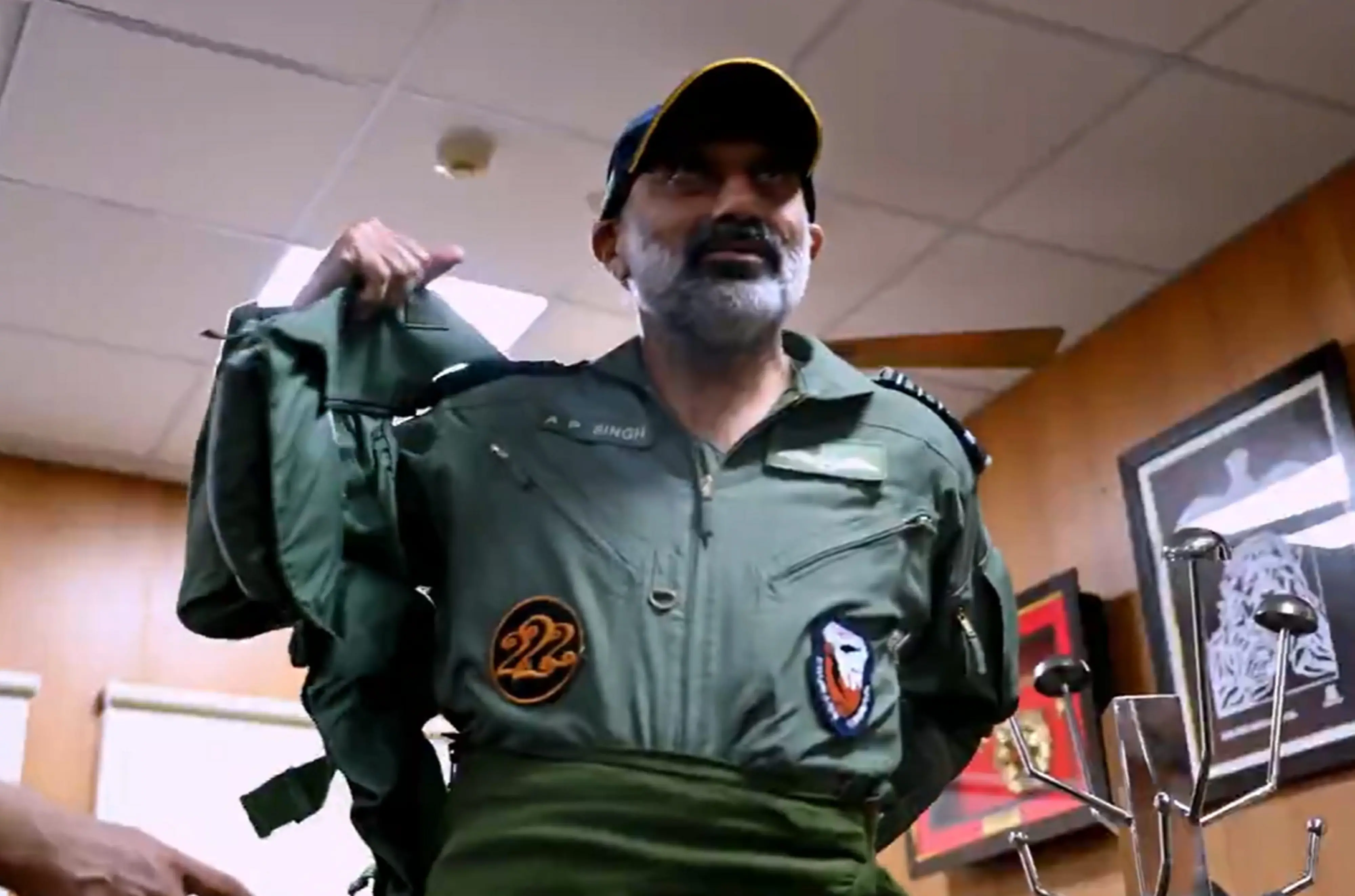
Air Chief Marshal AP Singh chooses India's homegrown fighter for his final fighter flight before retirement, highlighting his belief in the country's indigenous aerospace capabilities. The sortie took place during Exercise Tarang Shakti at Jodhpur, with foreign aircraft and the Suryakiran Aerobatic Team also in the skies.
For a fighter pilot, few moments can be as emotional as the final flight of a long career. For Indian Air Force (IAF) Chief Air Chief Marshal Amar Preet Singh, that moment came in the cockpit of India's indigenous Light Combat Aircraft (LCA) Tejas.
A FINAL FIGHTER SORTIE. A LIFETIME OF PASSION.
At the controls of the indigenous Tejas, the Chief of the Air Staff, Air Chief Marshal AP Singh, takes to the skies for his last fighter sortie — a defining moment in a distinguished career shaped by an abiding passion for flying… pic.twitter.com/pPqABdRFBm— Indian Air Force (@IAF_MCC) October 12, 2026
With retirement approaching on October 31, 2026, Air Chief Marshal Singh flew his final fighter sortie in the Tejas at Jodhpur Air Force Station during Exercise Tarang Shakti 2026. The Indian Air Force shared a video of the flight and photographs of the Air Chief flying alongside aircraft from friendly foreign countries and the IAF's Suryakiran Aerobatic Team.
The sortie marked an important moment in the career of a fighter pilot who has spent more than four decades in uniform. It also carried a special message about India's efforts to develop its own fighter aircraft and strengthen its aerospace capabilities.
In a post on X, the IAF described the flight as a reflection of a pilot who has always believed in leading from the front. “A FINAL FIGHTER SORTIE. A LIFETIME OF PASSION,” the force wrote, describing the flight as a defining moment in a career shaped by a deep love of flying and an unwavering commitment to the nation.
The IAF added that although a chapter in his flying career was coming to an end, his commitment to national service would continue.
“Once a fighter pilot. Always a fighter pilot,” the force said.
Why choosing Tejas for his final flight matters
The choice of aircraft made the farewell particularly significant. Rather than simply marking the end of his fighter-flying career, the sortie brought attention to the Tejas, a fighter developed in India as part of the country's long-term effort to reduce dependence on foreign military aircraft.
The single-engine, lightweight fighter represents an important step in India's indigenous military aviation programme. Developed by the Aeronautical Development Agency (ADA) and manufactured by Hindustan Aeronautics Limited (HAL), the Tejas is intended to strengthen the IAF's combat capabilities while supporting the growth of India's domestic aerospace industry.
Air Chief Marshal Singh's decision to fly the aircraft for his final fighter sortie can be seen as a strong symbolic endorsement of the importance of India's homegrown fighter programme.
His choice is particularly notable because the Tejas programme has faced challenges, including delays in the delivery of aircraft. The IAF has previously raised concerns about delivery schedules, even as it continues to pursue the induction of more indigenous fighters.
The Air Chief's final flight does not erase those challenges. Instead, it highlights an important distinction that concerns about delivery timelines can exist alongside confidence in the long-term value of developing and operating an indigenous fighter.
For India, the Tejas is not just another aircraft. It represents years of work by Indian engineers, designers, test pilots and manufacturing teams to build a modern combat aircraft within the country.
By choosing the Tejas for this farewell flight, Singh placed India's indigenous fighter programme at the centre of a memorable moment in his own career.
A special flight during exercise Tarang Shakti
The final sortie took place against the backdrop of Exercise Tarang Shakti, the IAF's multinational air exercise held at Jodhpur Air Force Station from September 26 to October 12, 2026.
The second edition of the exercise brought together participating air forces from seven foreign countries namely the United States, France, Germany, Australia, Bangladesh, Sri Lanka and the United Arab Emirates.
The exercise provided an opportunity for the participating forces to operate together, exchange experience and improve their ability to work alongside one another during complex air operations.
One of the major attractions was the participation of the American F-35, a multirole stealth fighter, in the exercise for the first time. Its presence brought an advanced international fighter into the same exercise environment as India's own aircraft.
India also showcased its key air assets, using the multinational gathering to demonstrate its operational capabilities and encourage greater cooperation between participating air forces.
Against this international backdrop, the Tejas sortie carried additional significance. The flight placed India's indigenous fighter in the spotlight during an exercise that brought together aircraft and personnel from several countries.
The IAF also shared images of Singh flying alongside aircraft from friendly foreign countries and the Suryakiran Aerobatic Team, adding a memorable visual element to his final fighter flight.
A career spanning over four decades
Air Chief Marshal Amar Preet Singh joined the Indian Air Force on December 21, 1984. Over the following four decades, he built a career as a fighter pilot and senior military leader before taking charge as Chief of the Air Staff on September 30, 2024.
As Air Chief, he led the force during a period when modernisation, indigenous aircraft development and the strengthening of India's air combat capabilities remained important priorities. His career has also reflected the changing nature of military aviation, from the demands of flying fighter aircraft to the wider responsibilities of leading one of the country's key defence services.
For a pilot, flying a fighter aircraft is not simply about operating a machine. It requires years of training, discipline, technical understanding and the ability to make decisions under pressure. The final sortie therefore marked the end of a personal chapter that began when Singh first entered the IAF more than 40 years ago.
The Tejas flight offered a fitting link between that long personal journey and India's continuing efforts to build its own advanced military aircraft. Although he will retire from service on October 31, his experience and contribution to the force will remain part of the IAF's institutional history.
Air Marshal Ashutosh Dixit to take over as new Air Chief
As Air Chief Marshal Singh prepares to retire, the government has appointed Air Marshal Ashutosh Dixit as the next Chief of the Air Staff. He will take over as the 29th Chief of the Air Staff, in the rank of Air Chief Marshal, on October 31, 2026.
Air Marshal Dixit is currently serving as Vice Chief of the Air Staff. Commissioned into the fighter stream of the IAF on December 6, 1986, he brings extensive operational, flying and leadership experience to the position.
He has more than 3,500 hours of flying experience across several aircraft, including the Mirage 2000, Jaguar, Hawk, Tejas and various MiG variants. He is also an Experimental Test Pilot and a Qualified Flying Instructor.
His career has included several important appointments, including Air Officer Commanding-in-Chief of Central Air Command and Chief of Integrated Defence Staff to the Chairman of the Chiefs of Staff Committee.
Dixit has also been associated with the management of the MiG-29 upgrade programme in Moscow and has held responsibilities linked to India's defence modernisation efforts. His experience across operational flying, aircraft development and senior command positions will be important as the IAF continues to modernise its fleet.
He is expected to take charge at a time when the service is working to strengthen its combat aircraft inventory and expand its indigenous capabilities.
The end of a flying chapter, but not the mission
Air Chief Marshal Singh's final fighter sortie was more than a ceremonial flight before retirement. It was a farewell to the skies for an experienced fighter pilot and an opportunity to highlight the importance of India's indigenous aviation ambitions.
The Tejas programme continues to face challenges, particularly in meeting delivery schedules and expanding production. However, the aircraft remains an important part of India's plans to build a stronger domestic defence manufacturing base.
For the engineers and technicians working on the programme, the Air Chief's flight offered a moment of recognition for the aircraft they have helped develop and produce. For the wider public, it was a reminder that building a fighter aircraft requires not only technology and investment but also years of effort by people across the country's aerospace sector.
As Singh prepares to hand over command, his final flight in the Tejas brings his flying career to a memorable close. The aircraft carried him through one last fighter sortie, while the larger mission of strengthening India's air power continues.
His retirement will mark the end of one chapter in the IAF's leadership. The journey towards a stronger, more self-reliant Indian aerospace industry, however, is far from over.