Sajjad Lone spearheading shift from separatism to democracy in Northern Kashmir
Handwara: The regions of Kupwara and Handwara are central to production of walnut, known in Kashmiri as ‘Koshur Doon’ and in Hindi as ‘Akroot’. These areas are responsible for 90 percent of the country's walnut harvest, and hence often referred to as the "basket of dry fruits”.
Not just that, this region plays a pivotal role in shaping the politics of northern Kashmir as well. A key figure in this political landscape is Sajjad Ghani Lone, the leader of the Jammu and Kashmir People’s Conference. Having transitioned from separatist politics to mainstream electoral politics and from a tradition of boycott to actively seeking votes, Sajjad Lone is contesting in two constituencies this time: Kupwara and the adjacent Handwara.
September marks the harvest season for walnuts, cultivation of which begins in May. By the time the walnut season concludes, elections will be underway in both Kupwara and Handwara. Against a backdrop of a tumultuous history of separatism and violence, these complex areas will see heavy security during the elections and campaigning.
When Sajjad Lone was approached in Handwara, a small town located about 60 kilometers from Srinagar, he was busy in discussions with party workers on the upper floor of a spacious residence, while various security forces were stationed below. Upon reaching the upper floor, some local leaders arrived to meet Lone, bringing gifts and garlands. They exchanged pleasantries and discussed election campaigning, during which Lone also found time to speak with media representatives from Kerala.
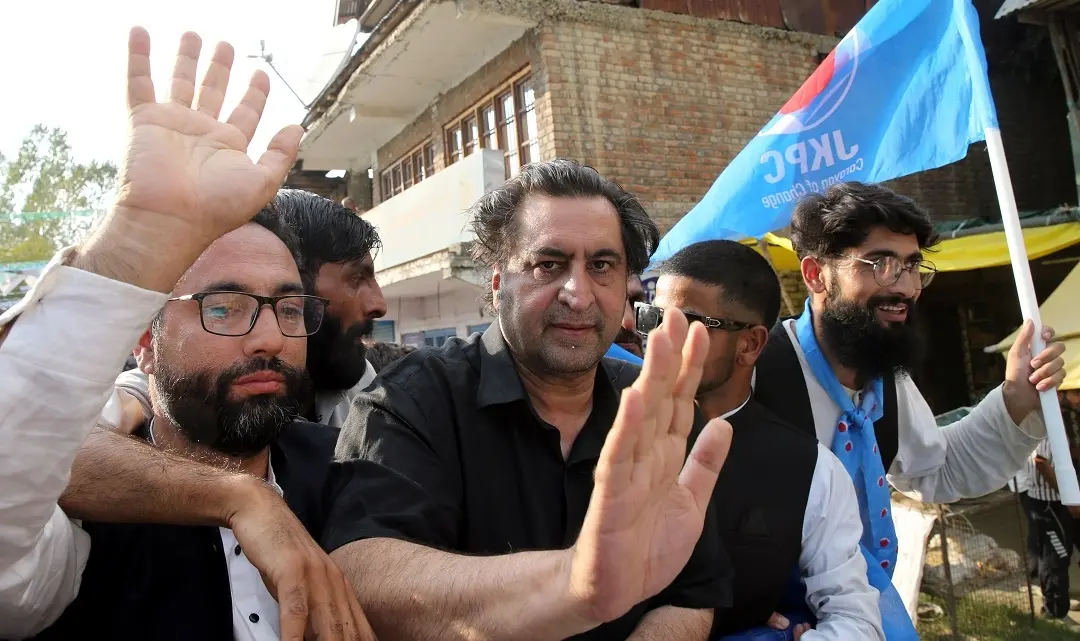
In the afternoon, surrounded by security forces and workers, Sajjad Lone departed from his residence for a roadshow, heading directly to the walnut town of Doonivaar, located 28 kilometers away. There, he began his campaign journey, greeting voters in a convoy of about fifty vehicles, accompanied by enthusiastic supporters chanting slogans.
Sajjad Ghani Lone is the son of Abdul Ghani Lone, a prominent figure who sowed the seeds of separatism in Jammu and Kashmir. Abdul Ghani Lone was shot dead during an election campaign in Srinagar in 2002. Following that, Sajjad took over the reins of the People’s Conference, which carried forward the separatist message.
In 2009, he contested as an independent candidate from the Baramulla Lok Sabha constituency but was unsuccessful. During the 2014 Assembly elections, he contested in two constituencies, losing to National Conference leader Sharifuddin Shariq in Baramulla. However, he was elected from the Handwara constituency by a margin of around 8,000 votes.
From 2016 to 2018, he served as the Minister of Social Welfare in the BJP-PDP Government in the state, indicating his adaptability in the political landscape. Allegations have been raised by the National Conference and PDP that Sajjad and other small party leaders are proxies of the BJP. In the 2024 Lok Sabha elections, Sajjad finished in third place in Baramulla.
Sajjad’s take:
Many believe this election is crucial. What is your opinion?
-This election is indeed vital for Jammu and Kashmir. We are witnessing elections with greater public participation. The entry of smaller parties and independents has made the elections more vibrant, strengthening democracy.
However, the National Conference and PDP claim that small parties and independents are proxies of the BJP. What do you say about that?
-I’m not surprised by such allegations. Those who transition into the mainstream have faced similar branding in the past. I have too.
Is the abrogation of Article 370 a significant topic in this election?
-Yes, there is widespread discontent among the people regarding the abrogation of Article 370. This sentiment will reflect in this election. During the Lok Sabha elections, this feeling was evident against the BJP.