Long before NEET, Dharmendra Pradhan was on the streets over another paper leak
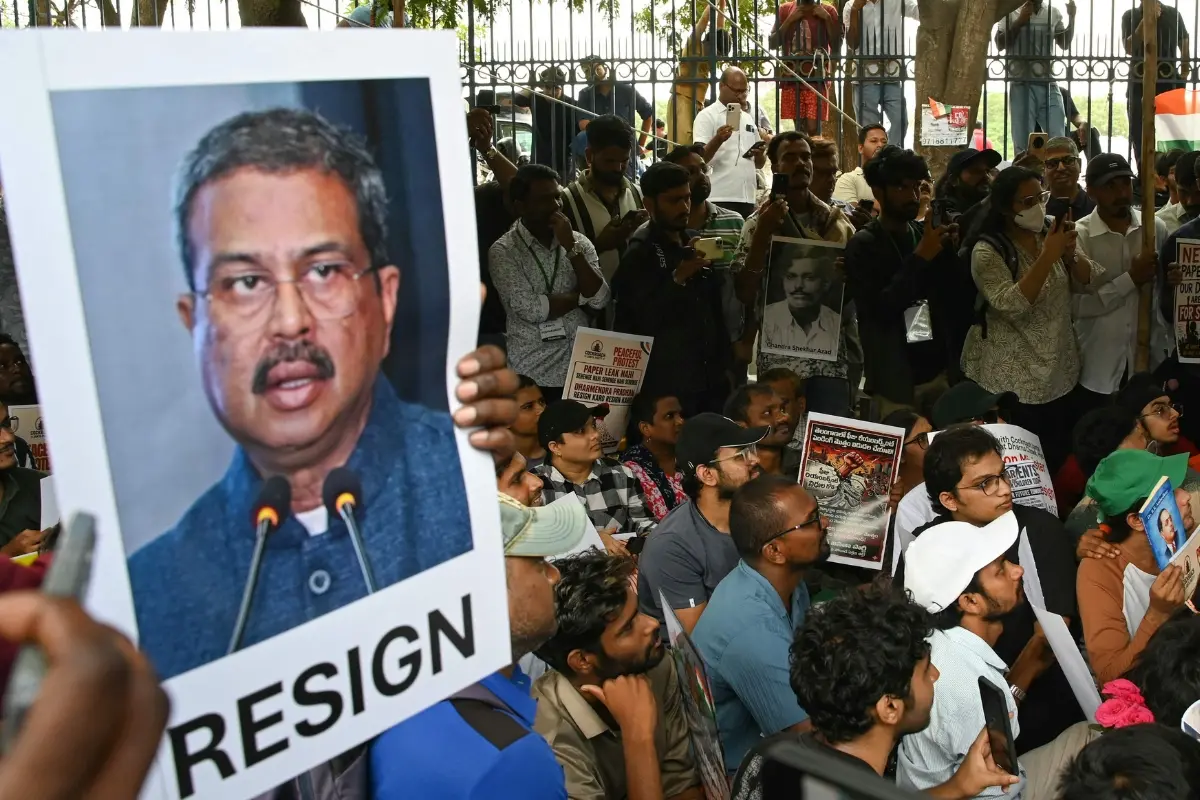
New Delhi: Nearly three decades before resigning as Union Education Minister over the NEET-UG 2026 controversy, Dharmendra Pradhan was himself at the forefront of a student agitation demanding accountability for an alleged examination paper leak in Odisha.
In 1997, Pradhan, then a rising student leader and National Secretary of the Akhil Bharatiya Vidyarthi Parishad (ABVP), led protests over the alleged leak of the Odisha Plus Two board examination question paper. The demonstrations, held outside the state Secretariat in Bhubaneswar, demanded action against the then Congress government led by Chief Minister Janaki Ballabh Patnaik and Education Minister Bhagabat Prasad Mohanty.
The protest, which drew around 1,500 students, began peacefully but turned violent after police carried out a lathi-charge. Pradhan was reportedly seriously injured during the crackdown, suffering multiple fractures, but continued to play an active role in the agitation.
The controversy prompted the Odisha government to engage with student leaders and initiate corrective measures. A committee was constituted to investigate the issue, while the chairman and secretary of the Council of Higher Secondary Education (CHSE) were replaced. The government also organised a state-level seminar on reforms to the Plus Two examination system and forwarded recommendations to the Chief Minister. The subsequent board examination was conducted without any reported paper leak.
The episode marked a defining moment in Pradhan's early political career, shortly before he formally joined the Bharatiya Janata Party (BJP).
Twenty-nine years later, Pradhan found himself at the centre of a similar controversy, this time as Union Education Minister.
He resigned on Saturday following weeks of nationwide protests over alleged irregularities in the NEET-UG 2026 examination, including the paper leak and concerns surrounding the CBSE's on-screen evaluation process.
The agitation, led by the Cockroach Janta Party (CJP), began with a sit-in at Delhi's Jantar Mantar on June 20 and grew into a nationwide movement demanding Pradhan's resignation and sweeping reforms to the examination system.
In his resignation letter, shared on X in Hindi, Pradhan said he had accepted moral responsibility for the NEET controversy from the very beginning.
"I have deep respect for the aspirations, emotions and legitimate expectations of the youth of this country. Fulfilling the dreams of India's young generation has always been the moral resolve of our political and social life," he wrote, while thanking Prime Minister Narendra Modi for giving him the opportunity to serve as Education Minister.
Pradhan said his resignation was intended to prevent "anti-national forces" from exploiting the unrest, preserve national unity, spare students from prolonged uncertainty and allow them to focus on their studies.
The Centre had already transferred the investigation into the alleged paper leak to the Central Bureau of Investigation (CBI), cancelled the original NEET-UG examination, conducted a re-examination and announced that future editions of the test would be held in computer-based mode.
The government also approved a draft law proposing stricter punishments for examination paper leaks, while the revised NEET-UG results were declared on July 16.