Delhi pollution protest turns violent; FIR filed over pepper spray as naxal posters surface
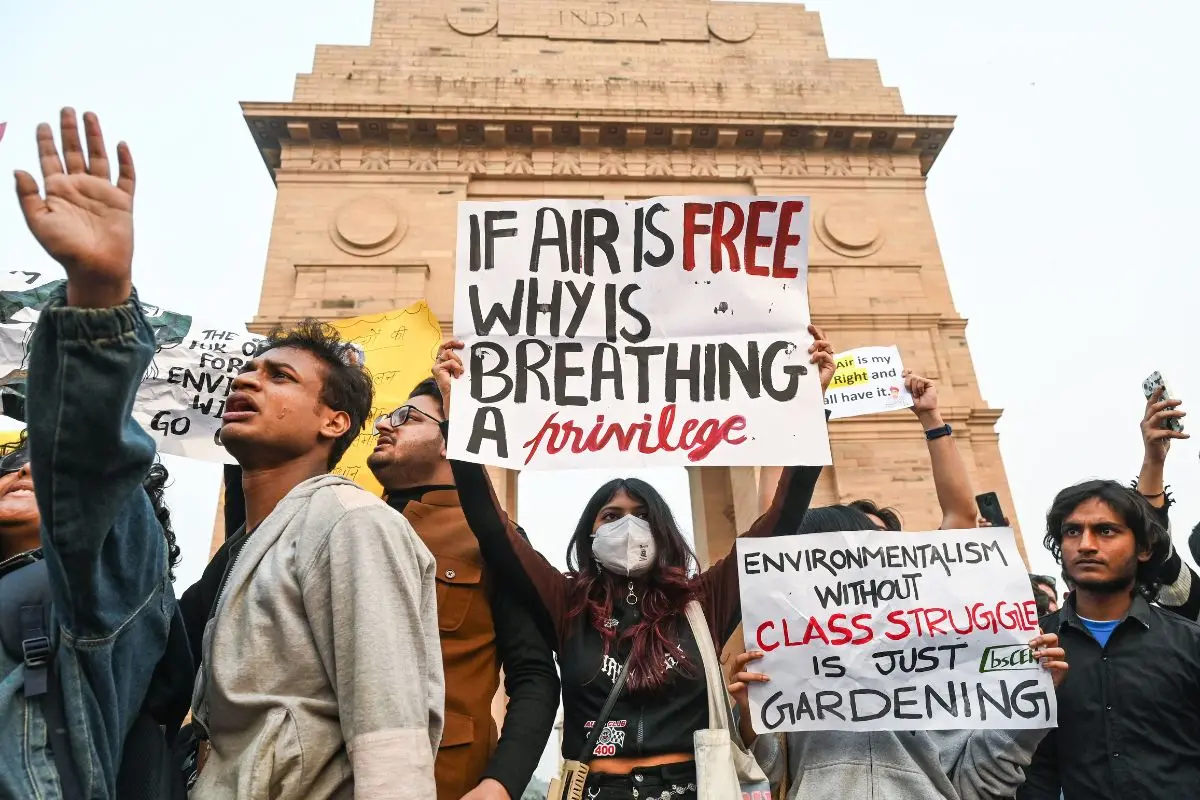
A protest against rising pollution levels at Delhi’s India Gate turned violent after demonstrators clashed with police. Some protesters were seen carrying posters of Naxal commander Madvi Hidma, who was recently killed in an encounter. Tensions rose when police moved in to disperse the crowd, prompting some demonstrators to allegedly use pepper spray on the officers.
A police official said it was the first time they had encountered protesters using chilli spray against personnel, adding that the group had “used force and violence” during the confrontation. The BJP strongly criticised the appearance of Naxal posters at the demonstration, with Amit Malviya, head of the party’s IT Cell, claiming the incident reflected a “communist agenda”. Several protesters were detained following the unrest.
Amit Malviya’s reaction
Delhi Police have lodged a first information report (FIR) against protesters at India Gate for allegedly using chilli spray on officers and obstructing government duties. Approximately 15 individuals have been arrested, with some detained at India Gate and others taken into custody near the Parliament Street police station.
On Sunday, the situation at the protest escalated as some demonstrators allegedly used pepper spray on police personnel while being removed from the scene, the official added.
According to a senior police officer, the protesters had gathered close to the C-Hexagon and were told that their demonstration at that location was obstructing ambulances and medical personnel trying to pass through.
"The situation then turned into a scuffle, and some protesters used pepper spray on our personnel, which is unusual and rare," the officer said, adding that so far, 15 protesters have been arrested.
Pollution levels
Delhi–NCR residents awoke on Sunday to a dense layer of smog, with private tracker AQI.in reporting the air quality index (AQI) at an alarming 559 — a level considered hazardous. In contrast, the Air Quality Early Warning System (EWS) placed the AQI significantly lower, at 397, which still falls within the ‘Very Poor’ category.
Thick smog engulfed the skyline, with visibility severely reduced as buildings and roads disappeared behind a grey haze.
India’s AQI scale is divided into six categories: ‘Good’ (0–50), ‘Satisfactory’ (50–100), ‘Moderately Polluted’ (100–200), ‘Poor’ (200–300), ‘Very Poor’ (300–400), and ‘Severe’ (400–500). Readings above 500 are typically classified as ‘hazardous’.
AQI.in estimated that breathing the air in Delhi at these levels is equivalent to smoking 11.8 cigarettes a day, based on the average PM2.5 concentration over the previous 24 hours and assuming continuous exposure.
The Delhi Coordination Committee for Clean Air, in a statement, said the city's worsening air quality has become a "serious risk" to public health and alleged that authorities have failed to address the root causes of pollution.
It further alleged that air quality has remained in the "severe" category, while the government relies on "cosmetic measures" such as water sprinklers, cloud seeding and spraying near Air Quality Index (AQI) stations instead of finding long-term solutions to tackle the issue.