Violence, conflicting claims and first talks: What Delhi police and protesters said after clashes
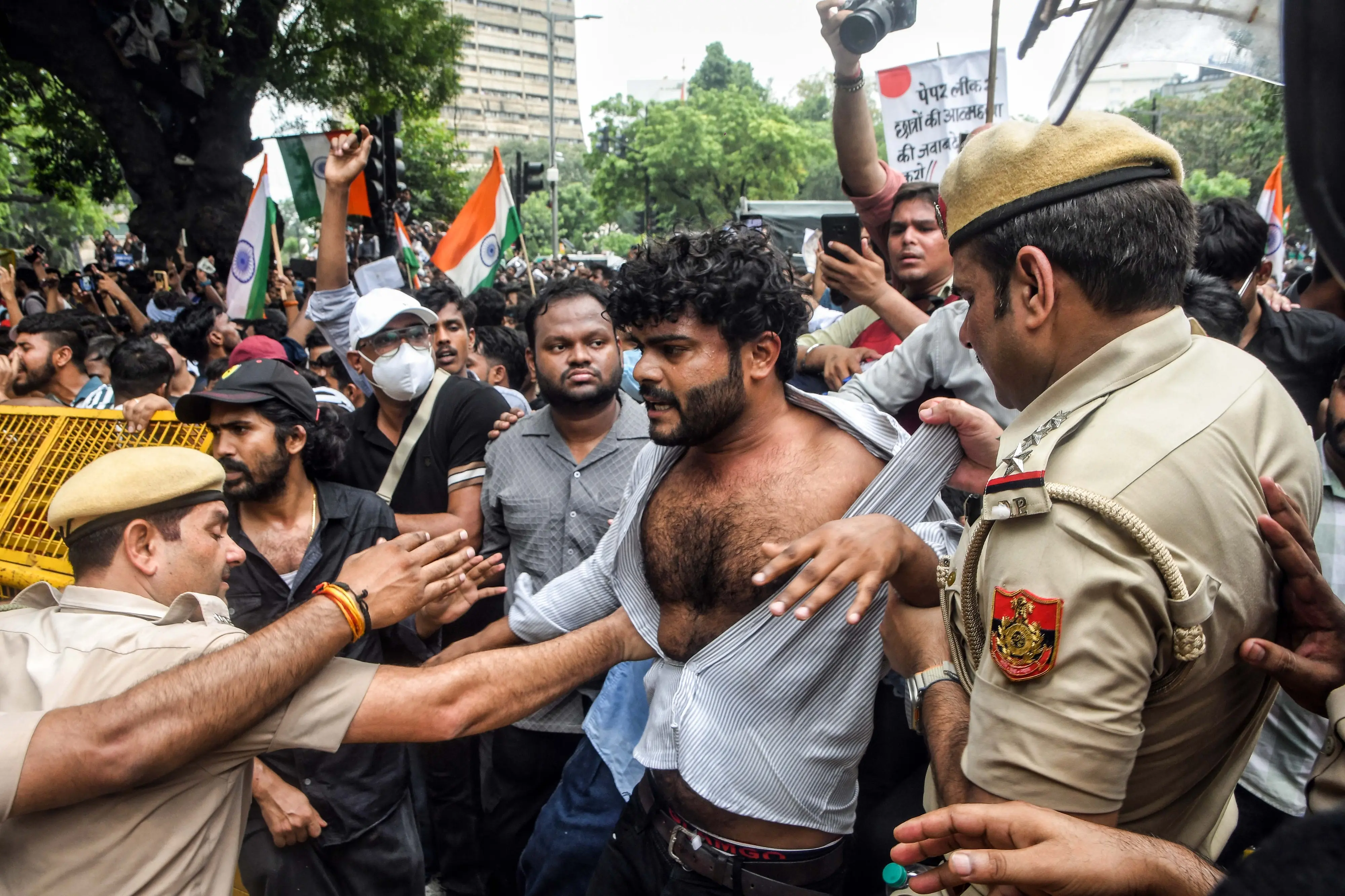
New Delhi: Thousands of supporters of the Cockroach Janta Party (CJP) clashed with Delhi Police during a march towards Parliament on Monday, leading to injuries, the use of tear gas and baton charges, and heightened security in the national capital.
The demonstrations, centred on alleged examination irregularities and demands for Education Minister Dharmendra Pradhan's resignation, also prompted the Union government to hold its first formal talks with representatives of the movement. While both police and protesters accused each other of escalating the violence, dialogue between the two sides has now begun.
March to Parliament ends in clashes
Thousands of protesters gathered at Jantar Mantar before attempting to march towards Parliament, where Delhi Police had erected multiple layers of barricades due to the ongoing Monsoon Session. According to police, demonstrators tried to breach security barriers, prompting officers to use tear gas and baton charges to disperse the crowd. Despite the action, many protesters continued moving towards Parliament in smaller groups.
ANI reported that several Delhi Police personnel were injured during the confrontation. A Delhi Police Sub-Inspector claimed protesters threw stones at officers stationed behind barricades, saying, "We were standing near barricades, stone was pelted by them (protesters)."
Police reject viral social media claims
As images and videos of the clashes spread online, Delhi Police issued a clarification regarding claims circulating on social media. The force denied allegations that a 12-year-old girl named Geetanjali had been assaulted or that 40 to 50 people had suffered severe head injuries during the protest.
In an official statement, Delhi Police said, "This information is false. The claims being circulated in the posts are not true." Authorities also urged people not to circulate rumours or unverified information and appealed to protesters to maintain peace and cooperate with law enforcement.
Protesters accuse police of excessive force
Protest organisers disputed the police version of events, alleging that officers used excessive force against demonstrators. CJP spokesperson Saurav Das accused authorities of carrying out a "brutal crackdown" on what he described as "peaceful protesters."
Participants maintained that they intended to continue their march despite police barricades. Many demonstrators said they had anticipated resistance but believed it was necessary to take their demands directly to Parliament. These statements represent the views of the protest organisers.
Why the movement began
The Cockroach Janta Party emerged in May after the Chief Justice of India referred to some unemployed young people as "cockroaches" during an unrelated court hearing. Supporters adopted the term as a symbol of protest, transforming it into a satirical movement that has since gained millions of followers online.
The campaign gathered momentum following repeated allegations of question paper leaks in medical entrance examinations and government recruitment tests. It expanded further after climate activist Sonam Wangchuk began a hunger strike over examination reforms and was later moved to hospital by police.
The protesters are demanding the resignation of Education Minister Dharmendra Pradhan, reforms to the examination system and compensation for families of students who allegedly died by suicide following examination paper leaks.
Government opens dialogue with protesters
In a significant development, Union Health Minister JP Nadda met a two-member CJP delegation comprising Saurav Das and Ashutosh Ranka. The meeting marked the first formal engagement between the Union government and leaders of the movement.
After the discussions, Nadda said, "This morning, for the first time, a proposal came from the protesters to hold talks with the government, and our discussions have been ongoing since 11:50 AM. The meeting took place in a cordial atmosphere. An initial verbal discussion was held in detail with their delegation, and they submitted a written petition to me around 4 PM. I have requested all the protesters to end their sit-in and assist the administration in restoring normalcy."
What the CJP delegation said
Following the meeting, CJP spokesperson Saurav Das said discussions with the government had begun but no decision had yet been reached.
In a post on X, Das wrote, "After waiting for more than 2 hours, Ashutosh Ranka and I just met J.P. Nadda ji at his residence for 10 minutes. While we submitted a written letter with our demands, he has assured us that he will meanwhile speak internally. We are in that process."
Ashutosh Ranka said the delegation had reiterated its key demands, including the immediate release of Sonam Wangchuk, the resignation of Dharmendra Pradhan and ₹1 crore compensation for the families of NEET aspirants who died by suicide. He also alleged that police were using "brute force on peaceful protestors." These statements reflect the position of the protest organisers.
Sonam Wangchuk's appeal
Separately, Sonam Wangchuk appealed for permission to leave hospital temporarily and join the Parliament march. In a handwritten note, he said he would end his nearly three-week hunger strike only if the government accepted responsibility for failures in the examination system and paper leaks, or if protesters were allowed to reach Parliament and lawmakers agreed to raise the issue in both Houses.
Why many protesters joined
Beyond examination reforms, several participants described the movement as a broader campaign for accountability and transparency.
Yoga teacher Jyoti Rajput said, "This rotten system refuses to take action. It cannot see the pain of students, and that's why so many people have joined this movement."
Another protester, Sneha Eppili, said, "I voted for this government, so I think it's accountable to answer our questions. That's the basic human right that I deserve." These comments reflect the views of individual protesters rather than independently established facts.
What happens next?
Although the clashes marked one of the most serious confrontations between the movement and authorities so far, Monday also witnessed the first formal communication between the government and CJP leaders. No agreement has yet been announced, but both sides have acknowledged that discussions have begun, leaving open the possibility of further negotiations while protests continue.