Constitution a lifeline for India's most vulnerable citizens: CJI at Oxford
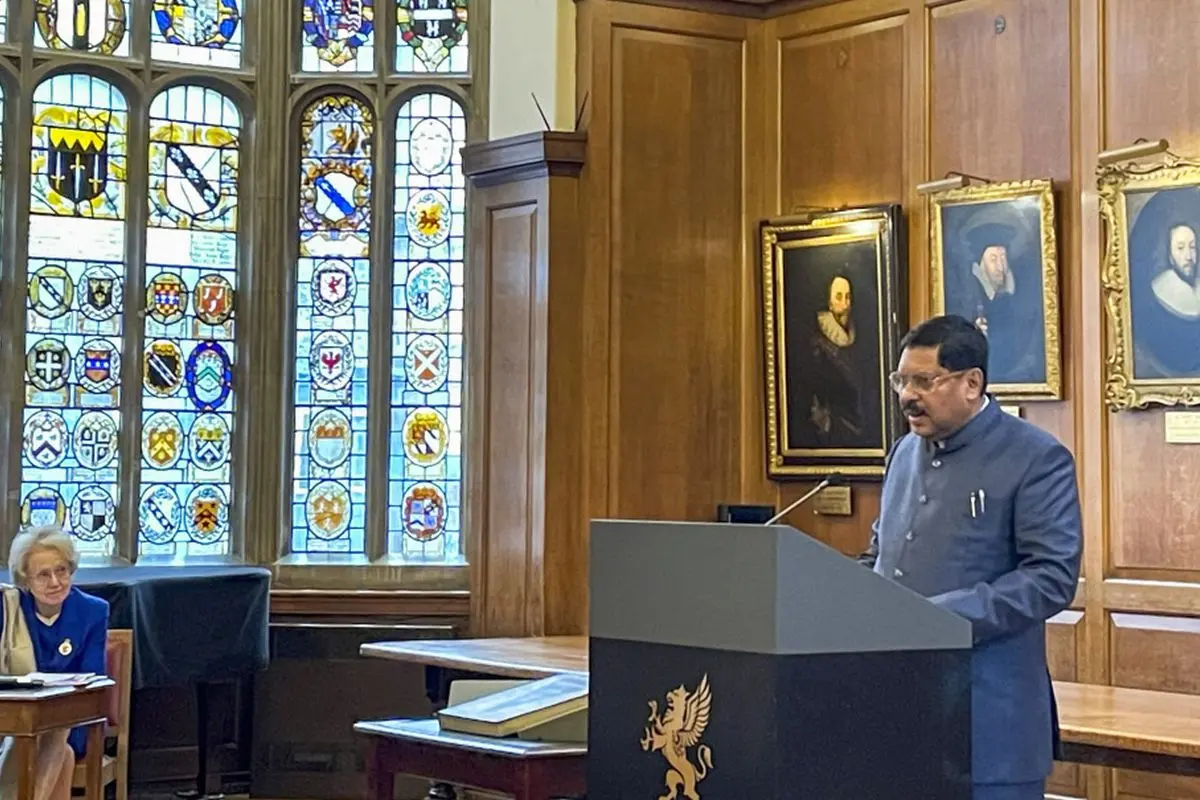
Chief Justice of India Justice BR Gavai delivered a powerful address at the Oxford Union where he emphasized upon the profound impact of the Indian Constitution on marginalized communities and its role in fostering equality.
Speaking on the theme 'From Representation to Realisation: Embodying the Constitution's Promise', CJI Gavai, who is the second Dalit and first Buddhist to hold India's highest judicial office, shared his personal journey as a testament to the Constitution's transformative power.
CJI Gavai vividly recalled a time when millions of Indian citizens faced severe discrimination. "Many decades ago, millions of citizens of India were called 'untouchables'. They were told they were impure. They were told that they did not belong. They were told that they could not speak for themselves," he stated.
He then drew a stark contrast to the present: "But here we are today, where a person belonging to those very people is speaking openly, as the holder of the highest office in the judiciary of the country. This is what the Constitution of India did. It told the people of India that they belong, that they can speak for themselves, and that they have an equal place in every sphere of society and power."
The Chief Justice described the Constitution not merely as a legal document but as a living force. "At the Oxford Union today, I stand before you to say: for India's most vulnerable citizens, the Constitution is not merely a legal charter or a political framework. It is a feeling, a lifeline, a quiet revolution etched in ink. In my own journey, from a municipal school to the Office of the Chief Justice of India, it has been a guiding force," he affirmed.
He characterized the Constitution as a vital social document that confronts deep-seated inequalities. "It does not pretend that all are equal in a land scarred by deep inequality. Instead, it dares to intervene, to rewrite the script, to recalibrate power, and to restore dignity," CJI Gavai explained.
He added that it embodies "the heartbeat of those who were never meant to be heard, and the vision of a country where equality is not just promised, but pursued," compelling the State to actively protect, uplift, affirm, and repair rights.
CJI Gavai also highlighted an often-overlooked aspect of India's constitutional history: the active participation of vulnerable social groups in its drafting. "From Dalits and Adivasis, to women, minorities, persons with disabilities, and even those once unjustly branded as 'criminal tribes,' their presence in the Constituent Assembly, and in the broader constitutional imagination, was a collective demand for justice," he noted.
He specifically lauded Dr BR Ambedkar, Chairman of the Drafting Committee, for his foresight in embedding crucial safeguards and affirmative measures, particularly the principle of representation, into the constitutional text.
"In an unequal society, he believed, democracy cannot survive unless power is also divided among communities, not just among institutions. Representation, therefore, was a mechanism of redistributing power, not only between the legislature, executive, and judiciary, but among social groups that had been denied a share for centuries," CJI Gavai concluded.