Why CJP chose Jantar Mantar for its first India protest: History behind Delhi's dissent hub
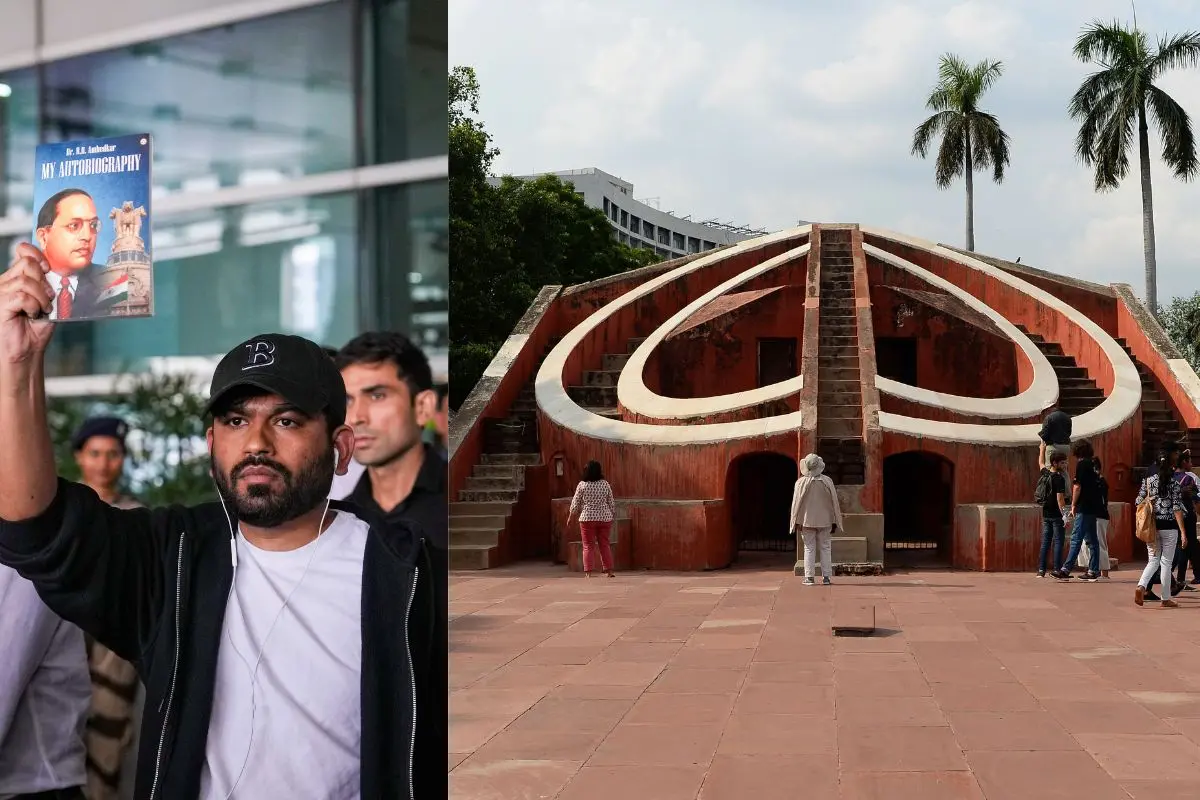
As the Cockroach Janta Party (CJP) prepares to stage its first public demonstration in India on Saturday, its chosen venue, Delhi's Jantar Mantar, is once again set to become the backdrop for political dissent.
The protest, led by CJP founder Abhijeet Dipke, comes amid growing anger over alleged irregularities in India's examination system, including the NEET-UG paper leak controversy and the CBSE OSM row. Dipke, who arrived in India ahead of the demonstration, is expected to join supporters gathering near the observatory, where security has been tightened with more than 1,000 Delhi Police personnel deployed, according to PTI.
While Jantar Mantar is now closely associated with public demonstrations, the site was originally built nearly three centuries ago for an entirely different purpose.
Why CJP picked Jantar Mantar
CJP leaders have described Jantar Mantar as a symbolic and practical venue for a movement focused on accountability and citizens' rights.
Speaking at a press conference on June 3, party spokesperson Ashutosh Ranka said, “Jantar Mantar has historically been a site for peaceful dissent. We are confident that the police will give us permission.”
Chief spokesperson Saurav Das added, “To protest is our fundamental right by the Constitution.”
Climate activist Sonam Wangchuk, who is expected to participate in the gathering, has also appealed for peaceful conduct and urged supporters not to allow the demonstration to turn disruptive.
The protest seeks the resignation of Union Education Minister Dharmendra Pradhan over recent examination controversies. Dipke has argued that failures within the education system have left millions of students uncertain about their future.
How Jantar Mantar became Delhi's protest hub
Jantar Mantar was not always the capital's designated protest venue.
For decades, large political demonstrations in Delhi were commonly held at the Boat Club lawns near India Gate. However, authorities reconsidered that arrangement after a massive farmers' rally in 1988 caused significant disruption in central Delhi.
In 1993, Jantar Mantar Road was formally established as the city's primary site for authorised protests.
Its location offered a balance between visibility and control. Situated close to Parliament and key government offices, it allowed demonstrators to make their voices heard near the country's political centre. At the same time, the relatively confined area enabled police to regulate gatherings without paralysing large sections of the city.
Over the years, the site evolved into one of India's most recognisable spaces for organised dissent.
Landmark movements held at the observatory
Several major protest movements have passed through Jantar Mantar.
Among the most prominent was Anna Hazare's anti-corruption campaign in 2011, which drew nationwide attention and eventually contributed to the political momentum behind the formation of the Aam Aadmi Party.
The observatory also became a gathering point following the 2012 Delhi gang rape case, commonly known as the Nirbhaya case, when citizens demanded stronger laws for women's safety.
Subsequent years saw a wide range of demonstrations, including student-led campaigns, protests linked to the FTII agitation, mobilisation following the death of Rohith Vemula in 2016, and the "Not In My Name" movement against mob lynching.
Farmers from several states, including Tamil Nadu, frequently assembled there to press their demands, while ex-servicemen used the site for sustained demonstrations over the One Rank One Pension issue.
Although the National Green Tribunal imposed restrictions on protests at Jantar Mantar in 2017 over environmental concerns, the Supreme Court restored the right to demonstrate there in 2018. The venue later hosted gatherings connected to the anti-CAA movement and protests surrounding wrestling federation allegations.
A monument built for astronomy, not politics
Long before it became associated with placards and public speeches, Jantar Mantar was an astronomical observatory.
The monument was commissioned by Maharaja Sawai Jai Singh II of Amber and completed in 1724. It was the first in a network of five observatories he established across northern India, with later sites built in Jaipur, Ujjain, Varanasi and Mathura.
Historical records from the Jaipur state indicate that the site's original name was Jantra, derived from the Sanskrit word referring to astronomical instruments.
Unlike Delhi's forts, palaces and religious monuments, Jantar Mantar was designed as a scientific facility. Its massive masonry structures enabled astronomers to track celestial movements, determine time, measure the sun's position and improve astronomical calculations used in calendars and rituals.
The observatory's stark geometric forms continue to stand apart from much of Delhi's historic architecture. Its angular structures often appear strikingly modern despite being nearly 300 years old.
Today, Jantar Mantar is recognised as a UNESCO World Heritage Site and remains one of the capital's most distinctive landmarks.
CJP's instructions for protesters
Ahead of Friday's demonstration, the Cockroach Janta Party released a detailed list of guidelines for participants.
Supporters have been asked to gather near Parliament Street Police Station at 9 am before proceeding towards Jantar Mantar. The party has encouraged attendees to carry the national flag and a book as symbols of educational rights and equal opportunity.
Participants have also been urged to document the event responsibly and report any disruptive behaviour to police.
“Please come prepared for weather, stay hydrated, and take care of your health and safety. It also urged protestors to apply sunscreen and get a cap. “We must collaborate with the sun,” the party said.
The party also advised supporters to arrive in groups where possible.
Among its more unusual instructions was a request not to throw flowers during the protest.
“Bring flowers and hand them to the police. Thank them for caring for our youth's future.”
The organisers further urged participants not to engage with online trolls or provocateurs and reminded them to eat before attending.
“Eat before you arrive, revolution requires breakfast.”