Centre pressures Meta; India moves towards rules separate from global standards
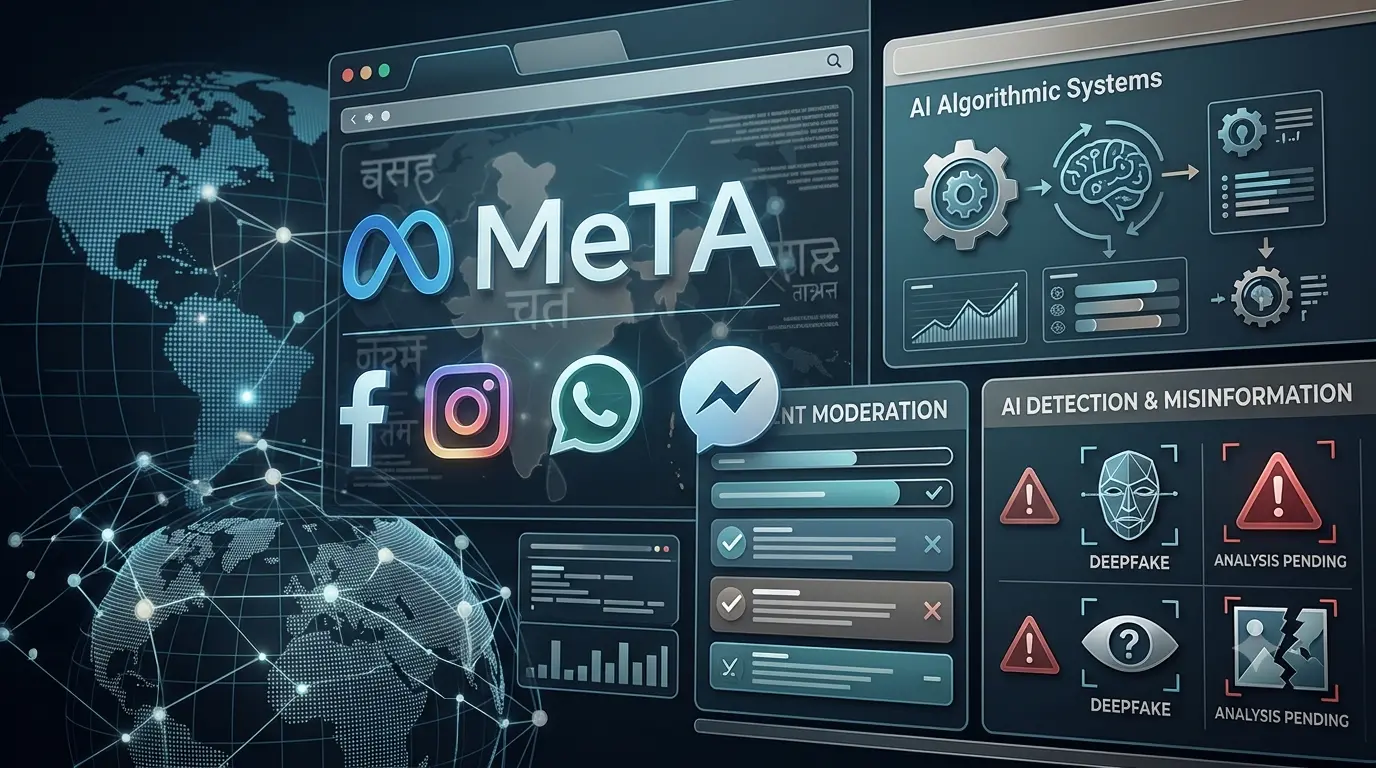
The Indian government is pressing Meta over how its algorithms recommend and moderate content in India, while broader discussions are focusing on whether global platform standards are sufficient for the country’s diverse languages, cultural context and legal framework. The talks cover deepfakes, child sexual abuse material (CSAM), synthetic content and recommendation systems, with the government seeking stronger safeguards and greater human oversight.
The Centre's tougher stance towards Meta comes after a series of developments that have brought the platform's content moderation, algorithms and compliance with Indian law under renewed scrutiny.
Why is the Centre being so adamant with Meta now?
The government's latest engagement with Meta is not happening in isolation. Several issues have converged at the same time, turning what could have been a routine platform-compliance discussion into a much wider examination of how Meta operates in India.
The Centre has held multiple rounds of discussions with Meta, including meetings involving senior company officials and the Ministry of Electronics and Information Technology (MeitY). Officials have made it clear that they want Meta's India operations to comply with Indian law and the IT Rules, rather than relying only on global content policies.
1. The Modi Facebook post episode brought the issue into the spotlight
One immediate flashpoint was the temporary restriction of a Facebook post by Prime Minister Modi.
The incident prompted the government to summon Meta officials and seek an explanation for why the post had been restricted. Meta subsequently apologised to the Indian government, describing the restriction as an error.
That episode appears to have opened the door to a much broader examination.
Instead of limiting the discussion to “Why was this particular post restricted?”, the government began questioning how Meta's systems make decisions more generally — including what content is recommended, what gets amplified and how potentially harmful material is detected.
2. Then came the bigger question: who decides what Indians see?
This is arguably the most important part of the current dispute.
Government officials are questioning Meta's recommendation algorithms — the systems that determine which posts, videos and other material are shown to individual users.
The issue is not merely whether Meta hosts content uploaded by users. It is whether its algorithms actively determine “what is shown to whom” and whether paid promotion influences that distribution.
That raises a legal question under India's Information Technology Act: can a platform continue to rely on intermediary protections while playing an active role in selecting and promoting content? Government sources have specifically raised this issue.
3. Why Section 79 matters
Under Section 79 of the IT Act, intermediaries can receive safe-harbour protection from liability for third-party information hosted or transmitted through their platforms, subject to statutory conditions and due diligence.
That protection is therefore not an unconditional exemption.
The government's current questioning of Meta's intermediary status is significant because it goes to the foundation of the platform's legal position in India.
The Centre is essentially examining whether Meta's increasingly active role in recommendation, amplification and paid promotion creates responsibilities that go beyond simply providing a technological platform.
This does not mean the government has already decided that Meta is a publisher. Rather, officials are examining whether its activities are consistent with intermediary status under Indian law.
4. Deepfakes are no longer just a policy concern
The timing is also important because India has already strengthened its legal framework around AI-generated and manipulated content.
MeitY notified amendments to the IT Rules in February 2026 that brought synthetically generated information, including deepfakes, into the due-diligence framework. The amendments came into force on February 20.
The government subsequently proposed further tightening of disclosure requirements, including continuous and clearly visible labelling of synthetic content in visual formats.
So when officials now ask Meta why synthetic content is being recommended, amplified or allowed to reappear after removal, they are doing so against a newer Indian regulatory framework, not simply issuing a general policy request.
5. CSAM has made the government's position much harder
The Centre is also drawing a firm line on Child Sexual Abuse Material (CSAM).
Officials have told Meta that such material cannot remain on its platforms and are seeking stronger systems to identify and prevent its circulation.
This is important because the government's criticism is no longer limited to questions about political content or misinformation. It also concerns serious forms of unlawful and harmful content, including sexual abuse material and synthetic sexual content.
Recent discussions reportedly included questions about Meta's ability to detect such material proactively and prevent it from circulating again after removal. Meta has acknowledged serious issues and assured officials that it would take corrective action, according to reports.
6. The Centre is unhappy with the idea of 'remove it, then it comes back'
Another issue repeatedly raised with Meta is repeat circulation.
Officials want to know what happens after a deepfake or other harmful synthetic material has already been identified and removed.
If the same material can simply be uploaded again, resurface through recommendations or regain visibility through another account, removal alone does not solve the problem.
The government is therefore asking Meta for concrete safeguards to prevent flagged material from repeatedly returning to users' feeds.
7. India wants human oversight, not only algorithms
The Centre has also questioned whether automated moderation is sufficient for complicated Indian cases.
One concern involves genuine material from verified or authorised accounts being incorrectly classified as synthetic.
Officials have therefore pushed for a human-in-the-loop mechanism in sensitive cases, particularly when automated systems could make mistakes.
This is connected to another long-running concern: whether moderation systems developed largely outside India adequately understand Indian languages, cultural references and local context.
8. The government says this is about Indian law, not an algorithm overhaul
There is an important distinction in the government's latest clarification.
Officials have said it would be inaccurate to describe the talks as an order for Meta to completely overhaul its algorithms.
Instead, the stated objective is to ensure that Meta's policies, moderation systems and enforcement mechanisms comply with India's existing legal and regulatory framework.
That distinction matters because the Centre is not publicly saying that it wants to control every recommendation Meta makes.
Its argument is that whatever system Meta chooses to use, it must operate within Indian law when serving Indian users.
Why now, rather than earlier?
There are essentially four developments converging:
First, the temporary restriction of PM Modi's Facebook post put Meta's moderation decisions under immediate political and regulatory scrutiny, followed by an apology from the company.
Second, the government used the subsequent meetings to expand the conversation to deepfakes, CSAM, bots, synthetic content and paid amplification rather than treating the Modi post as an isolated technical error.
Third, India's 2026 IT Rules have created a stronger regulatory framework for synthetic content and deepfakes, giving the Centre a more specific legal basis for questioning platform compliance.
Fourth, the government is now questioning something much more fundamental: whether Meta's active role in deciding what users see is compatible with its intermediary status and the safe-harbour protection associated with it.
What could this mean for Meta in India?
The immediate outcome is likely to be continued engagement and technical scrutiny, rather than an instant regulatory confrontation.
Another round of talks is expected, and officials have indicated that they will monitor Meta's progress.
But the stakes are higher than a single content-moderation error.
If the government ultimately concludes that Meta is not meeting its statutory due-diligence obligations, questions could arise over its eligibility for intermediary protections and potential regulatory action. The government has not yet announced such a determination.
For Meta, the issue is therefore no longer simply Facebook or Instagram removing the wrong post.
It is increasingly about a larger question: how much responsibility should a platform bear when its own algorithms decide what millions of Indian users are encouraged to see, while the company continues to claim the legal protections available to an intermediary?
The bigger picture
The Centre's tougher approach reflects a broader shift in India's internet regulation in 2026.
The government has been moving from asking platforms to respond to harmful content after it appears towards demanding greater accountability for how such content is detected, labelled, removed, prevented from resurfacing and distributed through recommendation systems.
The February IT Rules amendments were already part of that shift, particularly around synthetic media and deepfakes. The current Meta talks show how that framework is now being tested against one of the world's largest social-media companies.
The Modi post episode may have triggered the latest confrontation, but the Centre's questions about Meta now reach much further: deepfakes, CSAM, algorithms, paid amplification, local moderation and, ultimately, Meta's legal responsibilities under Indian law.