‘Are you not ashamed of selling India?’: Rahul Gandhi’s remarks spark Lok Sabha uproar
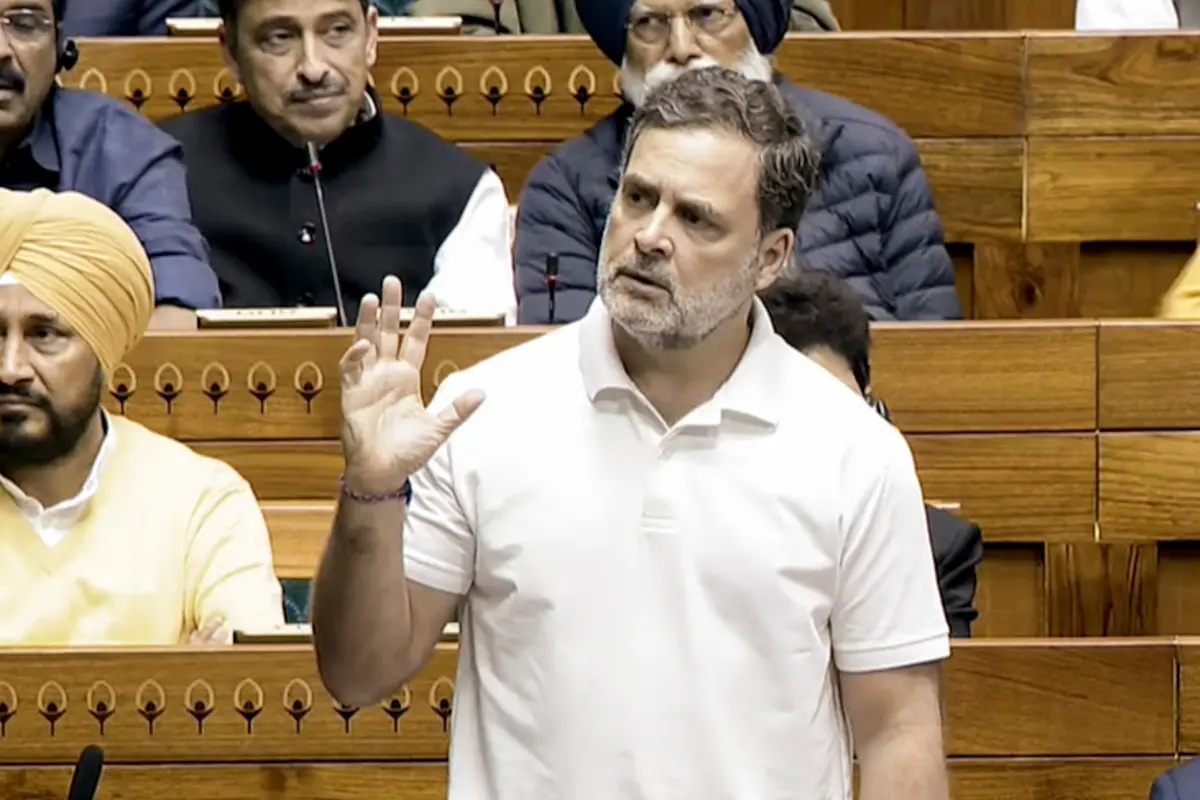
New Delhi: Leader of Opposition Rahul Gandhi addressed the Lok Sabha on 11 February 2026 during the Budget Session, focusing on the India-US trade deal, geopolitical tensions, artificial intelligence, data security and energy policy.
Speaking on global developments, Gandhi said, “The dominance of the US is being challenged,” adding that “we are moving into a dangerous world” and “an era of war.” He argued that the Union Budget did not reflect the seriousness of rising geopolitical tensions, stating, “There is nothing in the budget about intensifying geopolitical tensions and what we are going to do about it.”
On the India-US trade agreement, Gandhi made sharp remarks in the House. “You have sold India,” he said, criticising the government’s handling of negotiations. Referring to tariffs, he claimed, “3% US tariff has now gone up to 18%, a sixfold increase,” and questioned the outcome of the deal. He also stated, “There is no deal for data localisation in the India-US trade pact,” raising concerns about control over digital infrastructure.
The speech added to the sharp exchanges during the ongoing Budget Session, with trade, security and technological readiness emerging as central themes in the parliamentary debate.
Highlights from Rahul Gandhi’s speech
- On global instability and the Budget
“The dominance of the United States is being challenged.”
“We are moving into a dangerous world… an era of war.”
“There is absolutely nothing in the Budget that looks into these issues.”
Gandhi said the Economic Survey acknowledges geopolitical instability but argued the Budget does not provide a clear response.
- On intensifying conflicts worldwide
“We are moving from a world of stability to a world of instability.”
He referred to conflicts in Ukraine and Gaza, and tensions in the Middle East and Iran, to underline his point about global uncertainty.
- On energy and financial weaponisation
“Energy and finance are being weaponised all across the world.”
“Dollar is being weaponised… gold and silver price is going up.”
He said economic tools are increasingly being used strategically in global power contests.
- On the India-US trade deal and tariffs
“3% US tariff has now gone up to 18%, a sixfold increase.”
“They are keeping 18 per cent tariffs while we bring tariffs down to zero.”
Gandhi questioned the tariff structure under the trade arrangement and its implications for Indian sectors, including textiles.
- On data localisation and digital sovereignty
“There is no deal for data localisation in the India-US trade pact.”
He raised concerns about control over Indian data and its strategic value.
- On protection of farmers
“For the first time in history our farmers are facing a storm.”
“You’ve opened the door to crush poor farmers.”
Gandhi linked trade provisions to potential risks for agricultural livelihoods.
- On protecting people, food and energy
“We need to protect our people, data, food supply and energy system.”
He framed these as core national priorities amid global volatility.
- On Indian data as strategic asset
“In a contest between US and China the single most valuable asset is Indian data.”
“If US wants to remain a superpower… the key to that is Indian data.”
Gandhi argued that India’s large population and data resources are central to global technological competition.
- On artificial intelligence and jobs
“Talking about AI is like talking about the internal combustion engine without talking petrol. Petrol for AI is data.”
“Lots of jobs will be challenged by AI.”
“The entire Indian IT companies landscape is going to struggle.”
He warned that AI could disrupt employment and the IT sector if data capacity is not strengthened.
- On India’s population as strength
“The central strength is our 1.4 billion people.”
“Population is the biggest asset you can have… but only if you recognise that data.”
He described India’s demographic scale as a strategic advantage linked to digital capacity.
- On the Prime Minister and the trade deal
“You have sold India… You have sold our mother, Bharat Mata.”
“Are you not ashamed of selling India?”
Gandhi accused the government of compromising national interests in the trade agreement and alleged external pressure influenced decisions.
- On energy sovereignty in negotiations
“Our energy security is our energy security and we are going to protect it.”
He said India should assert independence in determining its energy sourcing.
- On political analogy
“In martial arts, the sequence is grip, choke and tap… In politics the grip, choke and tap remain hidden.”
Gandhi used the analogy to suggest political pressure operating behind the scenes.