BRICS leaders adopt New Delhi Declaration with full consensus
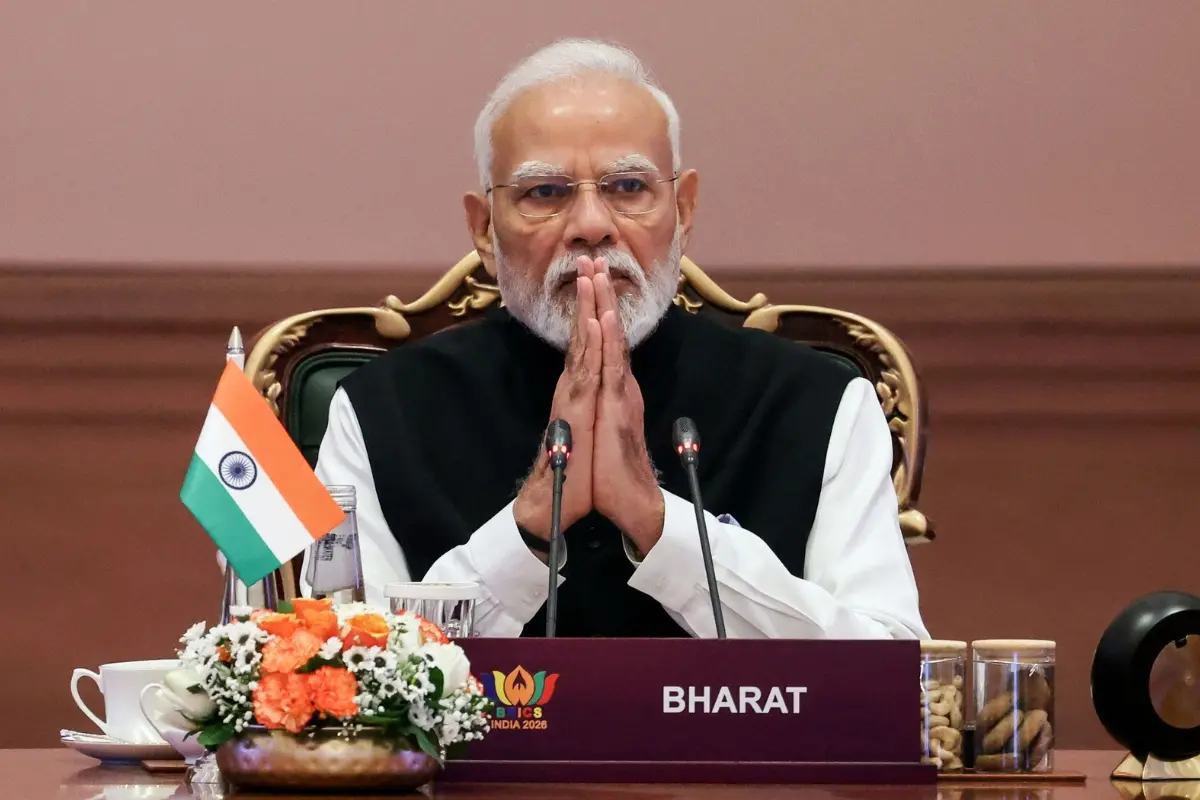
Prime Minister Narendra Modi on Saturday announced the unanimous adoption of the New Delhi Declaration 2026 at the 18th BRICS Summit in New Delhi, marking a significant diplomatic achievement for India amid complex geopolitical differences within the grouping.
'No member has raised any objection. The New Delhi Declaration 2026 is adopted unanimously,' Modi said while addressing the summit.
The consensus came after intensive negotiations that continued until 4 am on Saturday, with India leading sustained consultations to bridge differences among member countries and secure agreement on the joint statement.
According to Reuters, the declaration stressed the importance of conflict prevention, including efforts to address the root causes of conflicts.
It reiterated BRICS members’ commitment to resolving international disputes peacefully through dialogue, consultation and diplomacy.
The declaration also backed a multilateral approach that takes into account different national viewpoints and positions on major global issues.
The grouping expressed serious concern over the rise of unilateral tariff and non-tariff measures that distort trade and are inconsistent with World Trade Organization rules.
India bridges differences amid West Asia tensions
The consensus assumes particular significance because BRICS brings together countries with sharply divergent positions on several geopolitical issues. Iran, Saudi Arabia and the United Arab Emirates are all members of the grouping, despite their differing regional interests and positions.
Against the backdrop of continuing conflicts and heightened tensions in West Asia, reaching agreement among these countries presented a major diplomatic challenge.
India’s consultations and consensus-building efforts helped prevent these differences from derailing the BRICS process.
The New Delhi Declaration was adopted as India hosts the 18th BRICS Summit on September 12 and 13. India’s chairship is guided by the theme 'Building for Resilience, Innovation, Cooperation and Sustainability', with development, sustainability and innovation among the key areas of focus.
BRICS currently comprises 11 countries: Brazil, China, Egypt, Ethiopia, India, Indonesia, Iran, Russia, Saudi Arabia, South Africa and the UAE.
The grouping has emerged as an important platform for coordination among major emerging economies and for advancing the interests of the Global South in multilateral institutions.
Its agenda spans development, finance, technology, trade and people-to-people exchanges.
Modi pushes 10-point roadmap for global governance reform
Earlier at the summit session on inclusive global governance, Modi proposed that BRICS members jointly prepare 10 proposals for global governance reform, which could subsequently be developed into a BRICS Reform Roadmap by the next summit.
Modi argued that while the Global South is at the forefront of dealing with global crises, it remains underrepresented in global decision-making.
He said the proposed roadmap should focus on three areas: Representation, Responsiveness and Rule-making.
On representation, Modi said reform of the United Nations Security Council could no longer be delayed.
He called for text-based negotiations to be linked to a definite timeline and clear outcomes.
He also argued that voting power, leadership positions and policy priorities in international financial institutions should reflect current economic realities.
On responsiveness, Modi highlighted the need for faster and more effective global responses.
He proposed exploring a Seafarers Emergency Support Network to connect maritime authorities and missions, helping provide distress alerts, medical assistance, information to families and evacuation support.
On rule-making, Modi stressed that countries must have equal participation in shaping emerging global rules.
He pointed to artificial intelligence, cyberspace, outer space, biotechnology and critical technologies as areas that will increasingly shape the future.
Calling for the Global South to move from being a rule-taker to a rule-shaper, Modi said BRICS could help young diplomats and policymakers develop negotiation skills, practical training and legal expertise.
He also noted that September 12 is observed by the United Nations as the Day for South-South Cooperation, saying that adopting such an important decision on a day dedicated to the Global South carried special significance.