Jammu and Kashmir: Confident BJP eyes post-poll scenario to emerge on top of rivals
Srinagar: Even as the BJP continues to assert that they would grab power in Jammu and Kashmir in the upcoming assembly election, the fact that they are contesting only in 19 assembly constituencies out of a total of 47 in Kashmir makes this claim somewhat overambitious. Since they need a majority of 46 seats to achieve a simple majority in the assembly, the logic—or lack thereof—behind their claim has become a point of discussion in the election, as political observers keenly analyse the tactics they would use to form a government with these limited numbers. In an election where the BJP is campaigning strongly by highlighting the abrogation of Article 370 as their USP, the battle is viewed as a prestigious one for the saffron party, as they assert that it would serve as a referendum on this issue.
The INDIA bloc and other opposition parties are mainly focusing on the intricacies of the unprecedented presence of a large number of independent candidates and small parties in the election fray. NC, Congress, and PDP allege that these independent candidates, who hold considerable clout among local residents, are proxies of the BJP, intended to undermine the chances of other parties. According to them, the BJP is employing a simple strategy of winning the maximum number of seats from Jammu while ensuring the support of independents in Kashmir, where their presence is minimal. In short, they accuse the BJP of trying to reap benefits by fishing in troubled waters.
The BJP is also anticipating a political scenario similar to 2014, when no party gained a simple majority. They hope to form a government under such conditions, leveraging their advantage as the ruling party at the center. In 2014, J&K witnessed a hung assembly with PDP winning 28 seats, BJP 25, NC 15, and Congress 12. As no one could claim a simple majority, the PDP and BJP joined forces to form a government that lasted until 2018.
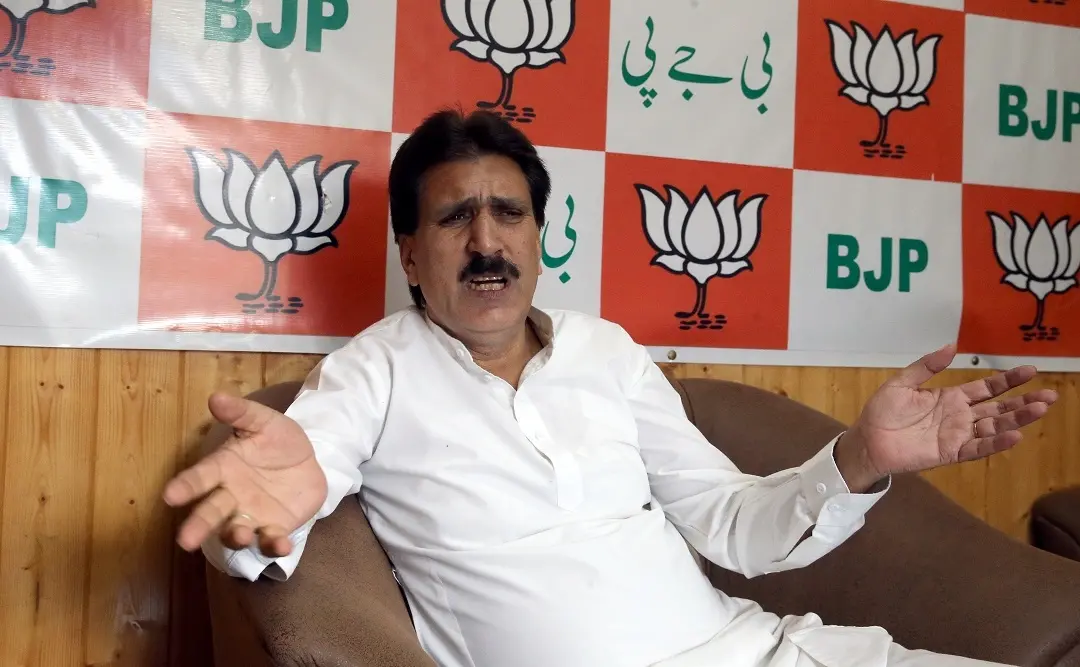
Meanwhile, Altaf Thakur, the state spokesman of the BJP, says that the party has a clear-cut game plan in Jammu and Kashmir and exudes confidence that they will come to power in the state. “We will get a huge win in Jammu and could ensure a majority with a few victories in Kashmir too,” he stated while speaking to Mathrubhumi at the state committee office of the BJP in Srinagar.
Q: Whom would you support in other seats where BJP is not contesting?
A: We have not declared any support to anyone so far. There are like-minded parties, and we had supported them during the Lok Sabha elections. We would adopt similar strategies in the assembly elections as well. But, as of now, we have not declared our support to anybody. We will not enter into any sort of alliance with anyone before the polling.
Q: NC has alleged that it is the proxies of BJP who fight in seats where BJP is not contesting. What is your reaction to this allegation?
A: The BJP has no A team, B team or C team. Neither do we have agents or proxies. We fight under the banner of BJP only. Those weak political opponents who are in the election fray are the ones raising allegations against us. The BJP has no connections with Engineer Rashid or Sajjad Lone.
Q: Again, NC alleges that BJP has entered into a secret pact with Engineer Rashid. What is your stand regarding this?
A: The idea of Engineer Rashid is aligned with the idea of Pakistan. The BJP is a party that stands for India. Our proclaimed stance is that the country comes first. The case against Rashid is that he provided financial assistance to terrorism. That is why he was jailed. The BJP would never compromise on certain issues like India’s pride and the safety of our nation. The BJP and Engineer Rashid are on different paths.
Q: BJP says that Article 370 has become history. But, NC says, if they come to power, they would reintroduce it. How do you see this?
A: Article 370 was canceled and will never make a comeback. Before the abrogation of Article 370, the situation in Jammu and Kashmir was extremely difficult. Stone-pelting, hartals, and boycotting elections were quite common then. Now, things have changed, and peace has returned. Colleges and universities function smoothly. No one could bring back Article 370. It is the Parliament that canceled it. Could two MPs of the National Conference bring back Article 370? That is nothing more than wishful thinking—just a campaign stunt.