2k tractor-trolleys, 7-day protest: Punjab farmers turn Chandigarh-Mohali border into agitation hub
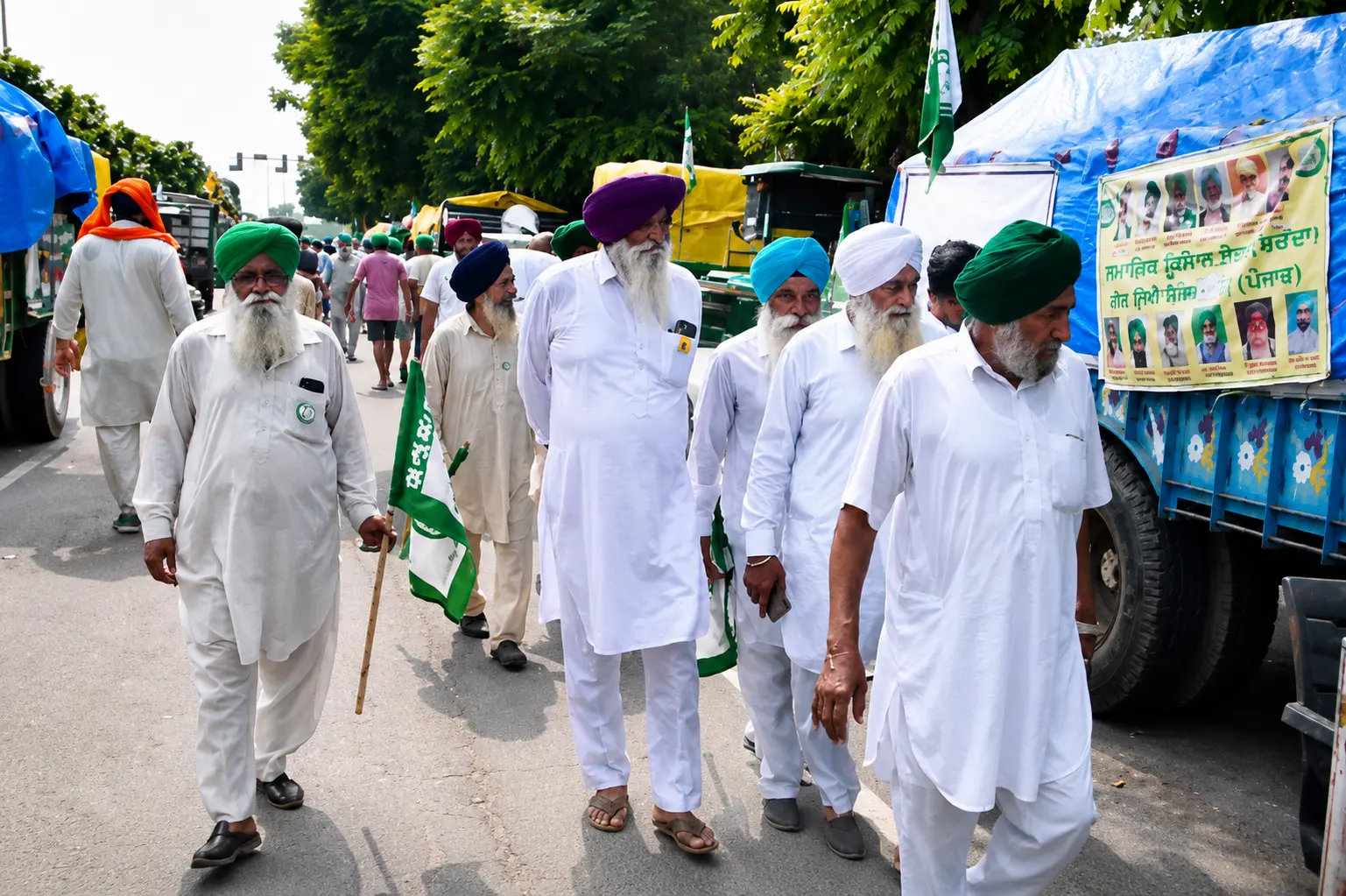
Chandigarh: The Chandigarh-Mohali border has turned into a sprawling farmers' protest site, with tractor-trolleys doubling up as transport, resting spaces and temporary shelters as thousands of farmers from across Punjab began a week-long agitation against the proposed India-US trade deal and a string of other demands.
Farmers under the banner of the Samyukta Kisan Morcha (SKM) began the protest on Tuesday, September 1, carrying ration and essential supplies with them.
Fans, beds and other provisions were brought to the site as the farmers prepared to remain there until September 7.
By Tuesday evening, farmers could be seen resting on the road and inside their tractor-trolleys, underscoring the scale of the mobilisation.
SKM leader Harinder Singh Lakhowal said around 2,000 tractor-trolleys were expected to reach the protest site by Tuesday evening. Some farmers had begun arriving on Monday evening.
'We have come here to press the Centre and the Punjab government to accept our demands,' Lakhowal said.
Several farmer organisations, including Bharti Kisan Union-Lakhowal, BKU-Rajewal, BKU-Dakaunda and Kirti Kisan Union, are taking part in the agitation.
MSP formula at the heart of farmers' demands
At the centre of the protest is the long-standing demand for a more remunerative minimum support price (MSP).
The farmers are seeking MSP for agricultural produce based on the C2 plus 50 per cent formula, or 1.5 times the comprehensive cost of production.
They have also demanded a complete waiver of the debts of farmers and agricultural labourers.
The proposed India-US trade deal has emerged as another major flashpoint.
Farmer leaders have opposed the agreement, arguing that it would be detrimental to both agriculture and the broader interests of the country.
The protesters are also seeking withdrawal of the proposed Electricity Amendment Bill, alleging that it would pave the way for complete privatisation of the electricity sector.
Another point of contention is the proposed Seed Bill. Farmer leaders contend that the legislation would dilute states' rights over seed research, development and related activities, while increasing centralisation and allowing domestic and foreign corporate companies to establish a monopoly in the seed sector.
Punjab's water crisis adds urgency to agitation
The protest has also brought Punjab's worsening groundwater situation into focus.
Addressing the gathering, farmer leaders cited a Central Water Commission report, according to which 133 of Punjab's 153 blocks have emerged as over-exploited or critical.
They said groundwater levels are continuing to decline and called for concerted action by both the Centre and the Punjab government based on the riparian principle and the constitutional framework.
The farmer leaders further demanded that the Punjab Legislative Assembly pass a resolution seeking repeal and reassessment of all 'unconstitutional and discriminatory agreements' concerning the state's water issues.
They also demanded that the price of sugarcane be fixed at Rs 500 per quintal.
Beyond sugarcane, the farmers want the Punjab government to guarantee procurement, at the MSP, of basmati, moong, maize, potato, peas and cauliflower at its own level.
Debt, suicides and rural distress
For the protesting farmers, the agitation is also about mounting rural indebtedness.
Farmer leaders attributed the growing debt burden of farmers and labourers to what they described as the 'wrong policies' of successive governments.
They pointed to a widening mismatch between rising agricultural input costs and inadequate remunerative returns from farm produce.
Their demand is for farmers and labourers to be freed from debt on the same lines as corporate houses.
They have also sought Rs 10 lakh in financial assistance for families of farmers and labourers who died by suicide due to debt and financial distress.
In addition, they want one member of each such family to be provided a government job and the entire debt, including government, cooperative and private loans, to be written off.
Among those who addressed the gathering were Harinder Singh Lakhowal, Rajinder Singh Deep Singh Wala, Prem Singh Bhang and Buta Singh Shadipur.
Farmer leaders Balbir Singh Rajewal, Harmeet Singh Qadian, Buta Singh Burjgill and Manjit Singh Dhaner were also present.
With the protest scheduled to continue through September 7, the arrival of thousands of farmers and an expected 2,000 tractor-trolleys has placed a range of Punjab's agricultural, economic and water-related concerns squarely at the centre of the week-long agitation.