‘Indian cinema is in crisis’: Venice Orizzonti winner Anuparna Roy on fear, power and films
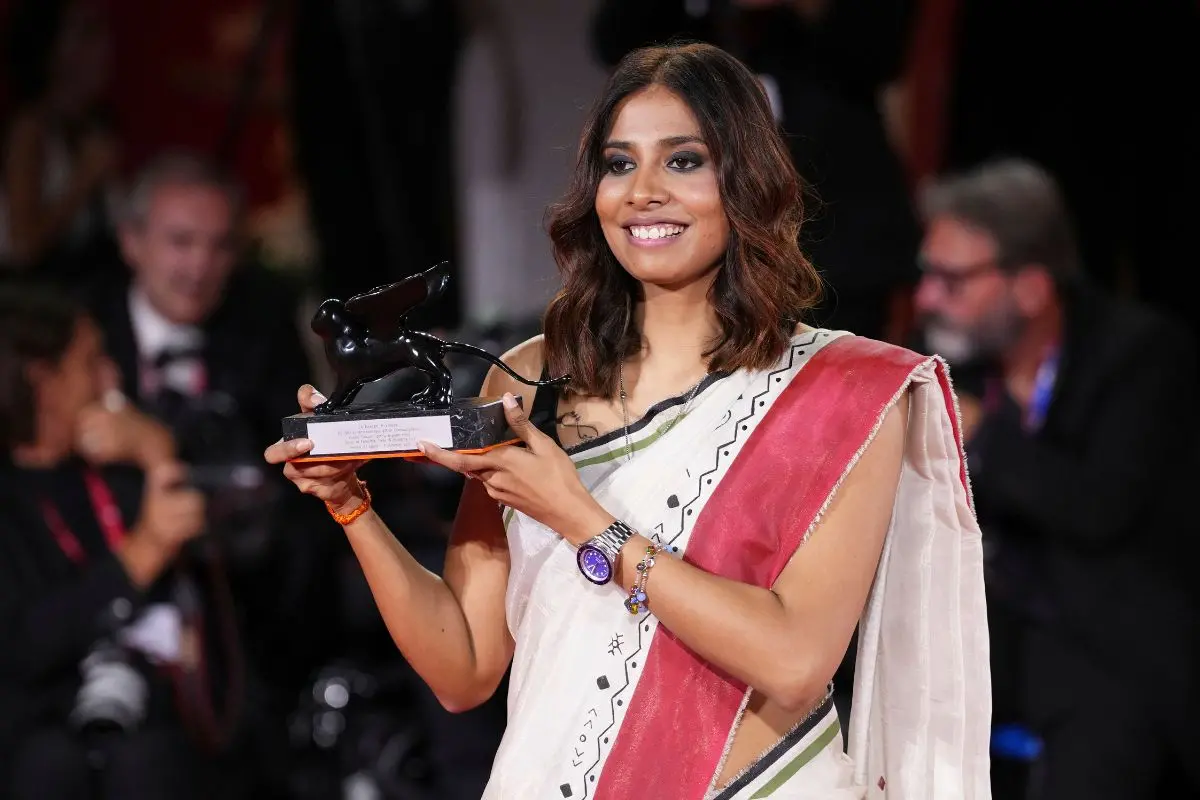
Filmmaker Anuparna Roy spoke with a mix of disbelief, gratitude, and quiet resolve — emotions that have come to define her journey so far — in a freewheeling conversation with Mathrubhumi.
In 2025, Roy emerged as one of the most compelling new voices in Indian independent cinema after winning the Best Director award in the Orizzonti section at the 82nd Venice International Film Festival for her debut feature ‘Songs of Forgotten Trees’ (2025).
Yet, for Roy, the moment was less about international validation and more about what it signified for filmmakers navigating similar, uncertain paths.
Raised in Narayanpur, a village in West Bengal’s Purulia district, Roy’s journey into cinema was neither linear nor privileged. Named by legendary filmmaker Ritwik Ghatak, she grew up far removed from film institutes, artistic networks, or industry access.
Her early education took place at Ranipur Colliery High School and Napara High School, after which she earned an undergraduate degree in English literature from Kulti College under Burdwan University, later pursuing mass communication studies.
Before cinema took over her life, Roy worked in a call centre in Delhi and later as an IT sales executive in Mumbai, navigating professional uncertainty while holding on to a quiet but persistent creative ambition. Those years, she says, shaped both her resilience and her worldview.
Her formal entry into the film industry came in 2023, when she worked as an assistant director on ‘Run to the River’ (2023). The experience, she recalls, grounded her understanding of filmmaking and prepared her for the long, often solitary process of developing her own film.
Despite the recognition that followed her debut, Roy admits she is still processing what the past year has meant.
“Definitely, Venice was something which is very, very big in my life. I always dreamt of achieving something like Venice, and that happened after a point in time when, as a first-time filmmaker, you are trying your best to get exposure to a very big festival at least. That happened to me. I don’t think I have gotten over it yet. I’m still overwhelmed to this day that something like Venice happened.”
However, Roy is quick to push back against the idea that a single award can alter the trajectory of Indian independent cinema.
“I don’t think my win can change any perspective about indie cinema in India. But definitely, it can bring different perspectives. It can bring hope to indie filmmakers in India — that we can definitely make something better and we can definitely win.”
For Roy, the larger purpose of cinema lies not in dismantling existing narratives but in widening the space for new ones to coexist.
“For me, bringing a new perspective is far more important than changing the whole stereotypical perspective that is already there. I don’t think that is a responsibility of mine — to change anything which has already been said or told. What I can do is bring new discussions on the plate, new perceptions on the plate about Indian cinema, about indie filmmakers, about Indian filmmakers.”
Asked about fear, censorship, and the pressure of being politically vocal as an artiste, Roy is unequivocal.
“Fear cannot be the editor of my work or my voice. That is something which is imposed by society. I hardly give any value to it.”
On the state of Bengali cinema, Roy consciously broadens the frame, refusing to isolate one industry from a larger systemic concern.
“To be very honest, I am not going to talk only about Bengali cinema. I am going to talk about the whole Indian cinema, which is suffering and I am not saying that my film can save this crisis, or that any award-winning film can save this crisis.”
She believes the responsibility lies collectively with independent filmmakers, not formulas or spectacle. “All of us indie filmmakers have to take a step ahead and take responsibility to make better cinema. There are no justified answers for better cinema — cinema that does not only showcase the male gaze, or objectify women, or exaggerate patriarchy, or glorify patriarchy. We have to get rid of all of it. Then only we can show human stories — stories that are already felt, experienced, seen, or heard.”
Roy is careful not to single out one regional industry. “It is not only the crisis of the Bengali industry. It would be really bad if I just pointed that out. This is a problem of the Indian film industry.” She sees hope in the rise of regional voices across the country.
“Every filmmaker is trying. Regional voices have reached there, and they want to come up with better films. We have to encourage regional filmmaking and regional filmmakers more. That is how we can reach somewhere, where we are also one of the countries where films are told in a very honest way.”
That belief in collective progress shapes how Roy views her own achievement. She repeatedly credits other filmmakers — particularly women — whose journeys offered reassurance while she was still finding her footing.
“It’s not only my win. Before me, there were a lot of other filmmakers. For example, Payal Kapadia’s win also felt great. That inspired me when I was shooting my film.”
She goes on to acknowledge a lineage of filmmakers who shaped her understanding of cinema and authorship.
“Filmmakers like Nandita Das, Zoya Akhtar, Reema Kagti, and Rima Das — they have always inspired me. Meera Nair, Kiran Rao — I guess my win and their wins together bring a lot of different perspectives about women filmmakers and indie filmmakers.”
For Roy, ‘Songs of Forgotten Trees’ (2025) is not a culmination but a beginning — a reminder that stories rooted in sincerity, patience, and lived experience can travel without losing their essence. Her journey, she believes, underscores a larger truth: independent voices from small towns and unconventional backgrounds can find their place in global conversations without carrying the burden of representation alone.
In the end, Roy sees her role simply — not as a torchbearer, but as one of many voices quietly reshaping how Indian independent cinema is seen, felt, and remembered.