Was the Loch Ness Monster spotted again? Mystery 'green mass' sparks Nessie theories
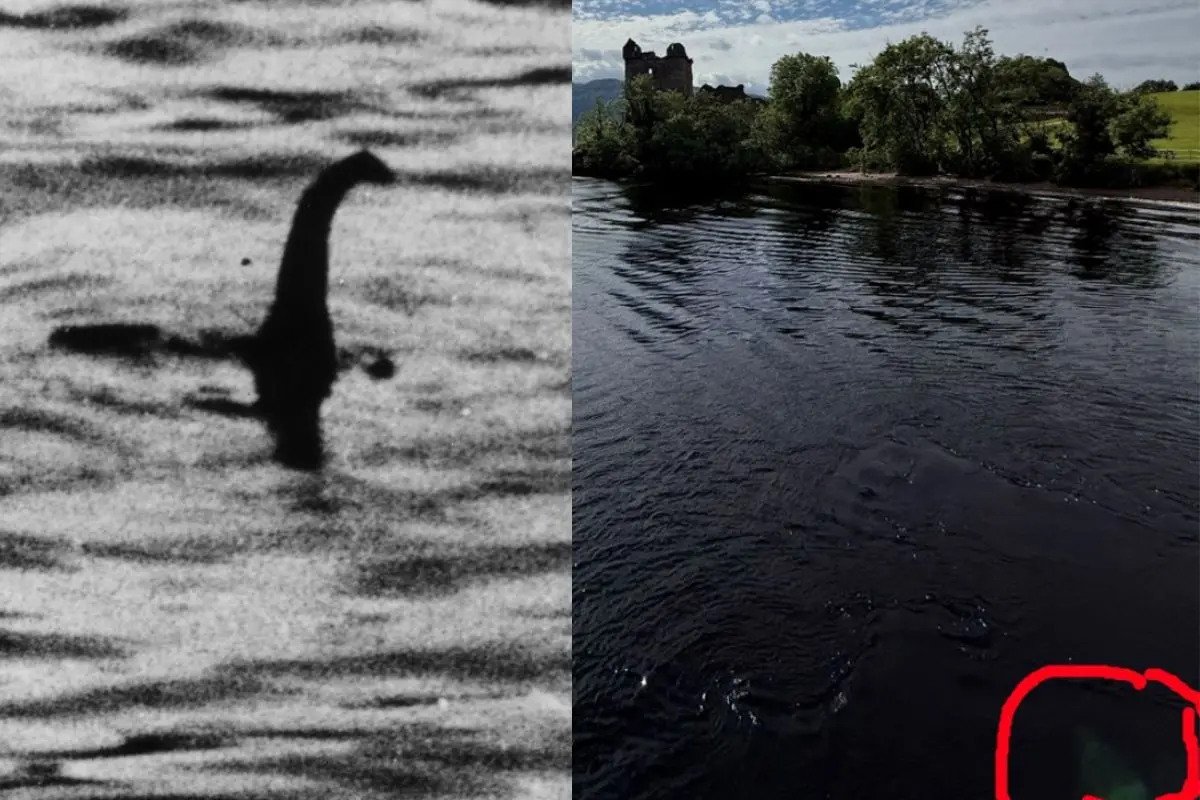
A mysterious object spotted beneath the waters of Loch Ness has reignited decades-old speculation about the existence of the legendary Loch Ness Monster, popularly known as Nessie.
The unusual sighting, recorded near the historic ruins of Urquhart Castle, has become the latest entry in the Official Loch Ness Monster Sightings Register. A tourist visiting from Kent captured an image of what appeared to be a strange green object moving close to a Jacobite Cruises boat, leaving both enthusiasts and experienced lake operators searching for answers.
The photograph, taken by Sharon Herbert during a cruise tour, reportedly shows an unidentified "green mass" beneath the surface as the boat approached Urquhart Castle. According to the sightings register, the image was captured at 10.27am as the vessel reached the shore.
Jacobite Cruises, whose boats regularly navigate the waters of Loch Ness, said the skipper could not identify the object.
"Jacobite Cruises have confirmed that their skipper says there is no explanation that they can offer as to what the green mass is."
The incident marks another chapter in the long-running mystery surrounding one of the world's most famous mythical creatures.
A year of renewed Nessie sightings
The latest photograph is reportedly the seventh potential Nessie sighting recorded this year, adding to renewed interest among monster hunters who have spent decades searching the loch for evidence of an unknown creature.
Since January, the Official Loch Ness Monster Sightings Register has recorded six reported in-person encounters and one webcam capture. This compares with 2025, when six in-person sightings and four webcam reports were documented throughout the year.
According to Daily Star, the recent wave of reports began in March when American tourist Tony Inhorn claimed to have seen a dark greenish-grey shape emerging from the water.
Describing the encounter, he said, "She came about two feet out of the water and her exposed portion was about five to ten feet in length, suggesting it was just her very top. She was about 15 feet from the boat I was on."
He added, "Nessie hovered for about five seconds, then dipped back into the water. Her body emerged against the chop of the surf, but appeared clearly defined against the waves, leading me to believe it wasn't just the current."
Further reports followed in April. US visitor Sara Gubicza said she spotted a triangular shape in the middle of the loch while travelling past on a bus.
"The fin size was about an 18 inch triangle and it was whitish grey. As far as how fast it was moving, I'm not really sure as I was on a bus riding by when I saw it. It seemed to be right in the middle of the loch. It wasn't close to any shore line."
Days later, Canadian visitors Margaret Sunstrum and Joan Sweeney reported seeing a large whale-like shape in the water. Worcestershire resident Holly Palmer also recorded an unidentified object later that month, while US tourist Nickolas Wiegand filmed a dark shape breaking the surface in May.
Experts once feared Nessie sightings were disappearing
The latest reports come after concerns among some Nessie researchers that sightings of the creature had become increasingly rare.
Rob Long from the Loch Ness Exploration (LNE) team previously expressed concern over the decline in reported encounters, saying the lack of sightings was unusual for the group of volunteers who regularly monitor the loch.
"There is a real fear for her as it normally is not this long that we go without a single glimpse.
"Normally people from our team will see her but so far, none of us have. Others have claimed to but we have not seen waters this quiet.
"The viewings have gotten less over the years, but never this scarce for us. Despite the lack of viewings, 2024 was the year we got the most definitive proof that Nessie exists - with the sonar recordings among the best we have ever got."
Long also suggested that while sightings had declined, previous evidence collected by researchers continued to fuel interest.
"So although the viewings were scarce, they were of better quality. Now there's nothing.
"Nessie has been there, we all know it, but she is clearly getting wise to people looking for her. We also think she is being put off from additional activity in the loch, such as people wanting to try cold water swimming."
The LNE has continued its search efforts despite fewer reported encounters. The group recently introduced a high-tech research boat equipped with hydrophones, sonar equipment, thermal imaging, infrared cameras and 4K recording technology to investigate unusual activity above and below the water.
The enduring legend of Loch Ness
The Loch Ness Monster remains one of the most recognisable mysteries in modern folklore. According to Scottish legend, Nessie is believed to inhabit Loch Ness, a large freshwater lake in the Scottish Highlands near Inverness.
Descriptions of the creature have varied over the years, with many reports portraying it as a large animal with a long neck and one or more humps visible above the water. However, despite decades of searches, no scientific evidence has confirmed the existence of such a creature.
The modern legend began gaining worldwide attention in 1933 after several reported sightings near the loch. Improved road access around Loch Ness gave visitors clearer views of the water, leading to increased reports of unusual creatures being spotted.
One of the earliest famous accounts came in April 1933, when a couple claimed they saw a large animal resembling a "dragon or prehistoric monster" cross their path before disappearing into the water.
Later that year, the Daily Mail sent big-game hunter Marmaduke Wetherell to investigate reports of a sea serpent. He claimed to have discovered large footprints along the shoreline, but experts at the Natural History Museum later concluded that the tracks were fake and had likely been created using a modified object resembling a hippopotamus foot.
The mystery grew further in 1934 when Robert Kenneth Wilson captured what became known as the "surgeon's photograph". The image appeared to show a creature with a long neck emerging from the water and became one of the most famous pieces of alleged evidence supporting Nessie's existence.
Some researchers at the time speculated that the creature could have been a surviving plesiosaur, a marine reptile believed to have gone extinct millions of years ago. However, scientists have not found evidence supporting the idea that such an animal could survive in Loch Ness.
While scientists and sceptics have offered explanations ranging from floating debris and waves to misidentified animals, the fascination surrounding Nessie has remained strong for nearly a century.