Ode to Saraswati Puja: Bengalis’ own Valentine’s Day
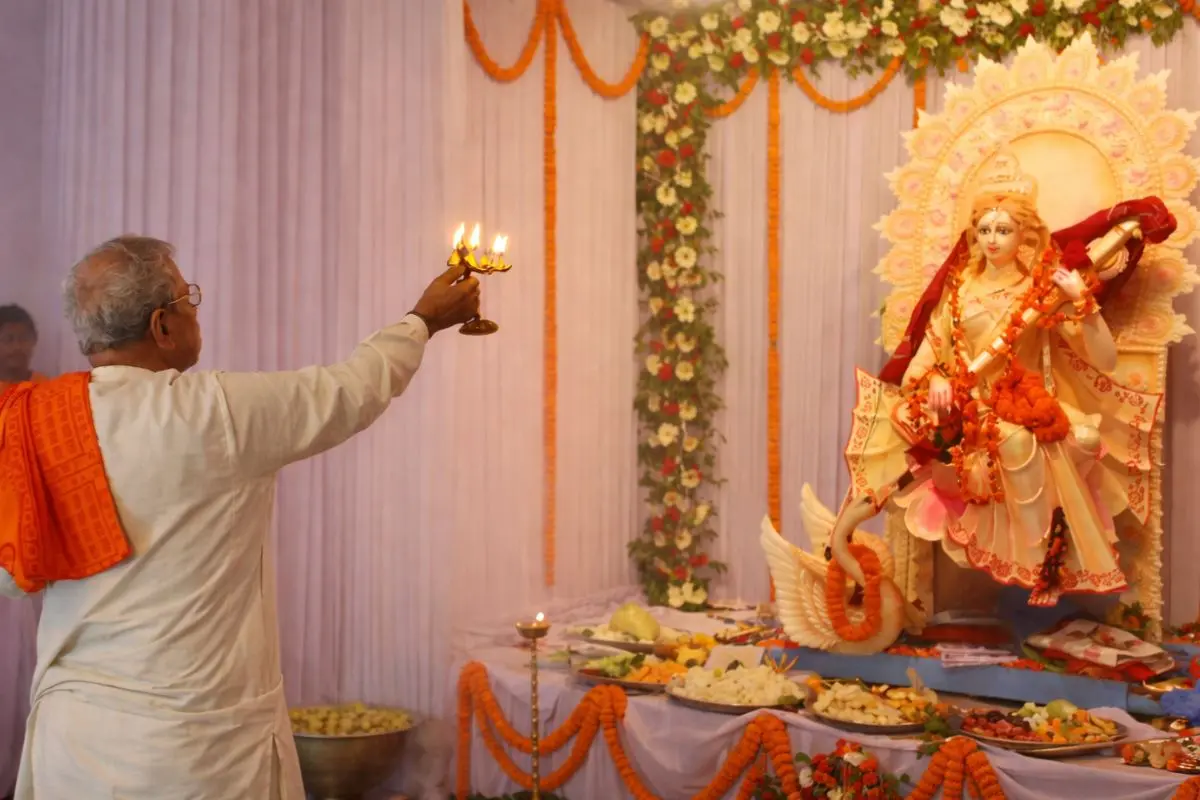
Tomorrow is Saraswati Puja — a day Bengalis lovingly call their own version of Valentine’s Day. However, this day was not always defined by romance alone.
Of course, love eventually became the showstopper. Yet in our childhood, Saraswati Puja arrived like a long-awaited blessing, a red-letter day for every schoolgoer. It meant no studies.
Parents wouldn’t dare ask you to step into the study room or even touch your books. The belief was absolute: if you studied on Saraswati Puja, thakur ‘paap dyay’ — meaning the goddess would ‘withhold her blessings’. And no Bengali household wanted to take that risk.
For nearly a month before the puja, young children and teenagers would roam through neighbourhoods and para lanes, collecting chanda (donations) to organise their own Saraswati Puja. There was, however, a delightful condition to earning that money — you had to spell “Saraswati” in Bengali correctly. That was the innocent joy.
More often than not, kids failed miserably. Yet they never returned empty-handed. Such was the magic, such was the mercy of Saraswati Puja.
Children dressed in new clothes — young boys in crisp panjabis (the Bengali version of Kurtas), girls glowing in basanti (yellow) sarees. They fasted patiently until the aarti or anjali — the sacred chanting of Sanskrit mantras — was complete. And then came the long-awaited reward: bhoger proshaad, food offered to the goddess and shared with devotion.
One special attraction was kul (ber fruit). There was a popular belief that students were forbidden from eating kul before Saraswati Puja. If you did, the goddess of knowledge would be displeased, and exams would go terribly wrong. Fear, faith, and folklore blended seamlessly.
Schools across the state shimmered with celebration. The air carried the unmistakable aroma of khichuri and lyabra — a rich medley of vegetables. I still remember how enormous the demand for pandits was. Saraswati Puja was everywhere — in homes, schools, colleges, and at every nook and corner of the locality.
People would practically play tug-of-war on the streets, pleading with pandits to come and perform the puja at their venue. For teenagers and college-goers, Saraswati Puja unfolded differently.
Love had just begun to make sense. Saraswati seemed alive on the streets — women in yellow sarees, eyes full of quiet magic.
Hotspots across Kolkata — Dhakuria Lake, Sarobar, Jadavpur University, Shyambazar, and countless unnamed lanes — brimmed with couples lost in romance, momentarily forgetting their maths problems and unfinished assignments.
Maybe this is no longer the age of innocence. Maybe pandits will someday be replaced by ChatGPT bots chanting mantras.
Yet the true essence of Saraswati Puja lives on — in our hearts, in our collective memory, in the endless quest for knowledge and learning that flows through generations. For every Bengali, Saraswati Puja is not just a festival.
It is nostalgia.
It is innocence.
It is a feeling that never quite fades!