'Nihilist Penguin' explained: Viral clip behind the White House’s geography blunder
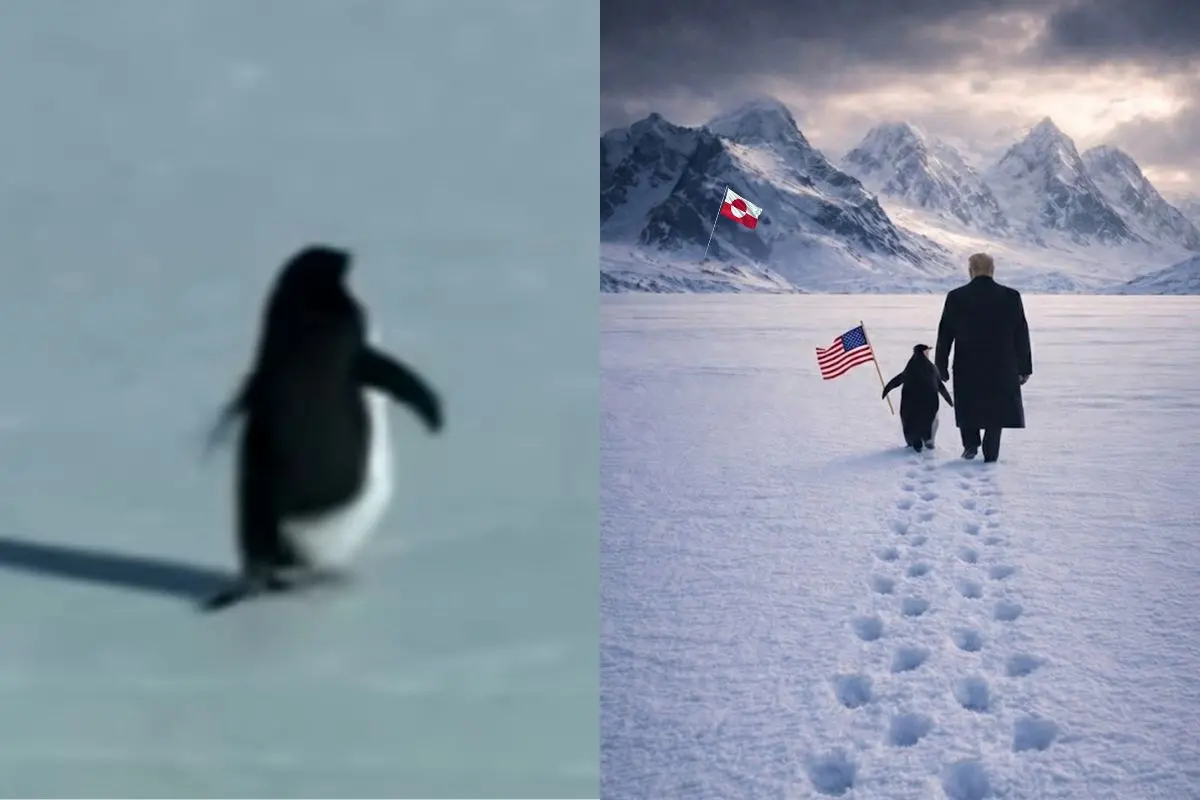
A decades-old documentary clip has unexpectedly become one of 2026’s biggest internet obsessions, transforming a solitary penguin into a global symbol of existential dread, burnout and quiet rebellion. The resurgence of the so-called “Nihilist Penguin” coincides with a separate controversy in the United States, where the White House shared an AI-generated image of President Donald Trump walking alongside a penguin toward Greenland – an animal that does not inhabit the Arctic at all.
The juxtaposition has fueled a wave of online mockery, confusion and fascination, pushing the lonely penguin to the forefront of global social media once again.
White House post sparks uproar
The latest burst of attention began when the White House posted an AI-generated image depicting President Trump strolling beside a penguin toward snowy mountains, with the bird carrying a US flag and Greenland’s flag appearing in the background. The caption read, “Embrace the penguin.”
The image quickly drew backlash. Critics pointed out that penguins are native to the Southern Hemisphere and do not appear anywhere in the Arctic. Journalists and commentators openly ridiculed the geographical misfire. As The Guardian’s Pippa Crerar noted, “You don’t get penguins in the Arctic.”
The post was widely interpreted as another symbolic nod to Trump’s long-standing interest in acquiring Greenland from Denmark – even as he pauses trade tensions with Europe. But it also coincided with something bigger already unfolding online: the revival of a much darker penguin story.
A lone bird, a long walk and a rediscovered documentary
Well before the White House image went viral, users across social platforms were sharing a clip from Werner Herzog’s 2007 documentary ‘Encounters at the End of the World’. In the footage, an Adélie penguin drifts away from its coastal colony and begins marching inland — not toward the sea, but toward remote Antarctic mountains nearly 70 kilometres away.
There is no food or breeding ground ahead, only ice and isolation. Herzog famously described the behaviour as a “death march.”
The stark scene, resurfacing almost two decades after it was filmed, captivated younger online audiences encountering it for the first time.
How a wildlife clip became 2026’s existential mascot
Users quickly transformed the footage into a cultural metaphor, projecting their own anxieties and emotions onto the penguin. Many framed it as a symbol of disillusionment, burnout or philosophical defiance, pairing the clip with captions such as:
- “When you’re done with everything.”
- “He knows something we don’t.”
- “Me walking away from my problems.”
The term “Nihilist Penguin” stuck – and spread.
In the middle of global uncertainty, persistent stress and digital fatigue, the penguin’s solitary trudge resonated deeply. What scientists see as unusual but natural animal behaviour, the internet reframed as a mood.
Scientists urge caution
While the memes lean into human emotion, researchers insist the behaviour is not symbolic. Experts say lone inland journeys can be triggered by several factors, including:
- disorientation caused by environmental cues
- stress or confusion during the breeding cycle
- neurological issues or illness
- instinctual errors common in wildlife
The penguin, they note, was almost certainly not making a philosophical choice.
But that has not stopped millions from interpreting it otherwise.
A cultural mirror for modern life
The viral moment ultimately speaks less about penguins and more about people. Online, the bird has become shorthand for feeling lost, overwhelmed or detached – a quiet protest against routine and expectation.
As one meme summed it up, “The penguin knows,” while another suggested it was “heading toward oblivion.”
In 2026, the “Nihilist Penguin” has become a surprisingly fitting emblem of the digital age: a creature that simply wandered off, yet somehow captured the internet’s deepest fears and funniest self-reflections.
Sometimes, a penguin walking into the mountains is just a penguin. And sometimes, it’s a whole mood.