Fashion and textile designer Sreejith Jeevan’s house that remembers everything
Most of us travel to escape our walls. Sreejith Jeevan and his photographer wife, Anoodha, travel compulsively and then carry the trip back, one object at a time, until the walls begin to talk.
Their home, Roukaveedu, sits a short drive from Fort Kochi. His grandfather built it in 1961, when the modern Kerala home meant arches, mosaic floors, curved balconies and open terraces. Sreejith calls it his version of Kerala Modern.
It stands on four cents of land, with roughly 1,000 square feet on each floor. It keeps the old vocabulary of laterite walls, red oxide floors and wooden doors and windows. Inside, though, there is no straight timeline. It reads like an autobiography with the chapters shuffled.
A house that has been everything
It began as Sreejith’s father’s bachelor pad, then became the family home after his marriage. Over the decades it housed a long list of relatives.
In 2013, Sreejith took it over as the base for Rouka, his label built around Kasavu and cotton, and for years it worked as a studio.
Now, with two children, he is moving back in as a home. The return is bittersweet, because he recently lost his mother. As he puts it, spaces shared with parents in good times turn into amulets. Roukaveedu holds generations, and it feels like it.
Also Read: Malavika Mohanan’s house is proof that a home can carry its roots
Where the past sits in plain sight
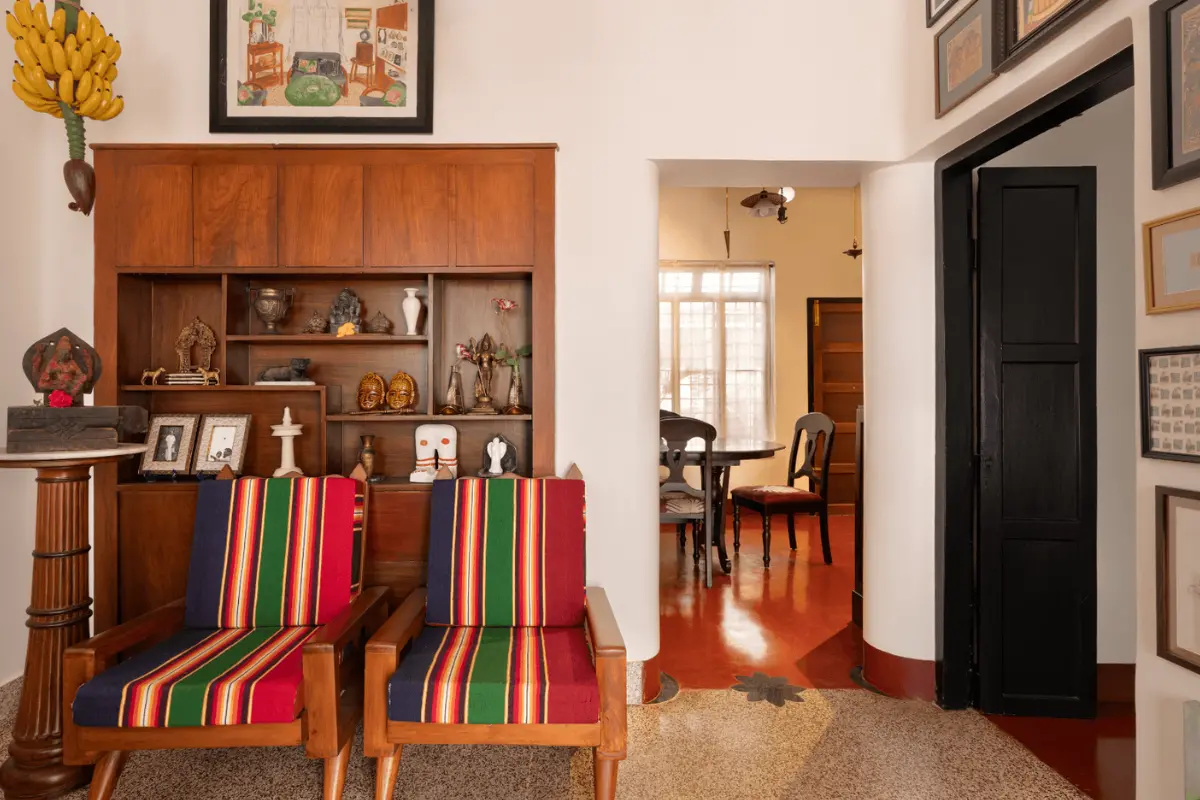
The living room is where it shows most. Everything here was gathered slowly, Anoodha’s photographs, Sreejith’s drawings from his student years in Paris, and scribbles by their son, Spandan.
Chairs from a shop that once supplied furniture to tribunal judges now wear Rouka appliqué. Others got a Jamakalam makeover, using the striped carpet fabric woven in Tamil Nadu. Much of the wood is reclaimed and treated for Kerala’s humidity. The mirror-topped table began life as a bakery shelf and now holds fruit instead of croissants.
Temples and churches feed the rest. A bright yellow banana carved by a temple woodcarver hangs above a goddess found on a holiday in Palakkad. A Tanjore Mariamman was commissioned specially.
A photograph of the Diwan of Kochi, an ancestor six generations back, shares space with an old picture of the Guruvayur temple from his grandmother’s family album. Near Fort Kochi he hunts down convent lace and stitches it onto curtains and furniture, to induce Kerala into every room.
Layering as a way of living
“As a textile and fashion designer, even the home for me becomes an experiment in layering and textures,” Sreejith says.
The dining room follows that instinct, with framed textiles, Kerala leather puppets and stone carvings around a six-seater table, each carrying a different reference.
Upstairs, an old post-office letter-sorting unit now stores the knick-knacks they have bought or been gifted on the road. A large Kutch textile recalls their years at NID Ahmedabad. Ayyanar horses sit beside a Tanjore mirror and Anoodha’s photographs of oil lamps being lit at the Sun temple.
Then there is the wall on the way to the terrace, which Sreejith calls the house’s most secular wall of prayers. Every deity the family prays to has a place there, especially the local ones.
Flowers hold the days together. Before each Onam, his Instagram fills with his Pookalam reels, which have a dedicated fan following. With his green thumb, he grows his own flowers and changes the offerings at the smaller altars every morning, as a calming meditation.
Ivory curtains hold tone-on-tone embroidery of moon phases, foliage and palm leaves, finished with a ruffled frill borrowed from temple drapery. The motifs come from Rouka’s own library. A reading chair wears a piece of textile art inspired by Munnar’s tea plantations, a favourite weekend escape.
Also Read: The case against Beige, what a Polka Dot knows about fear
In the master bedroom, three temple images the family visits regularly hang above baskets from different craft clusters, koodais, wire bags, Assam grass bags. All of them hang from a carved piece of wood picked up in Kottayam and turned into a hook. Above them are three of Sreejith’s own photographs of offerings: the grass garlands of Thiruvananthapuram’s Ganapathy temple, jasmine from Maruthamalai in Coimbatore, and the banana and silk offering at Guruvayur.
It is an ordinary household hook carrying an extraordinary amount of geography. Nothing here insists on matching, sets or sameness.
We tend to treat travel as something that takes us away from ourselves. People who have been on the road for years often say they can talk about nothing else. Sreejith turned his love of the road into a road that leads inward.
The lesson is radical. You do not need a bigger house, a matching set or a design plan. You need to stop packing your memories away. What you love can live in plain view, on a wall, on a hook, in a chair that used to seat judges. Roukaveedu is, ultimately, a house where the things you love stay within reach, memories included.
So look around your own home tonight. If it could tell your story, would it? And if it can’t yet, what are you keeping in a drawer that deserves a hook?
(Disclaimer: All images used in this article are the property of Syam Sreesylam. Credit goes to the photographer.)