Why failed heroes captivate audiences? Devdas, Chidambaram and Vidheyan
“Success” and “failure” are two sides of the same coin. It depends on the perspective of common men and women to define the two words triggered by our social conditioning. These again, are trapped within socially acceptable terms such as “solid education”, ‘good career’, ‘talent’ and ‘affuence’ all of them fleshed out in physical terms. Those who are jobless, or are not even interested in a job, those who lack ambition or goal even within the immediate informal circle like “home”, “family’, “wife” and “children” are considered failures in life. And if, by any chance, a given person flops because of his/her incurable addiction to liquor, drugs, gambling and so on, everyone gives up on him/her as a failure in life whose life ceases to hold value to those who know him.
Is it natural for the audience to be weary of larger-than-life heroes with tanned, muscular bodies who can overturn a truck with bare hands or bash up dozens of goons at a single stroke and in its place, accept this normal man with extra-ordinary dreams who cannot cope with failure and walks out of life because of his personal failures? No one knows. But for us, perhaps, Sarat Chandra Chattopadhyay’s novel is the best example of a ‘failure’ becoming one of the biggest success stories for Indian literature and cinema.
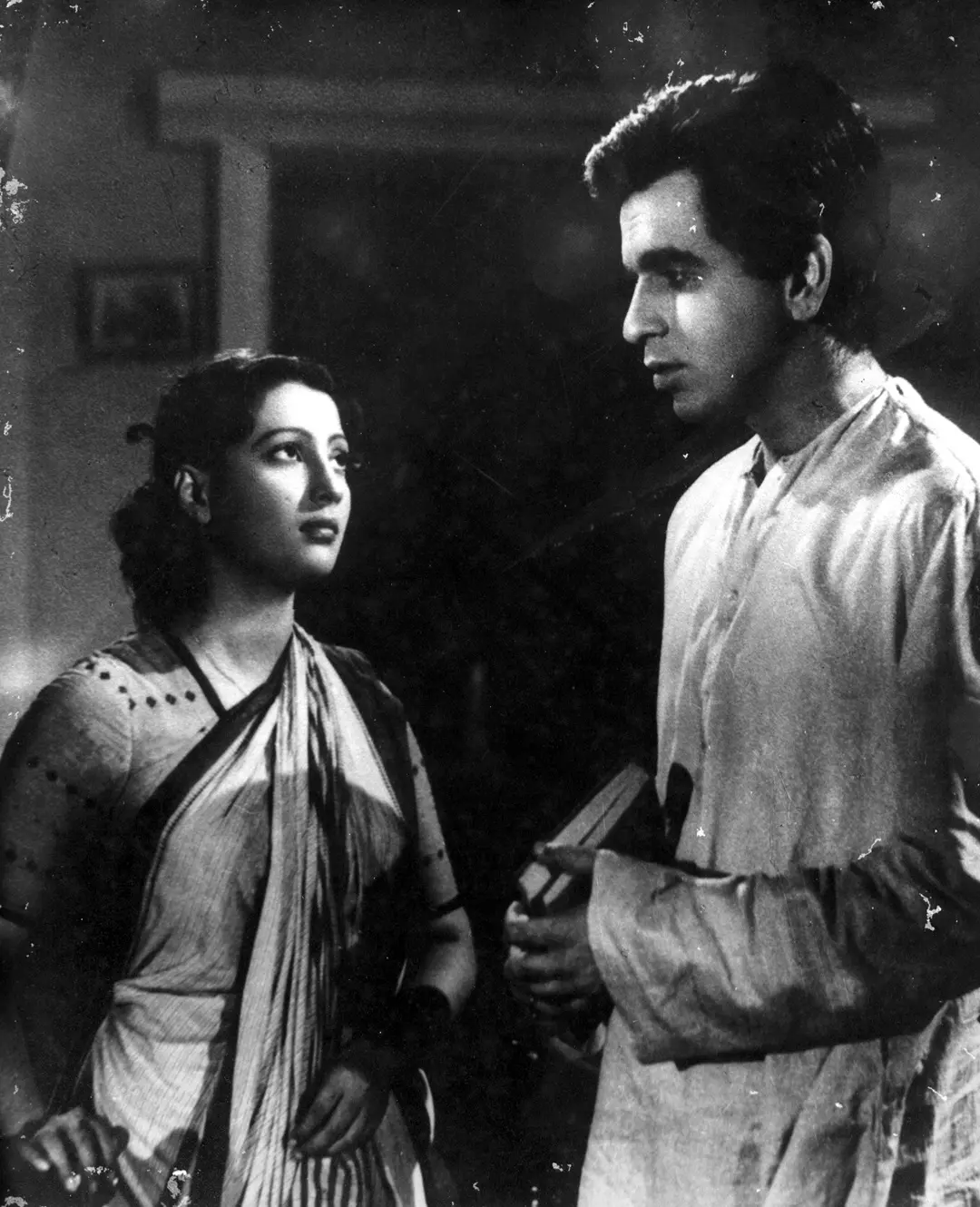
Devdas the famous Bengali novel, originally published in 1917, began its celluloid journey from the silent era in 1928. Three of its most memorable celluloid adaptations were the two by Pramathesh Chandra Barua, in Bengali (in 1935) and Hindi (in 1936), for New Theatres; and Bimal Roy’s Devdas (1955) featuring Dilip Kumar, Vyjayantimala and Suchitra Sen. All three films had a beautiful musical score that remained faithful to the original novel.
The 1935 Devdas, produced by New Theatres, remains an all-time favourite. It made Barua (1903-1951) an overnight star and revolutionalised the way cinema was perceived. It was no longer just about entertainment. Now, cinema could be used for social concern and to express literature on celluloid. Chattopadhyay, who was a frequent visitor of the New Theatres studio in south Calcutta at the time, said to Barua after seeing Devdas “It appears that I was born to write Devdas because you were born to recreate it in cinema.”It is rare to hear such praise from a writer. Over time, the character of Devdas became synonymous with the name of Barua. Till today, the image of Barua, the man, is inseparable from the image of Devdas, the character he played.
The conjecture around the success of the novel’s translation into English, by Sreejata Guha, first published in 2002, is quite strange. Looking back, Devdas, the character, is a failure in life, in love, and within his family. He is a bad son who is “whitewashed” by the author when he gives his share of the inheritance to his mother before walking away. He does not give it out of love and duty to his mother. He does it because he has already stepped into a world where his family, including the inheritance, have become meaningless for him. Do failures in cinema and literature make great heroes for the audience and the readers?
Shakespeare’s Hamlet and Othello are also failures, if looked at from a certain perspective. Yet, they are immortalised in different representations in literary criticism, drama, and cinema. The two women in Devdas’s life are stronger, more confident, and more powerful than Devdas could ever hope to be. They make their choices when they have to and, as much as possible, live life on their own terms. Not so, Devdas. He harbours a narcissistic, tempestuous love, he wallows in self-pity; his ego hurt by his father’s rejection and Paro’s marriage to a kind zamindar whose old age guarantees that her virginity remains intact. He makes alcohol his wife, his mistress, and his companion, in life and in death.
Why, even Apu who was small in Pather Panchali and grew up through Aparajito and Apur Sansar, turned out to be a failure in the game called life. He is an escapist who uses his wife’s early death as an excuse to run away from the responsibilities of fatherhood and in the end, introduces himself to his little son as “friend.” Even in Aparajito, his mother dies waiting for him but he does not come back to the village. Yet, we all love the evolution of Apu. In Ghatak’s Ajantrik, the owner-driver of the rickety Jagaddal, Bimal, is also a failure. The hero in Ghatak’s Nagarik, slides down from lower middle class to a slum not because he did not do anything but because the post-independence socio-economic circumstances forced failure on him.
G. Aravindan’s Chidambaram (1985) is a psychological and spiritual masterpiece that explores themes of guilt, moral decay, and redemption. Adapted from C.V. Sreeraman's short story, the film is set against the sprawling, quiet landscapes of the Kerala-Tamil Nadu border, the lush, misty Nilgiris function as both an Eden of purity and an overwhelming, humbling force. While the men in the film view the landscape as a revenue generator or something to be "tamed," the women are connected to its romantic and fleeting beauty.
The main core of the film focusses on the devastating fallout of an illicit affair between the estate manager Shankaran (Bharath Gopi) and the newly married bride of one of his labourers. But was there really an ‘affair’? Or was it just conjecture, and a slight suspicion in the mind of Sivakami (Smita Patil)’s husband Muniyandi (Srinivasan) a labourer employed by Shankaran? There is not the slightest clue that Shankaran and Sivakami were ever physically close but a strange warmth grew between them as Sivakami stepped into his house to do the general chores of a housemaid. There are clearly drawn caste and class differences between Shankaran and the newly-wed couple. Muniyandi commits suicide and Sivakami goes missing while a very quiet and restrained Shankaran seems to suffer from some strange guilt one cannot pinpoint till the end.
From a solemn, reserved and quiet estate manager, Shankaran slides down the moral ladder from a mysterious sense of guilt following Muniyandi’s suicide and slowly becomes an alcoholic, incapable of leading a normal life any more. He sets out alone, perhaps to try and absolve himself of his ‘guilt’ and the film changes its tracks in the second half. What guilt? Perhaps the guilt of Muniyandi’s suicide and he somehow, guesses at the cause? One never quite gets to know. This is an example of how a “successful” man descends from his “success” to become a failure.
The film's musical narrative is built around "Thondar Anchu" (The Five Senses) and not on the Nandanar songs associated with the Chidambaran temple where Sivakami hails from. This, along with the long silences with very little dialogue invests the film with a strange, mystic and emotional impact.
The title Chidambaram connects with the Chidambaram Nataraja temple, symbolizing a space for spiritual shedding and inner liberation. Shankaran ultimately journeys toward a place where he can seek forgiveness and heal his broken conscience. We find the camera focussing on the cracked face of Sivakami, a ghost of her former self, looking up, with a shocked look at who, one cannot be certain about. Shaji Karun’s brilliant cinematography gives an extra edge to the film in terms of the contrast it presents through the beautiful cattle farm with lovely trees and flowers outside and the sparse and dry interiors of Shankaran’s home and office. The other contrast is between the two halves of the film, the first half narrating a strange story and the second half trying to find the answers and turning into a journey, emotional, moral and physical.
Adoor Gopalakrishnan’s films often depict failures in life and he does it with subtlety and constraint that, over time, defines his style, his perspective and his approach to life and to cinema. Is it that failures attract him as solid stories for cinema or does this connect to his choice of stories for films? These are questions best answered by him but though Mukhamukham, Vidheyan and Elipathayam are completely off-mainstream films not targeted at the box office, they have been widely viewed by the audience across decades. This writer has chosen Elipathayam (1981) for the most obvious failure as a human being and as the protagonist of the film.
Unni (Karamana Janardanan Nair) is a middle-aged landlord somewhere in a village in Kerala. He is the radical opposite of the common image and conception about landlords who own large tracts of land and plantations and live in a mansion with a large retinue of servants who eat out of their hands. Lazy beyond belief, he is a complete social recluse who runs away from any kind of social interaction with relatives, neighbours, his farm hands or visitors. He does not interact even with his two sisters, Rajamma (Sharada) and the pretty Sridevi (Jalaja) who take care of him. To ensure that his comfort matrix remains undisturbed, he keeps cancelling any marriage alliance that comes for Rajamma. She is visibly sad and disturbed but has never learnt to question her brother’s decisions. Sridevi is more conscious and takes the first opportunity to elope, presumably with a boyfriend, without leaving a note. Unni, however, is too scared and too lazy to bother about finding out her whereabouts.
As Rajamma’s condition worsens, she is taken out of the house much like the rats were. When Unni realises he has no one to fall back on now, unable to live without their support, he goes out of control. The villagers carry him to the same pond where the rats were drowned but he rises from the murky waters, perhaps to face his destiny all alone…
The test of a great film lies in that each time one watches it, different layers of meaning begin to emerge that may not have been noticed in the earlier viewing. Elippathayam is one such film that offers different readings at different viewings, especially when each successive viewing has a reasonably long time-gap as one’s viewing also matures over time. I have seen this film thrice now with huge gaps in between and it has been an extremely enriching experience each time.
Elippathayam is not just arguably Adoor Gopalakrishnan‘s greatest film, but also one of the finest Indian films ever made. Set against the decaying feudal set up in Kerala and showing a microscopic eye for tiny little details, Adoor brilliantly deals with the tragedy of an idle, lotus-eating man who exemplifies selfishness, personal failure and subtle violence in a way that destroys the lives of not just himself but also those he lives with. Unni is perhaps the most unconventional protagonist one has encountered over the history of Indian cinema. The ambience he lives in – physical, mental, filial – defines him. Unni is an escapist, a coward and a narcissist whose entire life is divided between taking care of himself on the one hand and on the other, making his two sisters attend to all his cares including capturing rats who invade the home and even eat up into his ironed shirt. Sridevi, the younger sister, keeps drowning them in the pond behind their home after catching them in the mousetrap. Unni is unperturbed because he knows his needs will be taken care of by his sisters. He is unconcerned when his sisters point out that their coconuts are being stolen. And while he feels physically attracted to a farm hand who tries her best to seduce him, he literally begins to walk faster away from her in order to avoid her…
The Rat Trap, the title of the film in English, is not just a physical reality but is also a metaphor. The large, dilapidated family home of the Unni family itself is a rat trap wherein one must either die or remain trapped or go berserk if one cannot escape. Each member is captive within his/her own rat-trap which Sridevi manages to escape from but Rajamma gets trapped within. By the film’s end, Unni rises from the slushy pond, his hair dripping with water, water dripping off his clothes which suggests that he is doomed to live in the rat trap he has reduced his life and his home to.
Karamana Janardanan Nair gives a goose bump-inducing performance as Unni. He is always seen reading a newspaper which appears more like an escape route to avoid communication with anyone, including his sisters. One wonders whether he reads the newspaper at all except once, when he sees an advertisement for “male rejuvenation” medicine. But he does not follow it up. Once we see him step into a room where Sridevi stayed, and probing through her notes, discovers a letter. A convincing cameo is turned by the actor who visits Unni with a marriage proposal for Rajamma where he points out that Unni keeps cancelling all the matches he brought for Rajamma. Before leaving in anger, he takes the glass of buttermilk from Rajamma – a lovely touch. “It’s good for the heat,” he says. The neighbouring farmhand who tries to seduce a scared Unni is also very good.
Cinematographer Mankada Ravi Varma has lit up the film beautifully even as he shifts gears from tight close-ups of the beads of sweat on Unni’s forehead whenever he is nervous and shaky and frightened, which he always is, to mid-shots of the rat-trap being carried back to the pond from a particular angle as if from an outsider’s perspective to a close-up of Rajamma’s face that changes expression from happy curiosity to sad compliance when she eavesdrops into the conversation around her proposed marriage.
The soft lighting in the indoor shots invests the film with a new dimension, holding characters and objects in relief within circles, slices and sheafs of light while the backdrop turns darker. The surrounding outdoors filled with the lush green mantle of nature defines a symbiotic contrast with the darkness – physical, emotional and social – of the Unni home. Whenever the rat trap or Rajamma is being carried to the pond, the soundtrack is filled with a queer and disturbing sound that offers a different perspective on the ugly twittering of rats and preempts the stark tragedy that is to follow. The editing is seamless, its rhythms of daily life blending perfectly with the film.
Elippathayam was screened at the Cannes Film Festival of 1982 and bagged the Sutherland Trophy at the London Film Festival that year. It also won the British Film Institute Award for the Most Original and Imaginative Film. Back home, the film picked up National Awards for Best Film in Malayalam and Best Audiography and the Kerala State Award for Best Film.
There are many other films featuring failures as protagonists which can go into a voluminous book of “Failures in Films.” But among filmmakers themselves, the two regarded as failures when alive, but looked back as distinctive icons of Indian cinema are Ritwik Ghatak and John Abraham.