Why Kerala wants virtual autopsy: The science, the benefits and the challenges
Healthcare remains a key priority in Kerala, with the government introducing several initiatives to improve the quality of medical services. While caring for the living remains central to the healthcare system, preserving the dignity of the deceased is equally important in forensic medicine.
The drowning death of an eight-year-old boy at a swimming pool in Kumarakom, Kottayam, renewed discussions on introducing virtual autopsy in Kerala. "Doctor, is it possible to avoid performing a post-mortem on my child?" This heart-wrenching question from the child's father became an emotional reminder of the need to preserve the dignity of the deceased while fulfilling legal requirements.
Following the incident, Dr AK Unmesh, Head of the Department of Forensic Medicine at Government Medical College Hospital, Kottayam, and Police Surgeon, submitted a detailed project report proposing the establishment of a virtual autopsy centre in the public sector and government medical colleges.
Preserving the dignity of the deceased has become one of the strongest arguments in favour of introducing virtual autopsy in Kerala. However, forensic experts say its benefits extend far beyond that, with the technology offering significant advantages for medico-legal investigations while complementing conventional autopsy.
Virtual autopsy and its significance
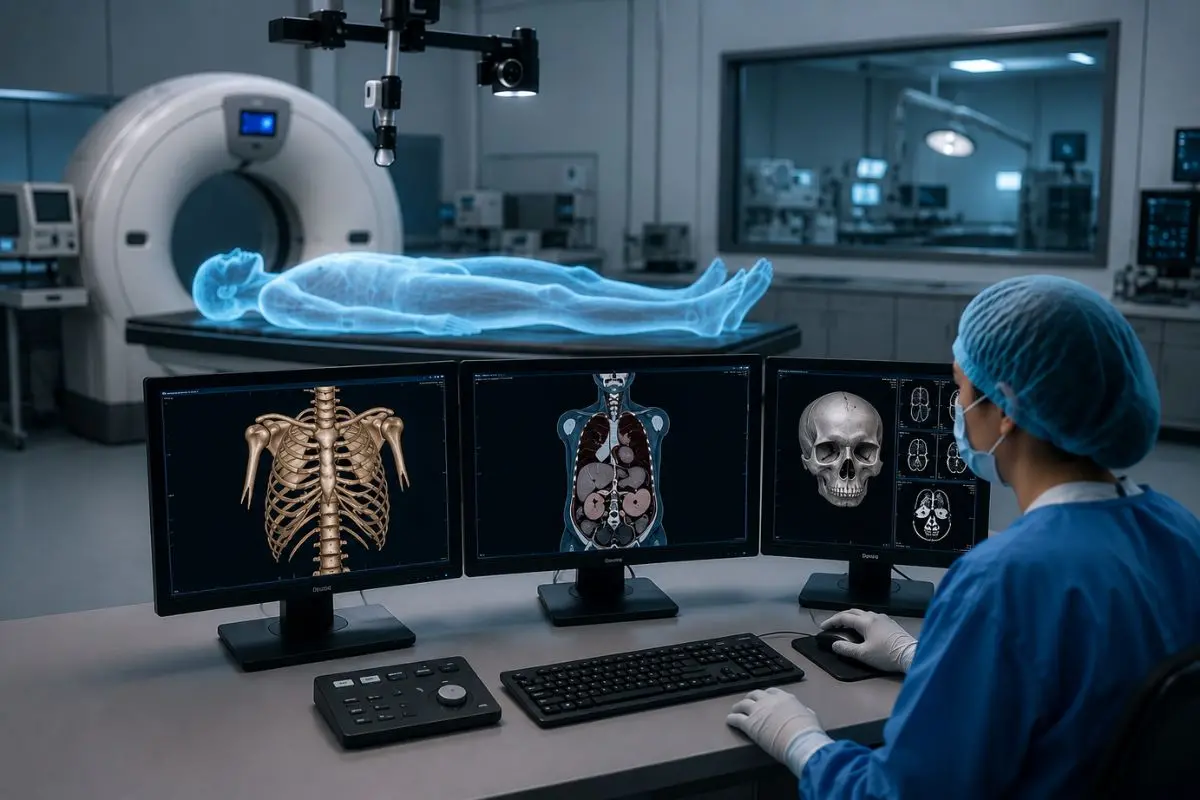
Virtual autopsy is a non-invasive or minimally invasive post-mortem examination that uses advanced imaging technologies such as Computed Tomography (CT) and Magnetic Resonance Imaging (MRI) to examine the body without extensive surgical dissection. While preserving the dignity of the deceased is one of its most visible advantages, forensic experts say virtual autopsy offers far-reaching scientific, legal and educational benefits.
Dr Unmesh said the technology represents a major advancement in forensic medicine because it creates permanent digital records that can be reviewed, verified and re-examined whenever necessary.
"Once a conventional autopsy is completed, it cannot be repeated because the body would already have been buried or cremated. Virtual autopsy creates permanent digital records that can be revisited during court proceedings, appeals or independent expert reviews," he said.
According to him, these digital records considerably strengthen medico-legal investigations by allowing forensic experts to present three-dimensional images and radiological evidence in court instead of relying solely on written observations, making the findings easier to explain and scientifically verifiable.
Beyond its legal value, Dr Unmesh said the technology also improves occupational safety by reducing the exposure of forensic doctors to infectious diseases such as tuberculosis, HIV and hepatitis while still providing valuable forensic information. He added that as more cases undergo virtual autopsy, the growing repository of digital images would become an important resource for forensic research, training and future scientific studies.
Virtual autopsy in India
Although pioneered in Switzerland, virtual autopsy has gradually been adopted across Europe, North America, Asia and Australia. In India, the technology has so far been officially introduced only at a few institutions, including AIIMS New Delhi, NEIGRIHMS Shillong and AIIMS Rishikesh.
Dr Abdul Raoof MP, Associate Professor of Forensic Medicine at KMCT Medical College, Kozhikode, who previously worked with virtual autopsy at AIIMS Delhi, said CT scanning and X-ray remain the principal imaging techniques used in India because they effectively identify fractures, internal bleeding, brain injuries and other trauma-related findings. MRI is also useful, particularly for soft tissue injuries, although its application remains limited in the Indian setting.
Drawing from his experience of participating in nearly 250 comparative cases, where virtual autopsy findings were matched against conventional post-mortem examinations, Dr Raoof said the two methods showed excellent agreement in trauma-related deaths.
"From a legal standpoint, there is not much difference between virtual and conventional autopsy as long as the findings are scientifically accurate. Courts are concerned with the evidence, not the method used to obtain it," he said.
Kerala’s proposal
The Kumarakom drowning has renewed efforts to establish Kerala's first virtual autopsy facility. Earlier, the forensic medicine departments of Thiruvananthapuram, Kottayam and Thrissur medical colleges jointly submitted a proposal to the state government. The proposal later came before the Assembly's Estimates Committee, which expressed support for introducing the technology.
The Directorate of Medical Education is now considering launching the facility on a pilot basis at Government Medical College Hospital, Thiruvananthapuram. The proposal recommends establishing both CT and MRI facilities, with experts estimating that nearly 60 per cent of post-mortem cases could potentially be examined through virtual autopsy, particularly deaths resulting from road traffic accidents, falls from height and other blunt trauma.
Dr Ajay Balachandran, Professor of Forensic Medicine at Amrita School of Medicine, said introducing virtual autopsy involves much more than installing a CT scanner. A complete system requires surface scanners, CT angiography facilities, trained personnel and dedicated infrastructure to deliver accurate and efficient examinations.
He also noted that explicit recognition under the Kerala Medico-Legal Code, along with specialised training through a DM programme in Forensic Radiology, would strengthen the technology's legal acceptance and help standardise its practice across the state.
Limitations of virtual autopsy
Despite its advantages, forensic experts agree that virtual autopsy cannot replace conventional post-mortem examinations in every case.
Dr Unmesh said the suitability of virtual autopsy depends entirely on the nature of the death, with more complex cases still requiring tissue sampling and laboratory investigations. Similarly, Dr Ajay Balachandran said while the technology performs exceptionally well in road traffic accidents and blunt trauma, conventional autopsy remains indispensable in cases involving stab wounds, gunshot injuries, poisoning, infectious diseases and several natural deaths.
The biggest challenge, according to Dr Unmesh, is financial. Establishing a fully equipped virtual autopsy centre with advanced CT and MRI facilities would require an investment of approximately ₹15–20 crore. However, experts believe that Kerala already possesses much of the required infrastructure in its government medical colleges. With specialised training and phased implementation, virtual autopsy can become an important addition to forensic medicine in the state.
“Virtual autopsy should not be viewed as a replacement for conventional autopsy, but as an advancement that complements traditional methods. Its real value lies in making forensic investigations more scientific, transparent and evidence-based while preserving human dignity,” Dr Unmesh said.
While preserving the dignity of the deceased remains one of its greatest advantages, virtual autopsy also offers permanent digital records, strengthens medico-legal investigations and creates valuable resources for future research. With specialised training, adequate infrastructure and scientific implementation, the technology could mark a significant advancement in forensic medicine in Kerala.
Looking beyond its immediate forensic applications, Dr AK Unmesh believes the technology will also contribute to future scientific progress. “As more cases are examined through virtual autopsy, the accumulated digital data becomes a valuable resource for medical research and scientific studies, helping improve forensic knowledge and future investigations,” he said.