Satyajit Ray’s Devi: The tragic deification of a young girl
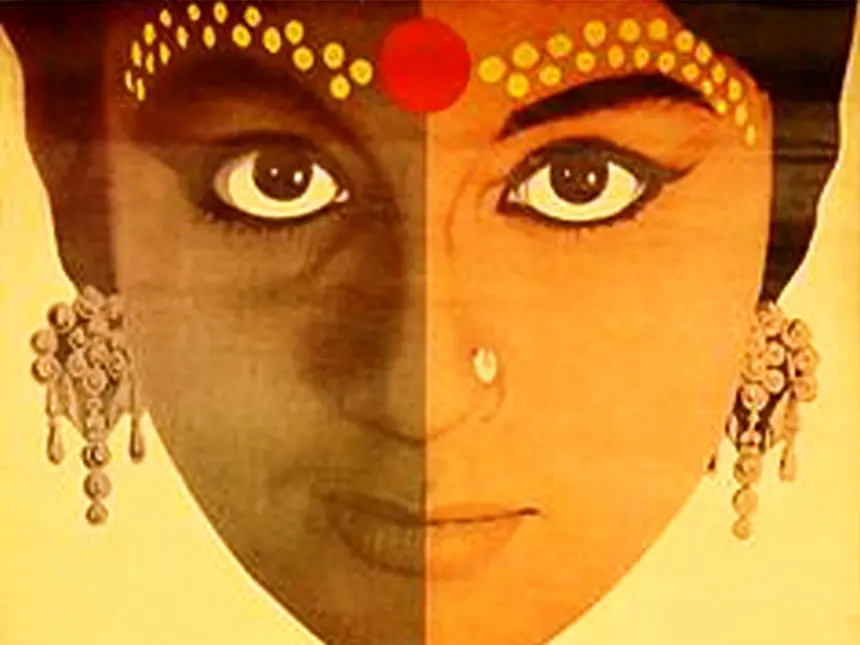
The Mother Goddess has been an oft-repeated figure in Indian cinema, be it as an icon in itself, be it in a metaphorical form, or be it as a symbol. This applies to classic Indian literature as well and therefore, when films have been inspired or adapted or interpreted from literature, the translation of this eternal mythical figure of the female goddess onto celluloid, sometimes went beyond the frame of the film as in Satyajit Ray's classic Devi (1960) where the goddess takes shape from the basic straw and clay to gain sharper focus against the credit titles, thus, neatly placing the film in its time-set : just before the Durga Pooja in Bengal.
The Mother Goddess is used both as an icon and as a symbol. In Ray’s Devi, The icon appears in the form of a dream Kalikinkar, a devout worshipper of the Goddess Kali, has where he sees his teenaged daughter-in-law Dayamoyee as the devi who has crossed the threshold in the guise of his own daughter-in-law. The film thus unfolds "a monstrous process of condensation in the aristocrat's psyche that culminates in a flash in the dream-content: all the mixed-up elements of the old brain find a 'truth' that achieves, via cunning displacement, the fulfillment of his desire" writes Geeta Kapur in her study of this film. Kalikinkar thus, separates his son from his teenaged and beautiful bride, the daughter-in-law by placing Dayamoyee literally on the holy pedestal of the devi, bestowing on her, imaginary and unreal magical powers of conquering death and disease.
The 'real' devi has no such powers. The young girl is sucked into a vortex of religious bigotry she does not understand and cannot run away from. In a strange irony that spells out the conflict between myth and reality, she turns insane and then dies, unlike the Mother Goddess who always triumphs and underscores her power of upholding good over evil.
Devi is based on a story by Prabhat Mukhopadhyay who built it on a concept created by Rabindranath Tagore. The story was published in 1899 in the Bhadra (July-August) issue of Bharati, a Bengali monthly magazine. Ray picked up the story to use it as his personal celluloid tirade against the mindset of the feudal Hindu Bengali who can stretch superstition far enough to ‘sacrifice’ an innocent young girl by deifying her as goddess Kali. The story is set in 1800 at Chandipur in rural Bengal. The original story (by Mukhopadhyay) had a different timeline. Ray's Devi is set in September-October 1868, almost seven decades later.
Ray’s film differs and departs from Mukherjee’s story in several respects. In the Mukherjee story, the plot concludes with a demure sixteen-year-old hanging herself; she would rather face death than the humiliation of being a failed healer, a false Devi following the death of her little nephew she was commanded to save from sure death but fails. In Ray’s rendition, the character of Daya loses her mind; she runs across a field near the family’s mansion and vanishes into the mist. The last shot of the film, repeating the first, shows the unadorned white clay face of the idol of the Goddess, an image shorn of the colours and attributes humans usually ascribe to her.
In Devi, Ray patiently unmasks a pathetic illusion of the holy. His subtle suggestions repeatedly scattered through a poetic yet, painful and brutally realistic narrative clearly hint at the ageing Kalikinkar's incestuous feelings for his own daughter-in-law, who he vests with the seemingly infallible power of the female goddess.
Devi depicts the classic example of a young girl turned into an icon–an object–by placing her on the pedestal of a goddess without her permission or understanding of what is happening to her and why, just on the basis of the dream of an elderly man. Turning the subject into an object of veneration, of beauty, of devotion and of blind faith is unique in Indian cinema that becomes an entrapment for life for the young girl leading to her tragic death.
By allowing the camera (Subrata Mitra) to focus on Dayamoyee’s ‘little-ness’ again and again, Ray insists on her deification which is as tragic as it is futile and ironic. Devi therefore, defines Ray's solitary voice of anger and protest against the empowering procedures of myth and religion, restraining himself from surrendering to the temptation of allowing her face and figure to take on an iconic aspect.
Daya hardly talks once she is forced into the goddess mode. The steadily increasing droop of her shoulders, the tired helplessness of her eyes, silent tears streaking down her cheeks, her reluctant acceptance of the shift from her bedroom to a room downstairs, say it all. The shift from private space where she has much more freedom to move and play with her nephew Khokon or talk to her parrot to the public space of the thakurdalan–the raised platform in the outhouse–traps her within a prison.
We never once see Daya eating. Does this mean that she is not fed properly? When she once faints of fatigue, it is interpreted as ‘samadhi’ and she does not utter a single word. She has absolutely no say in this shifting of space from the interiors of the mansion and though confused about this shift, does not ask or say anything. Her tender body is burdened by the weight of the garlands around her. One scene shows a serpentine queue moving in the far distance towards the Roy home to get a palmful of her charanamrita (water drawn from a vessel in which Daya’s feet are dipped) which they believe has magical powers. Yet, we never find Kalikinkar trying to take commercial advantage of this sudden popularity of his home and his daughter-in-law. Kalikinkar, though dictatorial and autocratic, was focused on Dayamoyee’s magic powers.
Asked about her experience of playing the title role in Ray’s Devi, Sharmila Tagore says:
At that time, I was too little to actually understand the implications of the role I played in Devi. What helped was that I was very well-read even at that tender age. We were brought up within a culture of reading. There was no television, no computers or internet, and even movie-going was doctored and censored by the elders in the family…Dayamoyee, the character I played in the film, was around the same age as I was when I shot for it. I still remember that when the lights were being changed on the sets, I would often fall fast asleep on the huge four-poster bed. The crew would wake me up when the shot was ready.It ended very tragically for that young girl. The fact that the character and the one who played it–me–were the same age, helped, I think, because I did not have to pretend I was older than what I was.
Sharmila went on to add that the film was widely misinterpreted in the West at the time. While everyone in Bengal is familiar with Kali worship and is aware of the nature of the orthodox family structure and its dos and donts, the Western audience was not, and therefore experienced difficulty in following the course of events, as the development of the plot grows out of this orthodox Bengali nature of the theme.
Even in India, there was a lot of trouble at the time of its release. The film became quite controversial as it was seen as an attack on Hinduism. The Communist government of the time also seemed unwilling to promote a film that talked of what they deemed was outmoded superstition. More so, because Ray was a Brahmo, it was hinted that he had chosen the subject to attack Hinduism, which was not true at all. Manikda had to clarify that the film was against the orthodoxy of religion and not against Hinduism per se.
Though many critical studies have focused on the ideological conflict between the very dictatorial and fundamentalist Hindu Brahmin father Kalikinkar and his younger son Umaprasad, educated in more liberal Western studies, the real sacrificial goat is the deified young girl who Kalikinkar is determined to keep worshipping in public space. Her husband does not have the mental strength or the courage to rescue her and bring her back to her private space fully knowing that this might destroy his married life for good. The elder son Tarapada has no will of his own. He spends his days ‘worshipping’ his father and his nights on wine and women. So, when his father asks him to touch the feet of his own young sister-in-law, he does this. But the young woman, shocked at this sudden ‘devotion’, curls her toes, scratches her nails against the wall, and turns her face to the wall in shock, disgust and hate–for herself, for the state she is in, or for the ones touching her feet? His wife, Harasundari however, has no respect for him and generally does not allow him to come close to her.
In the final sequence, when the unlikely goddess fails to save her beloved ailing Khoka—who is denied medical help by Kalikinkar, and is in turn, left at the mercy of Daya's divine prowess—she is reviled as a ‘rakkhoshi’ (demoness) by her sister-in-law, who accuses her of devouring her son. In the penultimate scene, before Dayamoyee disappears into a misty field of smoke, she appears in a bedraggled trance, asking her husband to help her get dressed. The scene is cast in a pall of white, lending it a surreal, almost unearthly tenor.
Devi throws up a different facet of womanhood in a Bengal we are not familiar with except through literature. We accuse society and corporate interests such as the advertising world for objectifying the woman as a commodity in order to push sales of goods to which they may or may not be linked. But in Devi, we discover the eldest patriarch of a family satisfying his own ‘devotional’ interests by ‘reducing’ his daughter-in-law into an animated, live version of his favourite goddess Kali and vesting her with ‘magic powers’ she does not possess. For the first time in Indian cinema, Ray presented elaborately and in great detail, how the goddess can be exploited as a fetish when personified in the form of a beautiful woman who not only has no say in this shift, but does not even understand it.