Resisting Regression—II
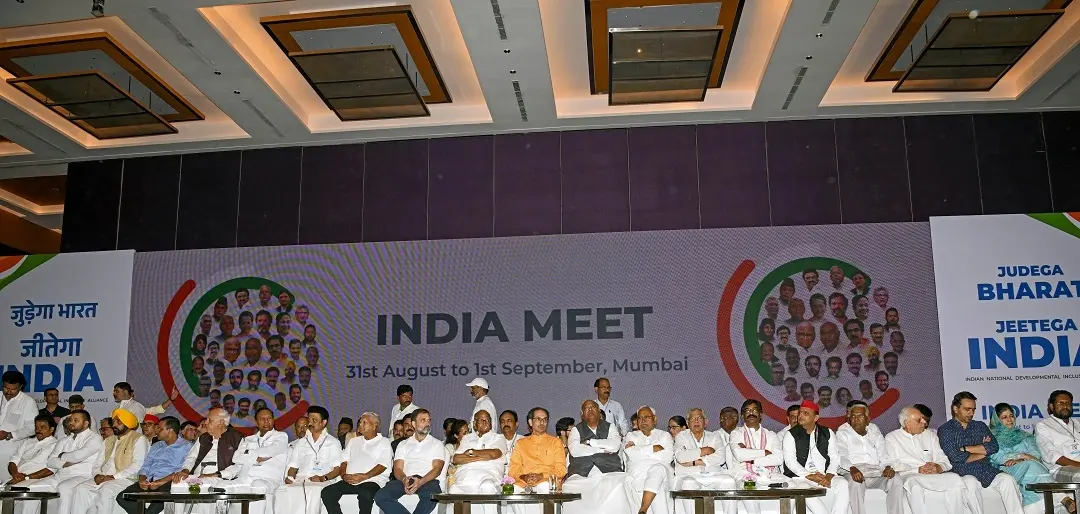
While the INDIA coalition’s existence is justifiable, is it viable? There is a need for all correctly-minded parties to unite in resistance against a regressive force. However, the re-establishment and strengthening of political propriety cannot make for a complete agenda of governance. Each party in the coalition knows that on the morning after the hoped-for victory, it will be competing with its electoral partners to advance its own policies and the interests of social groups loyal to it. To this end, each will try to fight and win as many seats as it can, so what is the scope for adjustments?
Before getting into details, we need to deal with the broad impression. From a countrywide perspective, the conglomerate will not present a very pretty picture. Parties working together in one state will be at each other’s throats in another. Leaders will be torn between the demands of their partisans and the needs of the coalition as a whole. Whether the committees to be set up to coordinate issue-framing, messaging, and campaigning will function smoothly is anyone’s guess. As the INDIA partners struggle with these issues, the BJP will do everything in its power to widen the cracks and lampoon every stumble.
Obstacles facing the coalition are formidable. But we all know that. So why not look at factors that could work in its favour. Or, at least, help reduce the size of its problems. Of these, the most important could be the growing political maturity of the country’s electorate. The splitting of the vote to favour one party at the Centre and another (even the diametrically opposite) at the state level has become almost a standard practice. This indicates the development of an ability to process conflicting rhetoric and get at the essential.
A similar maturity seems manifest in the tolerance for strange combinations. Neutrals find nothing amiss in the Congress and a section of the Shiv Sena coming together in Maharashtra. Hardly anyone in Kerala is perturbed by the fact that the United Democratic Front and the Left Democratic Front—bitter rivals in the State—work together even in neighbouring Tamil Nadu and Karnataka. Voters understand that all sorts of compulsions weigh on parties. At a minimum, this means that a propaganda tool that could have been used against the INDIA coalition has lost quite a bit of its potency.
Actually, if we proceed on a state-by-state basis, the seat-sharing problem might not be so intractable. We can start with the Congress, its strongholds, and the demands likely to be made on it. In Karnataka, Madhya Pradesh, Chattisgarh, Rajasthan, Himachal Pradesh, and Uttarakhand no INDIA partner can ask for anything based on local strength. Kerala should once again witness a straight fight. Whatever the outcome, the BJP is not likely to get much joy out of it.
While the Congress is the junior partner in Tamil Nadu, Maharashtra, Bihar, and Jharkhand, the anti-BJP coalitions in these states seem stable enough to overcome seat-sharing issues. Among the big states, only Uttar Pradesh and Bengal seem dead-ends for the Congress. If the party continues to display the same degree of maturity and patience as it has been displaying of late, it should defer to the front-runners among anti-BJP parties in these states. Contests against the Samajwadi Party and Trinamool can be postponed until future elections. At this moment, the Aam Aadmi Party appears to be the only major force with which the Congress will find an accommodation fundamentally impossible.
Will the Congress maintain that level of maturity? All else aside, it is about time due respect is given to Mallikarjun Kharge. It is not just that the party seems to have been enwrapped by Kharge’s deliberative, low-key style. Look at the record since he took over. Fissures that threatened to debilitate the party in Rajasthan, MP, Chattisgarh, Karnataka, and Kerala have all been contained. Allies such as Sharad Pawar and Lalu Prasad Yadav have not been enraged by a Congress greedily exploiting their troubles. Kharge is unlikely to become INDIA's Prime Ministerial candidate but his steadiness could be invaluable.
(Writer is a former editor of Mathrubhumi)
First part can be read here: Resisting Regression