Reaper vs TB2: The sky's most debated rivalry
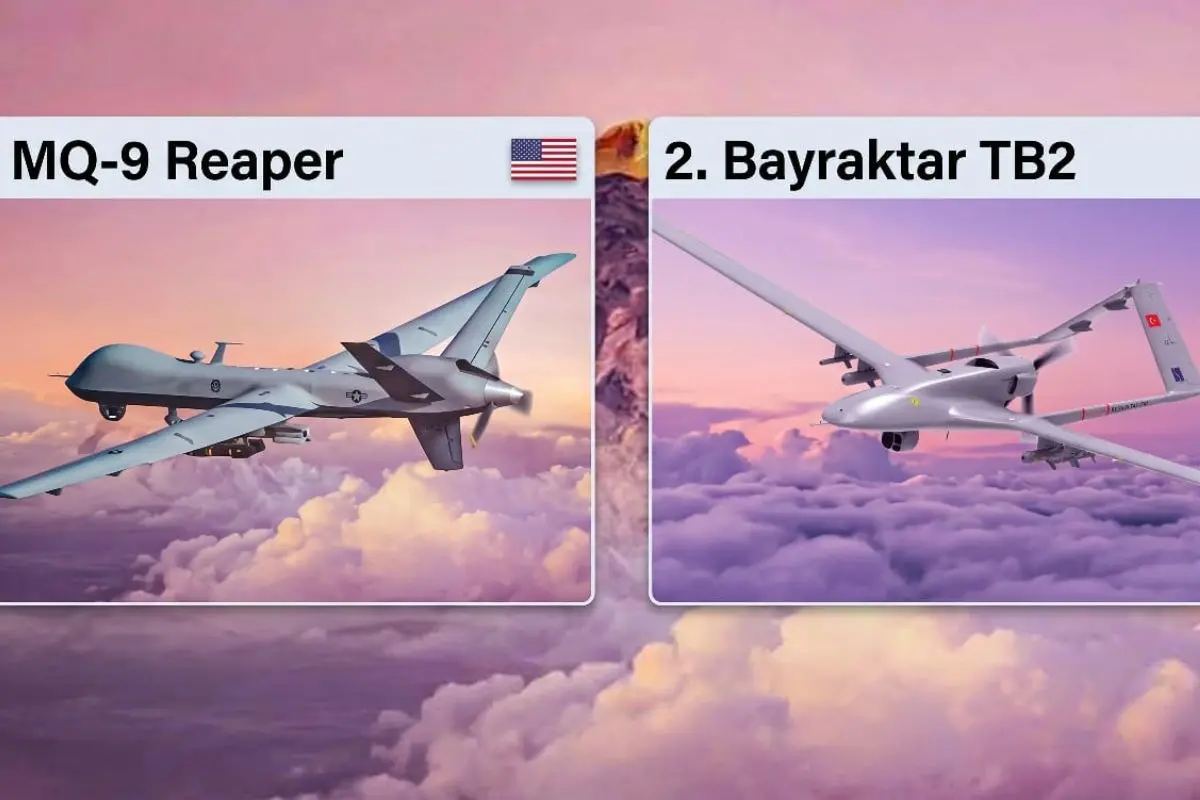
Ask any defence watcher today which armed drone rules the sky, and two names come up almost instantly — the American MQ-9 Reaper and Türkiye's Bayraktar TB2. Both have made headlines, both have destroyed tanks and radars in real wars, and both are wanted by air forces across the world. Yet placing them side by side and declaring one winner is not easy, because the two machines were never built for the same job.
Technically, both belong to the same family called MALE drones (Medium-Altitude Long-Endurance — meaning they fly at moderate heights and stay airborne for very long hours, instead of returning in half an hour like small camera drones). That is where the similarity ends.
The MQ-9 Reaper was born out of America's need for a watchman with a rifle. As per the U.S. Air Force, its main duty is ISR (intelligence, surveillance and reconnaissance — watching an area, collecting information and keeping an eye on chosen targets). When required, the same aircraft can strike that target with great accuracy. Remember, the pilot does not sit inside the drone. He sits in a control room far away, sometimes on another continent, and flies the machine through satellite signals while watching a live video feed on his screen.
The Bayraktar TB2, made by Turkish company Baykar, took a different path. Instead of chasing the highest technology, Baykar built an armed drone that is light, affordable and able to work from a small runway. Baykar says the TB2 is among the world's most widely used UAVs (unmanned aerial vehicles — aircraft that fly without any pilot on board). It can stay up more than 27 hours, and it can move on the runway, take off, fly the whole mission and land back with almost no human help.
Now the numbers, where the gap becomes clear. According to General Atomics, the MQ-9A can remain airborne beyond 27 hours, climb to 50,000 feet (about 15.2 km), touch nearly 240 knots (about 445 km/h) and carry a payload (weapons, cameras, sensors and other equipment) of up to 1,746 kilograms. It runs on a turboprop engine (a jet engine that spins a propeller to push the aircraft forward) producing roughly 900 horsepower. That muscle lets it circle over a huge war zone all day without returning for fuel.
The TB2, in comparison, has a 12-metre wingspan, maximum take-off weight of 700 kg, operating height of about 16,000 feet (roughly 4.9 km), endurance of more than 27 hours, and payload of just 150 kg, as per Baykar. So the Reaper is not simply a larger TB2 — it belongs to an entirely different class.
As detailed in a comparison by online media Interesting Engineering (I.E), the Reaper's real trump card is its sensor package. It carries electro-optical cameras (normal daylight cameras), infrared cameras (which detect heat and work in complete darkness), laser target designators (which guide bombs exactly onto the chosen spot), synthetic aperture radar or SAR (advanced radar that produces clear pictures even through cloud and smoke), and secure communication systems. Its usual weapons include AGM-114 Hellfire missiles, GBU-12 Paveway II laser-guided bombs, and GBU-38 JDAMs (Joint Direct Attack Munitions — GPS-guided precision bombs).
The TB2 carries a smaller punch — four hardpoints (mounting points under the wings where weapons are attached), usually loaded with ROKETSAN MAM-L and MAM-C laser-guided munitions (small precision bombs). Small, but deadly. These have destroyed armoured vehicles, artillery positions (places where enemy cannons and howitzers are deployed) and lightly protected bunkers.
Battle records tell the story better than brochures and as Interesting Engineering (I.E) notes in its analysis, both drones have built strong reputations in actual operations."The Reaper has flown countless missions for the U.S. and its allies over Afghanistan, Iraq, Syria, Africa, and even sea routes during maritime security missions (operations to protect shipping lanes). Its long loiter time (ability to keep circling above one place for hours) lets operators watch a target patiently and strike only when the moment is right.
The TB2 shot to fame in Libya, Nagorno-Karabakh and the early months of the Russia-Ukraine war, destroying logistics convoys (groups of vehicles carrying troops, fuel and supplies), artillery systems and even air-defence systems. But analysts note an important truth — much of that success came in favourable conditions. Once opponents deployed integrated air-defence networks (a team of radars, sensors and missiles working together to shoot down anything that comes near), the TB2's effectiveness dropped sharply.
Cost is where the two truly separate. The Reaper is a high-end strategic asset needing satellite bandwidth, complex maintenance and highly trained crews. The TB2 is far cheaper to buy and operate, which is why Baykar has sold it to dozens of nations.
So who wins? Honestly, nobody. For deep surveillance and heavy firepower, the Reaper stays unmatched. For tight budgets and quick, accurate strikes, the TB2 offers brilliant value — and it suits swarm warfare (many cheap drones attacking together at the same time), as seen in Ukraine and the US-Iran conflict.
(Girish Linganna is an award-winning science communicator and a Defence, Aerospace & Geopolitical Analyst)