Eve of Independence: How Mathrubhumi captured the birth of two nations
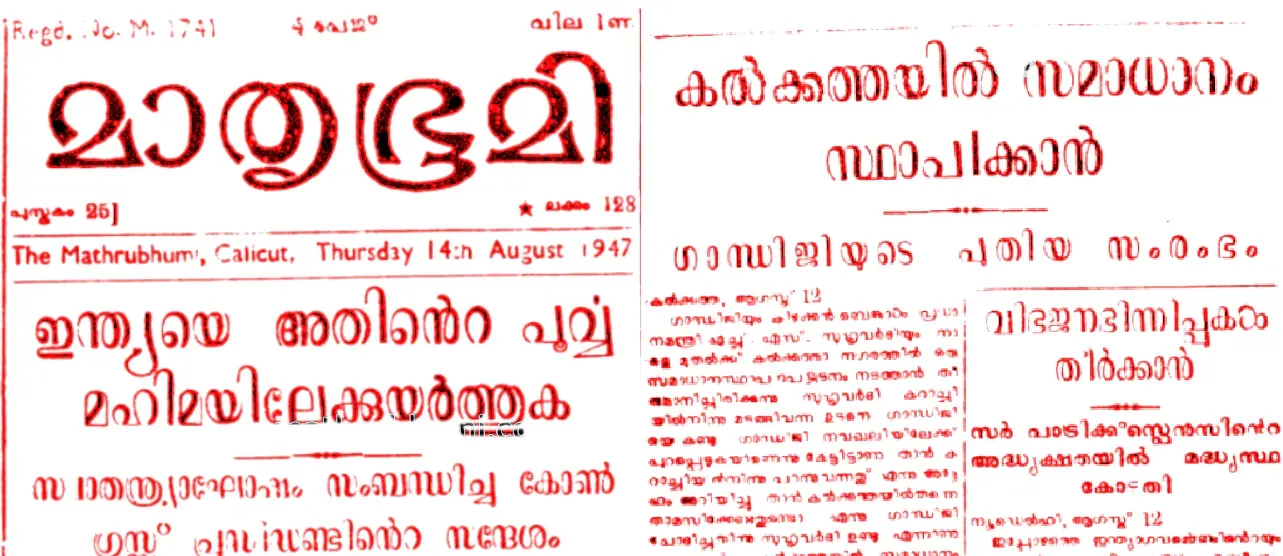
On August 14, 1947, as the world looked on, a new chapter in the subcontinent’s history began. Pakistan celebrated its first Independence Day, marking the end of British colonial rule and the birth of a new nation. As India prepared to celebrate its Independence the following day, we take a look at the 'Mathrubhumi Daily' from August 14,1947, which offers a glimpse into the tumultuous times that shaped the sub-continent.
Mathrubhumi’s Comprehensive Coverage
Mathrubhumi’s front page reflects the deep interconnections and conflicts that characterized the period. The newspaper's coverage is divided into three main segments: Gandhi’s peace mission in Calcutta, Congress President J.B. Kripalani’s independence message, and reports from Pakistan and abroad.
Gandhi’s Call for Peace
In a powerful display of resolve, Mahatma Gandhi’s efforts to quell the communal violence post-partition are prominently featured. Following the violent riots in Noakhali, Gandhi, in a bold move, decided to address the unrest in Calcutta. The article reports that Gandhi, alongside West Bengal Prime Minister HS Suhrawardy, was set to host a major rally aimed at restoring peace. The rally was to be held in a house identified in the eastern part of Calcutta, chosen to be a neutral ground where Gandhi would eventually engage directly with both communities affected by the violence.
Calcutta, August 12: Gandhiji and West Bengal Prime Minister HS Suhrawardy have decided to host a rally in Calcutta to reinstate peace. Suhrawardy met Gandhiji soon after returning from Karachi. He said that he decided to return after hearing that Gandhiji was headed to Noakhali, a site of communal violence. Suhrawardy also insisted that Gandhiji stay in Calcutta. Suhrawardy said that he needed the help of Gandhiji to reinstate peace in Calcutta. Gandhi also assured Suhrawardy that he would stay in a riot-hit area in Calcutta and speak with both communities to reinstate peace. Accepting Gandhiji's suggestion, Suhrawardy wrote to him today.
After meeting Gandhi, Suhrawardy stated that it was time for the citizens of Calcutta to change their thought process and that there was no other way.
A house has been identified in the eastern part of Calcutta city. Gandhiji and Suhrawardy will be staying here from tomorrow onwards. Gandhiji had halted his Noakhali trip.
The article highlights Gandhi’s speech, delivered after a prayer meeting, where he articulated his vision for national harmony. “India’s partition was the result of a joint agreement,” Gandhi stated, “and there is no point in continuing to fight amongst ourselves...
Congress President J.B. Kripalani’s message
Mathrubhumi also covered Congress President J.B. Kripalani’s stirring Independence Day message. The title of the article, roughly translated as "Raise India to Its Former Glory," encapsulates Kripalani’s call for national unity. He emphasized that India’s newfound freedom was not the privilege of any single group but a collective inheritance belonging to all its citizens.
Pakistan’s Independence and International Reactions
Turning to the newly formed Pakistan, Mathrubhumi’s August 12 coverage provided insights into the country’s nascent political landscape. An article details a parliamentary motion moved by Liaquat Ali Khan, seeking to formally recognize Muhammad Ali Jinnah as Quaid-e-Azam (Great Leader). The motion, however, sparked an intriguing debate among Congress members who viewed the designation as an unwarranted accolade, akin to conferring a degree.
In addition to local developments, the paper reported on international responses to the transition of power. Indonesia, in a gesture of solidarity, extended its congratulations to both Jawaharlal Nehru and Muhammad Ali Jinnah. Meanwhile, another article carries the United Nations Secretary-General's remark that the partition would not alter India’s standing within the UN.
A Glimpse into the Post-Partition World
The government's efforts to persuade various princely states to join India are highlighted in a front-page article, which reports that the majority of these states have agreed to become part of the Indian Union.
Another article says that the decision has been made to terminate trial proceedings against Communist leaders AK Gopalan and K. Ananda Nambiar. Both Gopalan, one of the 16 Communist Party of India members elected to the first Lok Sabha in 1952, and Nambiar had been imprisoned in Madras (now Chennai) in connection with violent protests.
Mathrubhumi’s coverage offers a vivid portrayal of the era, capturing both the hope and the challenges faced by the newly independent nations. The detailed reports on post-partition violence in Punjab and Calcutta underscore the gravity of the situation, while international reactions reflect the global significance of the transition.