Imagine your phone tracking your sleep, Korean Air is doing something similar for its crew
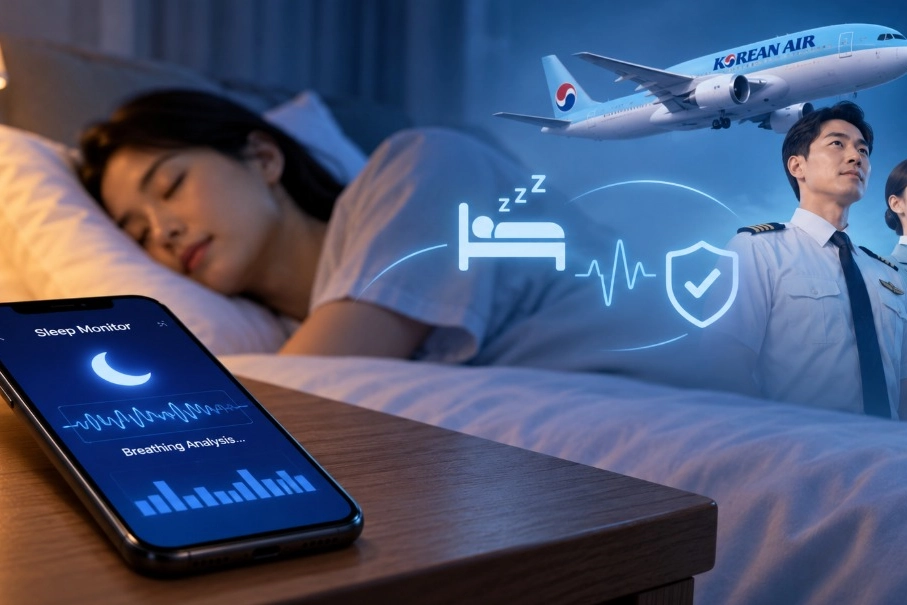
What if your smartphone could do more than wake you up in the morning? What if it could quietly monitor your breathing while you sleep and help identify a possible sleep disorder? Korean Air is bringing this idea into its employee health programme, using digital technology to monitor the sleep health of pilots, cabin crew and other employees.
Most of us keep our smartphones close to our beds. We use them to set alarms, check messages before sleeping or scroll through social media long after we should have switched off the lights. But imagine if that same phone could also help monitor how you breathe while you sleep.
That is the idea behind a new initiative introduced by South Korean airline Korean Air. The airline is using smartphone-based digital tests to screen employees for sleep-related health problems, including sleep apnoea. And it is doing this with a simple arrangement: employees place their phones beside their beds before going to sleep.
The idea has particular relevance in aviation, where working hours rarely follow a regular routine. Pilots and cabin crew may operate night flights, cross several time zones and work schedules that can disturb their natural sleep patterns. For them, getting enough rest is not simply about feeling fresh the next morning. It is also an important part of staying alert and carrying out their responsibilities safely.
Korean Air announced on November 26 that it had introduced the digital testing system in collaboration with sleep AI company Aisleep. The airline says it is the first in the aviation industry to use a smartphone-based medical device cleared by South Korea's Ministry of Food and Drug Safety to screen for sleep apnoea as part of crew health management. The tests have been conducted since September for employees identified as being at risk of sleep-health problems.
Your phone becomes a sleep monitor
So, how does it work?
Korean Air uses a digital medical device called AppnoTrack to screen for sleep apnoea. An employee simply places a smartphone beside the bed before going to sleep. The application then analyses breathing sounds recorded during the night.
The process continues over seven days. Once the data has been collected, medical staff at Korean Air's Aviation Health and Medical Centre review the results. Employees who may need further examination or treatment are referred to specialist medical institutions.
There is an interesting aspect to this approach. Employees do not have to visit a hospital for this initial screening, nor do they need to wear separate monitoring equipment while sleeping. They can undergo the test in the comfort of their own homes, following their usual sleep routine.
Of course, the phone does not replace a doctor. The application is designed to screen for possible signs of sleep apnoea, while medical professionals review the results and decide whether further tests or treatment are needed.
Why is an airline interested in how its employees sleep?
Think about the working routine of an airline pilot or a cabin crew member. A flight may depart in the middle of the night, arrive in a different time zone and be followed by a rest period that does not necessarily match the person's usual sleeping hours.
Night operations, long-haul flights, jet lag and changing duty schedules can all make it difficult to maintain a regular sleep pattern. Employees working shifts in other areas of airline operations can face similar challenges.
Sleep apnoea adds another concern. It is a condition in which breathing repeatedly stops or becomes shallow during sleep. A person may spend several hours in bed but still wake up feeling tired because their sleep has been repeatedly interrupted. In many cases, people may not even realise that they have the condition.
For aviation employees, identifying such problems early is important. Poor-quality sleep and fatigue can affect alertness and concentration, both of which are essential in an industry where safety depends on people being able to perform their duties effectively.
Another app watches when you sleep
Korean Air's digital initiative does not stop at monitoring breathing. The airline is also using another application, ChronoTrack, to understand employees' sleeping habits and identify possible problems with their sleep rhythms.
Unlike AppnoTrack, which analyses breathing sounds, ChronoTrack records when an employee goes to bed, when they wake up and how regularly they follow a sleep schedule. It collects this information over 14 days to assess insomnia and sleep-rhythm problems.
Together, the two applications offer different pieces of information about sleep health. One looks at what happens while a person is sleeping, while the other looks at the regularity of their sleep schedule.
This is particularly useful to consider in aviation, where employees may have to adjust their sleeping hours depending on flight schedules and shift duties. A regular sleep routine can be difficult to maintain when the working day keeps changing.
Taking employee health beyond routine medical check-ups
Korean Air has already been working on sleep-health management for its employees. The airline provides sleep education tailored to different job categories and conducts sleep assessments and medical consultations during pilots' aviation medical examinations. It also runs sleep-health programmes for employees working night shifts.
The smartphone-based tests add another layer to these efforts by allowing employees to monitor their sleep in their everyday surroundings. The airline plans to explore including sleep tests in regular employee health check-ups and strengthen the process of referring employees for specialist diagnosis and treatment when necessary.
Choi Yoon-young, head of Korean Air's Aviation Health and Medical Centre, said the health of employees was the starting point for aviation safety, with healthy sleep being an important part of it. The airline plans to continue strengthening its health management system so employees can monitor their sleep and receive medical care when needed.
A small device, a bigger idea
The interesting part of Korean Air's initiative is how it uses something that is already part of everyday life. A smartphone, usually associated with communication, entertainment and work, is now being used as part of an employee health-screening programme.
For airline employees, this could make it easier to identify sleep-related concerns that might otherwise go unnoticed. For the aviation industry, it is another reminder that safety is not limited to aircraft technology, cockpit systems or airport operations. It also depends on the people who operate and support flights.
And perhaps that is what makes this initiative particularly interesting. While most of us think of a good night's sleep as a personal matter, an airline is looking at it as part of its wider safety responsibilities. Sometimes, the first step towards understanding a health problem may be as simple as placing a smartphone beside the bed before turning off the lights.